Orcs Must Die! 3
If you have a co-op partner and a taste for engineering orc deaths on a spreadsheet, this trap-placement hybrid will swallow your evenings whole. Solo players, budget an extra dose of patience.
Veredicto de GamerScout
Best for co-op duos who enjoy pre-wave planning puzzles; solo strategy fans should expect a steeper grind and fewer breathing rooms.
Comparar precios(9 tiendas)
Todas las tiendas de esta tabla nos dan el precio en euros, así que la cifra en EUR es el precio que fijó el vendedor, no un cálculo nuestro, y por eso EUR es también la moneda en la que calculamos el ranking. Solo incluimos aquí una oferta cuando la tienda nos da su precio en euros, de modo que ninguna cifra de esta tabla es inventada por nosotros.
Elige USD, PLN, GBP, CAD o AUD en la cabecera y convertimos desde EUR con el tipo de cambio de referencia del Banco Central Europeo — los importes convertidos llevan el prefijo ~. Tu banco o la tienda pueden aplicar un tipo distinto al pagar. Nunca ocultamos ofertas según dónde estés: todo el mundo ve esta tabla completa.
We may earn a commission when you buy games through links on this page — at no extra cost to you. It never affects our rankings or verdicts.
Historial de precios
Capturas y multimedia
Acerca de Orcs Must Die! 3
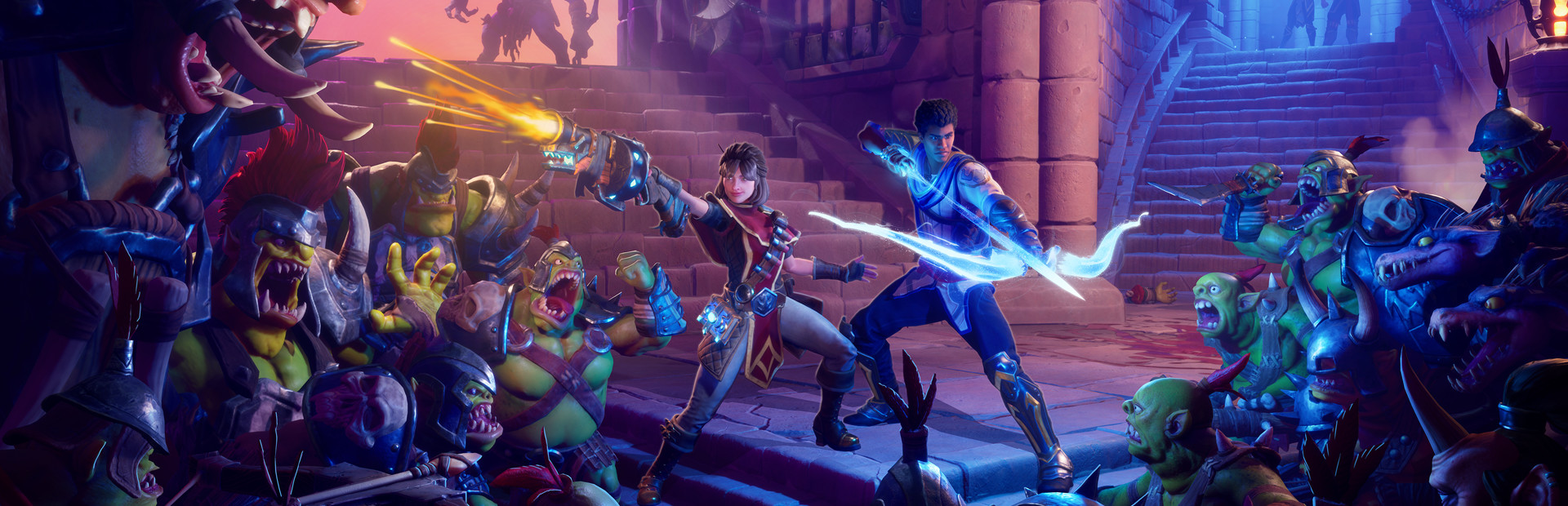
My first instinct with any hybrid strategy game is to ask: where does the decision-making actually live? With Orcs Must Die! 3, the answer is in the prep phase, specifically in how you arrange spike floors, wall-mounted arrow launchers, ceiling tractor beams, acid geysers, and boom barrel catapults before a single green body comes barreling through the gate. That placement puzzle is where the game earns its keep. Each level hands you a fixed budget, a map full of corridors and choke points, and a ghost-orc preview system that updates in real time as you drop barricades to reroute the horde. Watching your planned kill zone validate itself wave after wave is quietly satisfying in the way a well-optimized build order is satisfying: you made the right calls before the chaos started. The between-wave loadout loop is where strategy players will feel most at home. Skulls earned per level gate trap and weapon upgrades, and you can respec freely between stages, which sounds flexible until you realize different enemy compositions on different maps genuinely demand different kits. Trolls are weak to fire; fire lords are immune to it entirely. Gnolls ignore barricade routing to go destroy your placed archers. Heavy ogres cannot be spring-flipped off ledges. Each new enemy type is effectively a constraint added to your optimization problem, and the game keeps stacking those constraints all the way to the late-campaign and Endless mode runs. That depth holds up. The skull economy is a mild friction point: the main campaign is stingy enough with rewards that unlocking a substantial trap roster requires grinding Endless or Scramble modes, which may frustrate players expecting to open the full toolkit through story progress alone. Scramble mode is worth singling out because it is the most interesting structural addition in the package. Five consecutive levels share a single pool of Rift points, and before each stage you pick one buff and accept one debuff from a randomized pair. Accumulating modifiers across a run produces genuinely weird scenarios: floor traps half-price but enemies immune to lightning, or reduced mana costs combined with armored orc variants that shrug off arrow walls. It nudges you out of a default setup and forces real mid-run adaptation. Endless mode, by contrast, is pure attrition theater and a high-score chase, and it can run three hours before frame rates start to buckle under the enemy count. Both modes extend the life of the game well past the two main campaigns. War Scenarios are the headline addition and the weakest link. The concept is ambitious: massive open battlefields, mountable catapults you can literally jump into, mega flip traps that launch ogres skyward, boom barrel launchers with pyrotechnic range. In practice, the optimal play in most War maps collapses back to funneling enemies into a dense corridor and stacking damage there, which undercuts the epic-scale fantasy the mode is going for. Some maps do force trickier multi-front management, but the consensus from players and critics alike is that War Scenarios feel like long versions of regular maps rather than a genuinely different strategic layer. The direct combat abilities, your crossbows, the saw blade launcher whose ricochets can fill an archway with spinning death, and the freeze-bomb secondary fire, are serviceable and fun for cleanup but intentionally shallow. This is not an action game wearing strategy clothing; the trap engineering is the game, and the combat is there to keep you from zoning out during waves. For newcomers, the onboarding is lighter than it should be. The game assumes some series familiarity and does not always explain trap interactions or elemental weaknesses with enough clarity. That said, the lower difficulties are forgiving enough (no death penalty; you simply respawn at the Rift), and the ghost-orc routing preview removes a lot of the guesswork that would otherwise punish first-time players. Approached on Normal with a co-op partner, this is a genuinely accessible entry point into a niche genre. Approached solo on the hardest Rift Lord difficulty, it is a constraint-satisfaction problem with a timer.

Strategy & simulation
Etiquetas
Requisitos del sistema
Mínimos
- OS
- Windows 7
- Processor
- Intel Core i5-2300 | AMD Ryzen 3 1200
- Memory
- 6 GB RAM
- Graphics
- Nvidia GeForce GTX 660, 2 GB | AMD Radeon HD 7870, 2 GB
Recomendados
- OS
- Windows 10
- Processor
- Intel Core i5-9600K | AMD Ryzen 5 3600X
- Memory
- 8 GB RAM
- Graphics
- Nvidia GeForce GTX 1060, 3 GB | AMD Radeon RX Vega 64 Stora…
Sigue explorando
Community Discussion
Be the first to comment on Orcs Must Die! 3.
Reseñas y valoraciones
Información del juego
- Desarrolladora
- Robot Entertainment
- Distribuidora
- Robot Entertainment
- Fecha de lanzamiento
- 23 jul 2021