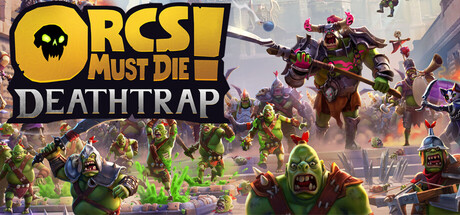
Orcs Must Die! Deathtrap
Trap-laying meets roguelite risk management across massive maps, but whether it clicks for you hinges almost entirely on whether you show up with friends.
Veredicto de GamerScout
Best for co-op squads who enjoy pre-run trap theory; solo players will hit the content ceiling faster than they'd like.
Comparar precios(9 tiendas)
Todas las tiendas de esta tabla nos dan el precio en euros, así que la cifra en EUR es el precio que fijó el vendedor, no un cálculo nuestro, y por eso EUR es también la moneda en la que calculamos el ranking. Solo incluimos aquí una oferta cuando la tienda nos da su precio en euros, de modo que ninguna cifra de esta tabla es inventada por nosotros.
Elige USD, PLN, GBP, CAD o AUD en la cabecera y convertimos desde EUR con el tipo de cambio de referencia del Banco Central Europeo — los importes convertidos llevan el prefijo ~. Tu banco o la tienda pueden aplicar un tipo distinto al pagar. Nunca ocultamos ofertas según dónde estés: todo el mundo ve esta tabla completa.
We may earn a commission when you buy games through links on this page — at no extra cost to you. It never affects our rankings or verdicts.
Historial de precios
Capturas y multimedia
Acerca de Orcs Must Die! Deathtrap
My first honest question when sitting down with Deathtrap was: does adding a roguelite layer to a decade-old tower-defense formula actually solve anything, or does it just paper over the same structural cracks? The answer, after a serious number of runs, is: both, depending on the night. The mechanical spine is still the one that made this series stick. You pick a War Mage from a starting roster of six (with unlockables beyond that), load a trap loadout from a pool of 30-plus options, and then alternate between a build phase and a wave phase on large, multi-route maps. What Deathtrap adds is a run structure built around two key systems: Threads and Distortions. Threads are mid-run buffs you pick between rounds, things like trap-type discounts, conditional damage bonuses, or the occasionally unhinged option that dumps your entire gold reserve into one supercharged trap. Distortions are the flip side, stacking debuffs or enemy buffs you agree to carry into the next stage in exchange for pushing deeper into a run. At the end of each level you also face a genuine risk-reward fork: cash out your accumulated skulls now, or gamble half of them on another, harder map. That single decision point is where the game earns its roguelite label, and it creates a real tension that the earlier entries never had. When the Threads line up correctly and your kill corridor funnels an orc column straight through a wall of spinning blade traps and into a lava pit, it still delivers that specific, satisfying crunch the series has always promised. The War Mage roster is where build variety lives. Harlow places explosive boom barrels and commands a dragonfly companion that can hold a zone independently. Kalos swings a hammer, leaps into crowds with a ground-pound, and drops berry clusters to restore health for nearby allies. Most Mages are ranged, and gunplay feels responsive; the two melee options have some hit-registration roughness on controller that veteran players will notice. Co-op scales the barricade pool across the group, so four players must actually coordinate their maze layout rather than each acting alone, which raises the tactical ceiling noticeably. Solo players get the full barricade count to themselves and enemies adjust to compensate, so neither mode is walled off, but the depth of co-op synergy between complementary Mages is where the game truly opens up. Here is where strategy-minded players will want to pay attention to the friction points before purchasing. The early runs, especially on default difficulty, are slow to the point of feeling like a tutorial that never ends. The good news is that difficulty can be bumped immediately, and jumping to around difficulty two after an introductory run removes most of the tedium. The harder problem is the endgame loop: once you have cleared the four orc faction bosses, progression flattens into repeated runs on a limited map pool with no new structural goal. Enemy health scaling per subsequent map was also unbalanced at launch, soft-locking certain trap-focused builds. Post-launch patches have iterated on this, and the PC modding community has moved even faster than the developer to address the worst offenders, so the version available now is meaningfully better than what shipped. Still, map variety is the ceiling that limits long-term engagement for solo players in particular. The tutorial video format also undersells the depth of the Threads and Distortions systems, meaning new players sometimes spend their first few runs not realizing how much agency they actually have over their build direction. For genre fans: this sits closer to a co-op session game than a deep solo campaign. It rewards the kind of group that enjoys pre-run trap theory-crafting and mid-run pivots when a Distortion reshapes the board. Solo, it works, but the pacing and map repetition become apparent faster. The mod ecosystem on PC is active, the cross-platform co-op broadens the matchmaking pool, and Robot Entertainment has shown willingness to patch aggressively. If the run-based structure and Warmage roster get expanded post-launch, the foundation here is solid enough to build something genuinely strong on. Right now it sits as a competent entry in the series that peaks in co-op and plateaus solo.

Strategy & simulation
Etiquetas
Requisitos del sistema
Mínimos
- OS
- Windows 10
- Memory
- 8 GB RAM
- Storage
- 15 GB available space
- Graphics
- Nvidia GTX 1080 / AMD Radeon RX 570 8 GB
- Processor
- Intel i5 6th Gen
Recomendados
- OS
- Windows 10
- Memory
- 16 GB RAM
- Network
- Broadband Internet connection
- Storage
- 15 GB available space
- Graphics
- Nvidia 3060 with 12 GB / AMD Radeon 6700 XT, 12 GB
- Processor
- Intel i7: 8 Core/16 Thread CPU at ~3.6 GHZ
Sigue explorando
Community Discussion
Be the first to comment on Orcs Must Die! Deathtrap.
Reseñas y valoraciones
No hay valoraciones disponibles
Información del juego
- Desarrolladora
- Robot Entertainment
- Distribuidora
- Robot Entertainment
- Fecha de lanzamiento
- 28 ene 2025