Medieval Kingdom Wars
A scrappy RTS-grand-strategy hybrid where you manage a medieval lordship, survive brutal sieges, and slowly rewrite European history one bloody battle at a time.
GamerScout Verdict
Worth it for strategy players who can stomach rough edges and want an RTS-grand-strategy hybrid with genuine campaign stakes.
Compare Prices(9 stores)
Every store in this table quotes us in euros, so the EUR figure is the price the seller actually set, not our arithmetic — which is why EUR is also the currency we rank in. We only list an offer here when the store gives us its price in euros, so nothing in this table is a number we invented.
Pick USD, PLN, GBP, CAD or AUD in the header and we convert from EUR at the European Central Bank reference rate — converted amounts are prefixed with ~. Your bank or the store may apply a different rate at checkout. We never hide offers based on where you are: everyone sees this whole table.
We may earn a commission when you buy games through links on this page — at no extra cost to you. It never affects our rankings or verdicts.
Price History
Screenshots & Media
About Medieval Kingdom Wars
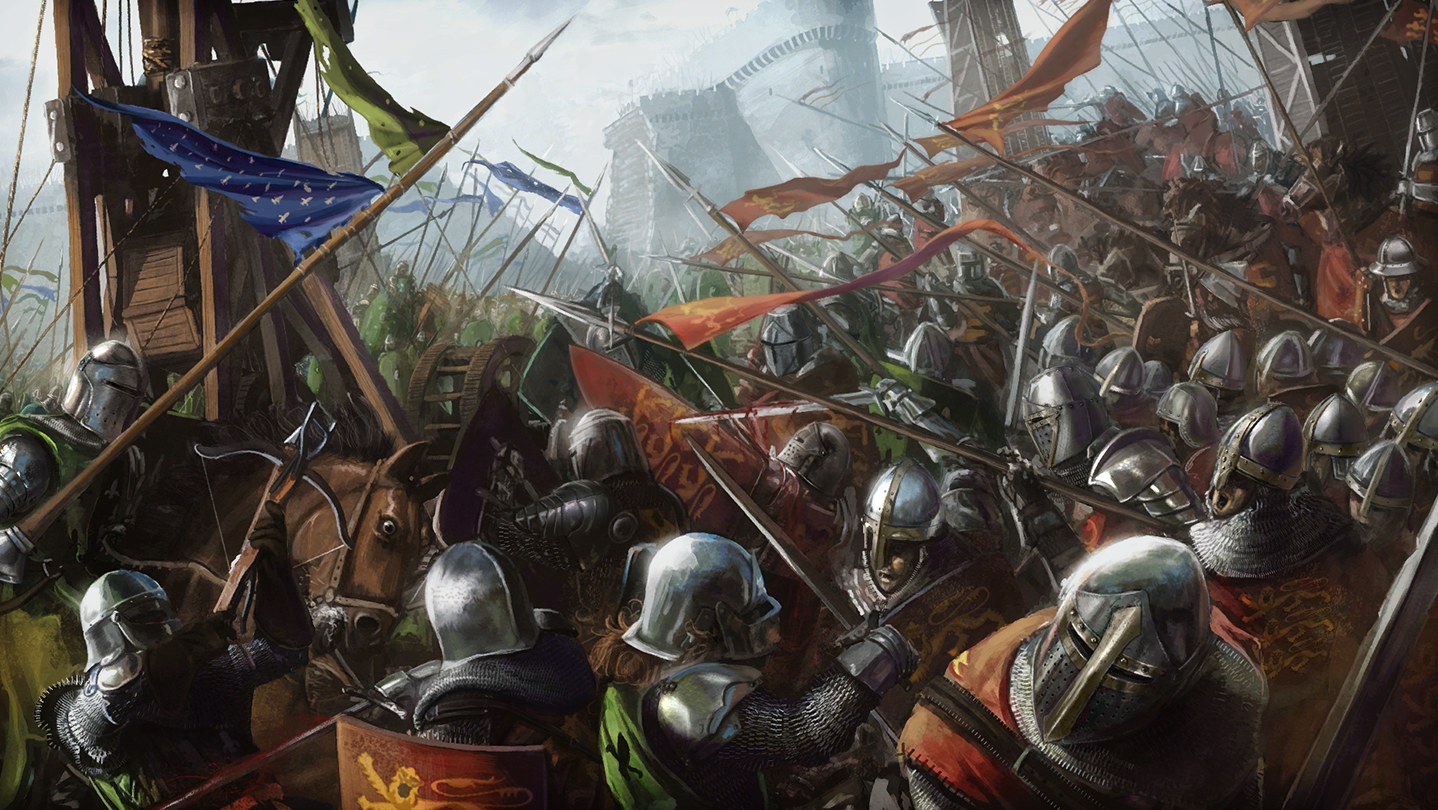
Medieval Kingdom Wars pitches itself as a fusion of real-time tactics and grand strategy, and that description is accurate enough to be useful. You play as a minor lord sworn to a king, building up towns, raising armies, and eventually throwing those armies at enemy walls in siege combat that leans harder into the 'brutal' end of the spectrum than most genre peers. The map layer handles diplomacy, territory control, and campaign progression, while the ground-level RTS layer handles the actual fighting. The two halves talk to each other in ways that matter: resources you gather in town-building feed your army composition, and losing a field battle has real campaign consequences. That feedback loop is where the game earns its hours. The siege system is the headline feature, and it mostly delivers. Battering rams, ladders, catapults, and fire mechanics give assaults a chaotic physicality that feels distinct from the cleaner abstraction you get in something like a Paradox title. Defending a settlement with too few troops while a wave of enemy infantry pours through a broken gate is genuinely tense. The rogue-like progression layer adds persistent stakes: campaign losses sting, and rebuilding after a bad string of battles requires real decision-making about where to invest your limited resources. Factions play differently enough that replays have a point. Here is where the spreadsheet matters, though. Medieval Kingdom Wars is a rough game. The AI is inconsistent, capable of threatening pressure in one engagement and then walking units into walls in the next. The UI communicates information poorly in several menus, and new players will spend meaningful time reverse-engineering mechanics that a competent tutorial should have explained. The town-building side is shallower than a dedicated city-builder, and the grand-strategy layer thinner than a dedicated 4X. Neither half is fully realized on its own terms. The Steam review score sitting at mixed-but-leaning-positive reflects exactly that tension: players who click with the core loop forgive a lot, and players who bounce off the rough edges bounce hard. For a newcomer, the honest advice is to treat the first few hours as a paid tutorial. Expect to lose your first campaign, read the Steam community guides (they are better than anything in-game), and approach the faction selection with some research rather than a random pick. If you have patience for systems that require external documentation and can look past UI that occasionally obscures rather than informs, the underlying design has real teeth. The rogue-like campaign structure in particular rewards players who enjoy post-mortem analysis: what went wrong, what resource call was wrong, which army composition left you exposed. That is a satisfying loop when it clicks. The mod ecosystem is modest and the developer update cadence has been slow since the 2019 launch, so do not buy this expecting active content additions. What is here is what you are getting. At the right price point it is a legitimate option for strategy players hungry for something that attempts the RTS-grand-strategy splice seriously, even if it does not fully stick the landing. Approach it as an interesting, flawed experiment rather than a polished product and it will treat you reasonably well.

Strategy & simulation
Tags
System Requirements
Minimum
- OS
- Windows Vista
- Processor
- 2.4 GHz Dual Core
- Memory
- 4 GB RAM
- Graphics
- NVIDIA GeForce 670 / Radeon R9 280X
- DirectX
- Version 11
- Network
- Broadband Internet connection
- Storage
- 4 GB available space
Recommended
- Processor
- 2.4 GHz Quad Core
- Memory
- 5 GB RAM
- Graphics
- NVIDIA GeForce GTX 970 / Radeon RX 480
- DirectX
- Version 11
- Network
- Broadband Internet connection
- Storage
- 7 GB available space…
DLC & Add-ons for Medieval Kingdom Wars1
Expansions, DLC packs and add-on content for this game. Click any item to see store offers.
Keep exploring
Community Discussion
Be the first to comment on Medieval Kingdom Wars.
Reviews & Ratings
Game Info
- Developer
- Reverie World Studios
- Publisher
- indie.io
- Release Date
- Jan 3, 2019