City States: Medieval
Most strategy games let you paint the map. This one asks whether your single city can survive being surrounded by empires that want to paint over you.
GamerScout Verdict
Worth buying now for hybrid strategy fans who can tolerate Early Access roughness - the systems loop is already the game's strongest feature.
Compare Prices(6 stores)
Every store in this table quotes us in euros, so the EUR figure is the price the seller actually set, not our arithmetic — which is why EUR is also the currency we rank in. We only list an offer here when the store gives us its price in euros, so nothing in this table is a number we invented.
Pick USD, PLN, GBP, CAD or AUD in the header and we convert from EUR at the European Central Bank reference rate — converted amounts are prefixed with ~. Your bank or the store may apply a different rate at checkout. We never hide offers based on where you are: everyone sees this whole table.
We may earn a commission when you buy games through links on this page — at no extra cost to you. It never affects our rankings or verdicts.
Price History
Screenshots & Media
About City States: Medieval
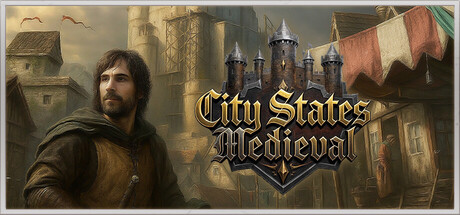
I keep a mental checklist when sizing up a hybrid strategy game: does each pillar of the loop actually talk to the other pillars, or are they just stapled together for a Steam tag count? City States: Medieval passes that test in a way I did not fully expect from an Early Access title launching in April 2026. The city-building layer feeds directly into a trade layer, the trade layer funds your military, and the military feeds right back into the decisions you make about where your hero goes next. Pull any one thread and the whole structure tightens. The core premise is deliberately narrow in geographic scope but wide in systems depth. You are not running a continent-spanning empire. You are one city-state in 12th-century Europe and the Middle East, wedged between kingdoms that could flatten you on a slow Tuesday. Growth tracks across economy, military, faith, and building chains, and the twelve tradeable commodities - wool, linen, spices, silk, and others - are not window dressing. Research is gated behind trade materials, so the route you establish to Genoa or the Holy Land is also the route that unlocks the siege engines you need to survive the next attack. That feedback loop is the game's strongest design argument. Combat drops you into real-time tower defense and siege warfare rather than a traditional RTS skirmish. Early player impressions flag loading screen instability and some crashes after battles, which is the honest Early Access caveat that needs saying. On the other side of those rough edges, people who have been playing strategy games for two decades are calling the combination of worldwide economic management, technology research, city planning, and RTS battles something they have not seen assembled in quite this way before. The hero mechanic is the element that separates this from a standard city-builder with combat bolted on. Your leader is a physical presence on the map: when present, you have full command of city, territories, and armies, plus meaningful stat bonuses. When you send them abroad to open a new market or conduct court intrigues, your city-state drops to a limited maintenance government. That single toggle creates constant, real pressure. Dispatching your hero to establish a spice route in North Africa is a genuine gamble with a clear downside, not a side-quest you can ignore. The three campaigns at launch each carry their own arc - the Republic of Genoa storyline alone is scoped at 25-30 hours according to Reverie - which is a reasonable content floor for Early Access. For strategy veterans, the honest concern right now is polish, not depth. The systems are present and connected; balance and stability are the work still ahead, and Reverie has stated plainly that the game will remain in Early Access through the rest of the year with community feedback shaping priorities. There is also a free demo drawn directly from the Genoa campaign, which is roughly four hours of real progression, not a tutorial sandbox. That is the correct way to evaluate whether the pace and complexity suit you before committing. For players who find pure city-builders too passive and grand strategy too turn-based and abstracted, this hybrid sits in a gap that does not have many serious occupants.

Strategy & simulation
Tags
System Requirements
Minimum
- OS
- Windows 7
- Memory
- 3 GB RAM
- DirectX
- Version 11
- Storage
- 5 GB available space
- Graphics
- NVIDIA GeForce GTX 1070 / AMD Radeon RX Vega 56
- Processor
- 2.4 GHz Dual Core
- Sound Card
- DirectX Compatible
Recommended
- OS
- Windows 10
- Memory
- 5 GB RAM
- DirectX
- Version 11
- Storage
- 7 GB available space
- Graphics
- NVIDIA GeForce RTX 2060 / AMD Radeon RX Vega 64
- Processor
- 2.4 GHz Dual Core
- Sound Card
- DirectX Compatible
Keep exploring
Community Discussion
Be the first to comment on City States: Medieval.
Reviews & Ratings
No ratings available
Game Info
- Developer
- Reverie World Studios
- Publisher
- indie.io
- Release Date
- Apr 20, 2026