Floodland
Post-apocalyptic colony sim that asks whether you can govern flooded survivors without fracturing along ideological fault lines. Strategy fans: the clan tension is the whole point.
GamerScout Verdict
Solid colony sim for players who want governance friction with their city-building, provided the clan volatility reads as challenge rather than chaos.
Compare Prices(8 stores)
Every store in this table quotes us in euros, so the EUR figure is the price the seller actually set, not our arithmetic — which is why EUR is also the currency we rank in. We only list an offer here when the store gives us its price in euros, so nothing in this table is a number we invented.
Pick USD, PLN, GBP, CAD or AUD in the header and we convert from EUR at the European Central Bank reference rate — converted amounts are prefixed with ~. Your bank or the store may apply a different rate at checkout. We never hide offers based on where you are: everyone sees this whole table.
We may earn a commission when you buy games through links on this page — at no extra cost to you. It never affects our rankings or verdicts.
Price History
Screenshots & Media
About Floodland
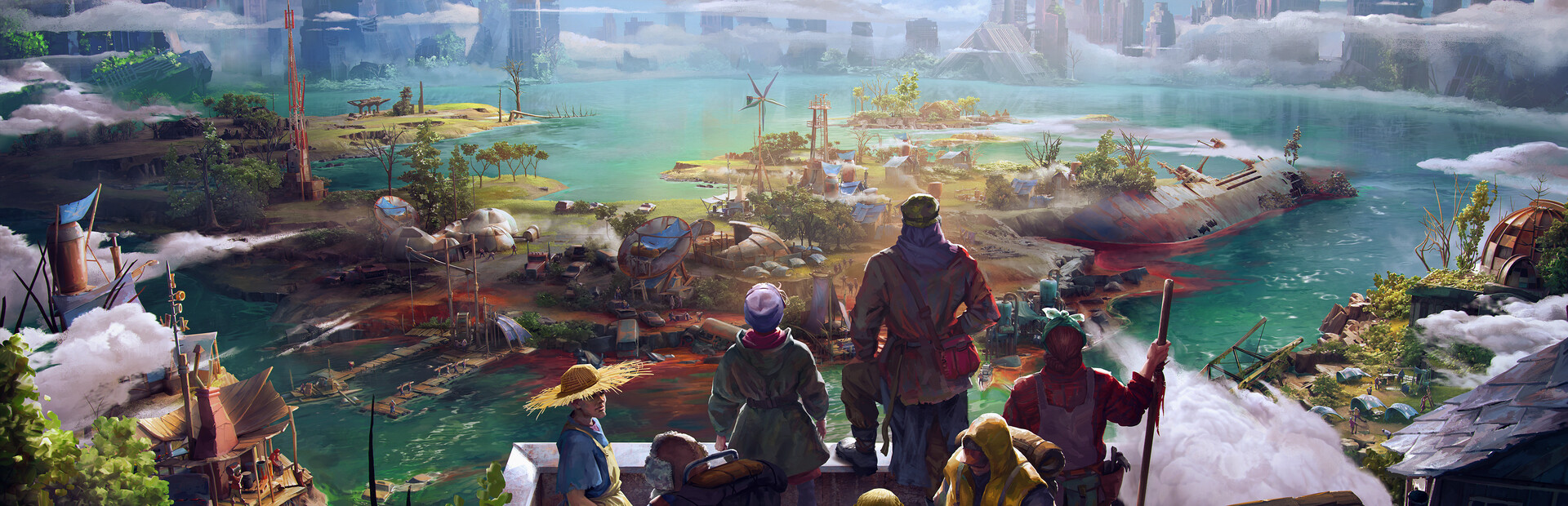
My first few hours with Floodland felt familiar in the best way. Scavenge rubbish to build primitive shelters, assign settlers to collection zones, unlock the Growth-Survival-Exploration-Well-Being research wheel, send three-person expeditions into the fog at the cost of food and water. The loop is clean, the UI is genuinely good, and the tutorial walks newcomers through enough of the fundamentals that even players new to colony sims should find a workable foothold. If you bounced off Frostpunk because it felt cryptic, Floodland's opening acts are noticeably more forgiving. Vile Monarch's pedigree runs through 11 Bit Studios and This War of Mine, and that DNA is visible in the pacing and tone. What distinguishes Floodland from the wider city-builder crowd is its focus on people over infrastructure. You pick one of four starting clans, each carrying distinct bonuses and political worldviews. The Good Neighbors boost water filter output and can enable night shifts; Berkut-3 prioritises speed in ruin exploration and resource collection. As you expand across the archipelago of scattered islands, you absorb additional clans, each represented by a talking-head leader who will surface constantly to register approval or fury with your laws. Passing legislation on compulsory health measures, burial rites, or recreational buildings is not just a checkbox activity: it shifts unrest meters, triggers crime, and can fracture your workforce if handled carelessly. Separating ideologically opposed clans into distinct districts is the community-sourced workaround that actually helps, though it demands spatial planning and splits your logistics. Here is where the honest accounting starts. The clan mechanics are the game's most polarising system, and criticism from launch reviewers was consistent: consequences often feel disproportionate or opaque. A seemingly minor expedition discovery or a law that satisfies three clans can send a fourth into a spiral of theft and absenteeism, with little telegraphing in advance. Rock Paper Shotgun also called out the research pacing specifically, noting that the wait on new technologies can become genuinely tedious mid-run. Launch builds carried performance problems, including frame-rate drops as population scaled and occasional crashes, though the developers indicated active patching. The randomly generated maps add replay value and the seed randomiser runs fairly, but the game ships with a single core scenario, which limits long-term variety compared to sandbox-heavy competitors. For players who accept those friction points, the reward is a colony sim that forces ethical and logistical trade-offs simultaneously. Deciding what to do with the dead, whether to impose epidemic controls, or whether to banish an uncooperative clan and absorb the workforce loss are all decisions with real downstream effects. The atmospheric art direction, colourful despite its bleak subject matter, and a choral ambient soundtrack have drawn consistent praise across reviewers. Steam Workshop support gives the modding community room to extend the experience beyond the base scenario, which matters for a game where single-run content is otherwise finite. Metacritic landed at 73, OpenCritic found only 48 percent of critics recommending it outright. That spread maps precisely onto the clan system debate: players who read the friction as intentional design tension tend to finish runs and restart; players who experience it as punishment for invisible rule violations put the game down. If you approach Floodland the way you would a Paradox title on low difficulty, treating the first run as a learning sandbox and accepting early losses as data rather than failure, the experience clicks. Micromanage your research branches in parallel, keep ideologically mismatched clans on separate islands early, and treat every law vote as a risk-management exercise rather than a narrative formality. New to the genre? The tutorial and adjustable difficulty settings provide enough scaffolding to get going. Veterans wanting a deep sandbox with extensive late-game levers will likely hit the ceiling faster than they would in Frostpunk or Endzone.

Strategy & simulation
Tags
System Requirements
Minimum
- OS
- Windows 10, 64-bit
- Memory
- 8 GB RAM
- DirectX
- Version 11
- Storage
- 30 GB available space
- Graphics
- GeForce GTX 1060 or AMD equivalent, 6 GB VRAM
- Processor
- Intel(R) Core(TM) i5-4460 or AMD equivalent
Recommended
- OS
- Windows 10, 64-bit
- Memory
- 16 GB RAM
- DirectX
- Version 11
- Storage
- 30 GB available space
- Graphics
- GeForce RTX 2060 or AMD equivalent, 6 GB VRAM
- Processor
- Intel(R) Core(TM) i7 8700k or AMD equivalent
Keep exploring
Community Discussion
Be the first to comment on Floodland.
Reviews & Ratings
Game Info
- Developer
- Vile Monarch
- Publisher
- Ravenscourt
- Release Date
- Nov 15, 2022