GamerScout Verdict
Worth it for players who can tolerate punishing navigation in exchange for one of the most handcrafted weird worlds in recent brawler history.
Compare Prices(0 stores)
Loading prices...
We may earn a commission when you buy games through links on this page — at no extra cost to you. It never affects our rankings or verdicts.
Screenshots & Media
About Clash: Artifacts of Chaos Zeno Edition
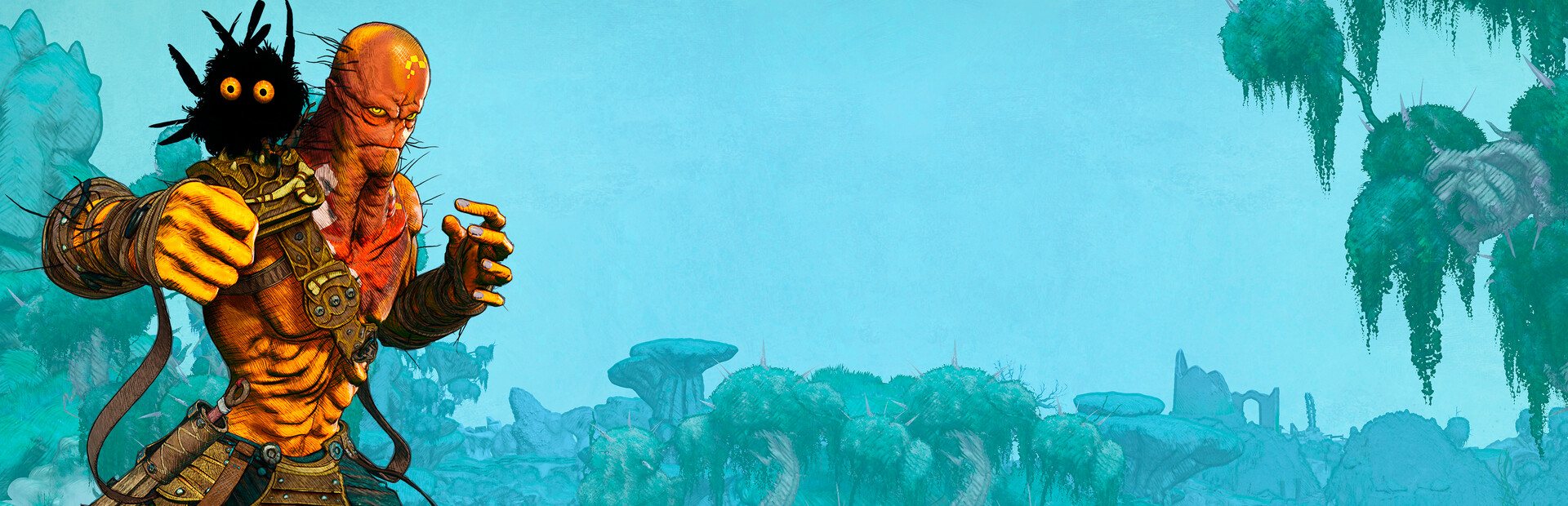
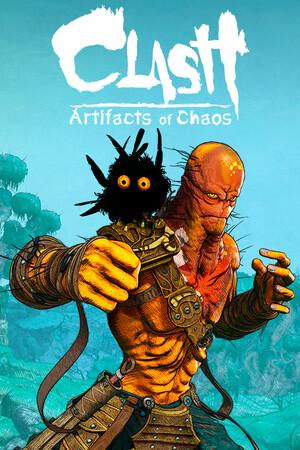
My first hour with Clash: Artifacts of Chaos felt like walking into a fever dream painted by someone who had never seen a video game but had read every myth ever written. That feeling does not entirely go away, and that is the point. ACE Team, the Chilean studio behind the original Zeno Clash games and The Eternal Cylinder, returns to the world of Zenozoik with their most ambitious and most conflicted work yet. The Zeno Edition bundles in cosmetic extras including Zeno Clash-inspired armour sets for the protagonist Pseudo and a few customisation items for his ward, the Boy, plus an exclusive ritual artefact. Nothing game-changing, but a decent bonus for newcomers and a small gift for series faithful. At its core this is a third-person melee brawler with a strong Souls-like skeleton. You play as Pseudo, a hermit martial artist who becomes reluctant guardian to the Boy after circumstances force them together. The world of Zenozoik is semi-open, built from wide linear corridors that eventually unlock shortcuts, and traversal is genuinely one of the weaker parts of the experience. Paths loop back on themselves in ways that feel more confusing than designed, and critics who called the level structure circuitous are not wrong. Post-launch patches have improved navigation legibility and added environment details to help with orientation, which softens the sting, but if you hate backtracking in spaces that feel deliberately obscured, factor that in. What keeps you moving is the pull of the next landscape. ACE Team renders Zenozoik in a cross-hatched pencil-drawing filter, all bottomless saturated hues and hand-painted shading, so that even a mundane alien shrub becomes something worth pausing over. The audio sits level with the visuals: the soundtrack by Patricio Meneses is the kind of thing you let loop after you close the game, and the voice work across the cast is mostly strong. Combat is the spine and the splinter simultaneously. The base loop is third-person fisticuffs with punches, kicks, sidestepping, blocks, and combos. Most enemies are tougher than Pseudo, so the rhythm becomes jab-retreat-punish, like a smaller fighter working on the outside. Landing enough hits fills a power meter that shifts the camera into first-person mode, a direct callback to Zeno Clash, letting you unload a finishing flurry. Breakable weapons such as crude clubs and hammers add a resource decision layer: save them for the hardest customers or burn them early. A dual day-and-night form for Pseudo adds environmental puzzle texture, with the night form required to pass certain thorn walls and carrying heavier death consequences than the day form. The RPG layer lets you burn collectible figurines to enhance fighting styles and special attacks, brew plants and animals into restorative potions, and craft gear from traded materials. None of it is deep, but together it gives you enough levers to feel agency over a difficult stretch. The Ritual system deserves its own mention: before significant fights, both sides select an artefact and roll dice on a small board game, with outcomes that can summon allies, grant first strike, or apply poison. It sounds gimmicky and it is a little luck-dependent, which irritates some players, but when the Ritual swings a fight that felt hopeless it produces a genuine moment of relief. The story, written by Jonas Kyratzes (known for work on The Talos Principle), earns more warmth than a beat-em-up setup suggests. The bond between Pseudo and the Boy accumulates quietly through shared camp moments and brief dialogue, and the heartfelt beats land because they are rationed properly. The game never mistakes volume of cutscenes for emotional weight. It does, however, under-explain its own systems in the opening stretch, and the tutorial dream sequence at the start is more cryptic than it needs to be. ACE Team patched in short tutorial videos on the game-over screen to address this, but you will still arrive at certain mechanics by accident. Sit with the discomfort. The game is asking you to feel your way through Zenozoik the same way Pseudo does: cautiously, with fists ready. Clash: Artifacts of Chaos is not a smooth ride. The traversal drags, the Ritual leans on dice rolls that occasionally feel unfair, and players who want a tightly directed experience will find the structure loose in places it should be taut. But if you are someone who responds to games that feel genuinely handcrafted from a singular vision, who finds the soundscape of a strange world worth the friction of learning its rules, this is exactly that. The Steam community has landed on Very Positive and I understand why: underneath the rough edges sits something ACE Team has been building toward for over a decade.

Indie & narrative
Tags
System Requirements
Minimum
- OS
- Windows 10
- Processor
- Intel i3 4130 (2.9 GHz) / AMD FX 8120 (3.1 GHz)
- Memory
- 8 GB RAM
- Graphics
- NVIDIA GeForce GTX 780 (3 GB) / AMD Radeon R7 260X (2 GB…
Recommended
- OS
- Windows 10
- Processor
- Intel i5 6402P (2.8 GHz) / AMD Ryzen 5 1600X (3.6 GHz)
- Memory
- 8 GB RAM
- Graphics
- NVIDIA GeForce RTX 2060 (6 GB) / AMD RX 5600X…
Keep exploring
Community Discussion
Be the first to comment on Clash: Artifacts of Chaos Zeno Edition.
Reviews & Ratings
Game Info
- Developer
- ACE Team
- Publisher
- Nacon
- Release Date
- Mar 9, 2023