
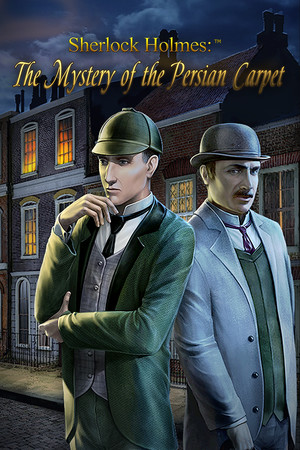
Sherlock Holmes: The Mystery of the Persian Carpet
If pixel-hunting for a strand of hair in a dimly lit Victorian parlor sounds like your idea of a good Saturday, Frogwares has a case for you. Everyone else should probably look at the studio's proper Holmes adventures instead.
GamerScout Verdict
Grab it only in a bundle if you tolerate hidden-object pixel-hunting; skip it if you want a proper Frogwares Holmes adventure.
Compare Prices(4 stores)
Every store in this table quotes us in euros, so the EUR figure is the price the seller actually set, not our arithmetic — which is why EUR is also the currency we rank in. We only list an offer here when the store gives us its price in euros, so nothing in this table is a number we invented.
Pick USD, PLN, GBP, CAD or AUD in the header and we convert from EUR at the European Central Bank reference rate — converted amounts are prefixed with ~. Your bank or the store may apply a different rate at checkout. We never hide offers based on where you are: everyone sees this whole table.
We may earn a commission when you buy games through links on this page — at no extra cost to you. It never affects our rankings or verdicts.
Price History
Screenshots & Media
About Sherlock Holmes: The Mystery of the Persian Carpet
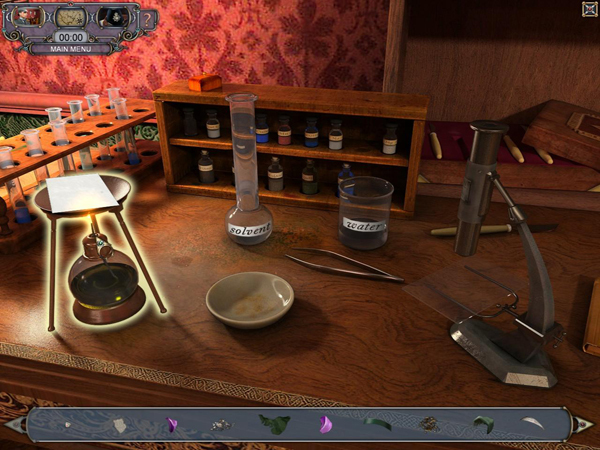
My first impression of Persian Carpet was confusion about what kind of game it actually wants to be, and that identity crisis never fully resolves. Frogwares built their reputation on full 3D point-and-click Holmes adventures, so when they stripped the formula down to a casual hidden-object framework in 2008, they produced something that lands awkwardly between two audiences. The free-roaming investigation of their mainline games is gone. In its place: fixed static screens of Victorian locations, a silhouette inventory bar at the bottom, and the instruction to find everything before you move on. The core loop has you scanning scenes for case-relevant clues, things like bloodstains, cigarette ash, hair samples, footprints, and scattered personal effects, rather than the random assortment of rubber ducks and garden gnomes that bog down lesser hidden-object titles. That thematic coherence is genuinely a point in the game's favor. Every item you collect feeds into Holmes's chemistry table or the deduction board back at 221b Baker Street, where you draw connections between suspects, evidence, and locations to build toward a final accusation. The structure is more purposeful than you'd expect from the genre. What kills the goodwill is the visibility problem. Many objects are so small or so well-camouflaged against the dark, atmospheric backgrounds that finding them stops feeling like detective work and starts feeling like an eye exam. You get three hints per chapter, so spend them carefully, and even then a hint sometimes just zooms you into a sub-screen rather than pointing directly at the offending pixel. Between the scene searches, each location also hides one or two logic puzzles: sliding tile sequences, pipe-routing challenges, combination locks requiring code-breaking, a tile-blocking board game against the AI, and a string-untangling puzzle with no fixed solution. These are the game's genuine bright spots. The variety is real, the difficulty is honest without being cruel, and a few of them are inventive enough to stick in your memory. You can also replay all unlocked puzzles from 221b, which is a small but appreciated touch. The problems pile up elsewhere. There is no voice acting at all, which flattens the atmosphere considerably given how much of the narrative is delivered through on-screen text exchanges. The story itself runs through jealousy, blackmail, and secret dalliances, serviceable Victorian murder mystery territory, but the payoff is an extended text dump that explains the whole case after you solve the deduction board. You've done the work; the game takes back the satisfaction by narrating the answer at you for several minutes rather than letting you feel the conclusion. Playtime sits somewhere between two and six hours depending on how much the hint system cushions you. Timed and untimed modes are both available at the start, and going untimed is the sensible choice for a first run. Steam's all-time review score sits at a rough 40% positive, which tracks with the general community read: fine for a bundle pickup, rough value as a standalone purchase. If you're a dedicated hidden-object fan who can make peace with occasionally hunting near-invisible specks against dark wallpaper, there is a coherent, modestly engaging mystery here. If you came to this page after enjoying Sherlock Holmes: Crimes and Punishments or Chapter One, know that Persian Carpet shares almost nothing with those games mechanically or in scope.

Catch-all
Tags
System Requirements
Minimum
- OS
- Microsoft Windows 2000/XP/Vista
- Sound
- DirectX® compatible sound card
- Memory
- 256 Mb RAM
- Graphics
- 32 MB Microsoft DirectX 9-compliant video card
- Processor
- Pentium III 600 MHz or higher and AMD Athlon
- Hard Drive
- 300Mb hard disk drive
Keep exploring
Community Discussion
Be the first to comment on Sherlock Holmes: The Mystery of the Persian Carpet.
Reviews & Ratings
No ratings available
Game Info
- Developer
- Frogwares
- Publisher
- Frogwares
- Release Date
- TBA