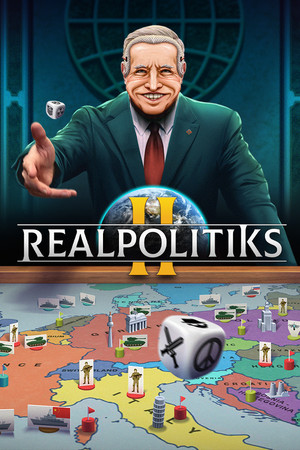
Realpolitiks II
A modern-era grand strategy with genuine breadth - 200-plus nations, six victory paths, covert ops and land/sea/air combat - held back by a weak tutorial, uneven AI, and a Steam rating that sits at roughly 46% positive.
GamerScout Verdict
Worth a look for Paradox veterans curious about the contemporary world setting, but newcomers should brace for a rough onboarding and uneven AI.
Compare Prices(9 stores)
Every store in this table quotes us in euros, so the EUR figure is the price the seller actually set, not our arithmetic — which is why EUR is also the currency we rank in. We only list an offer here when the store gives us its price in euros, so nothing in this table is a number we invented.
Pick USD, PLN, GBP, CAD or AUD in the header and we convert from EUR at the European Central Bank reference rate — converted amounts are prefixed with ~. Your bank or the store may apply a different rate at checkout. We never hide offers based on where you are: everyone sees this whole table.
We may earn a commission when you buy games through links on this page — at no extra cost to you. It never affects our rankings or verdicts.
Price History
Screenshots & Media
About Realpolitiks II
My spreadsheet instincts tell me to lead with the number that matters most here: 46 percent positive on Steam across several hundred reviews. That is not a rounding error or a review-bomb blip. It is the honest ceiling on what Realpolitiks II currently delivers, and anyone shopping for a modern Paradox alternative needs to walk in with that figure in mind. What the game gets genuinely right is its setting. Grand strategy almost never goes near the contemporary world - Jujubee carved out real estate that Paradox has largely left alone, and that novelty still counts for something. You pick from over 200 nations, ranging from superpowers down to microstates, across three scenarios: a standard present-day run, a Pandemic Aftermath variant that reshapes the opening geopolitical board, and a post-collapse mode where civilisation is clinging on by its fingernails. Six distinct victory conditions - world government unification, information dominance, cultural hegemony, economic supremacy, military conquest, or simple score leadership over a 100-year timeline - give each campaign a different skeletal shape. Action Points are the core rationing mechanic: there are never enough of them to do everything at once, which is where the most genuinely interesting decisions live. Over 700 projects and technologies let you sculpt your nation's ideology, infrastructure, and military doctrine across the campaign. The espionage layer is probably the game's liveliest corner - funnelling weapons into proxy conflicts, running covert destabilisation ops, or deploying levelled-up spies to neutralise rival politicians produces the kind of unpredictable story beats that keep a session going past midnight. The problems, though, are structural. The tutorial leans almost entirely on small dialogue boxes and delivers almost no hands-on practice with the systems it describes, which is a serious misstep for a game with this much surface area. The AI draws sustained criticism for being chaotic and unbalanced rather than meaningfully competitive - reviewers noted that aggressive territorial plays by major powers go largely unpunished by the international system, draining the geopolitical simulation of consequence. Combat on land, sea, and air factors in terrain and weather, which sounds promising, but the interface for managing multiple war theatres simultaneously is clunky enough that military campaigns often feel more like an admin chore than a strategic puzzle. The economic model has tooltip accuracy problems that dedicated community members have been flagging since early access, and while post-launch patches have addressed some of it, the balancing for smaller nations remains unforgiving. For complete newcomers to the genre, I would not recommend this as a starting point. The learning curve is steep and the tutorial does not compensate for it. If you have any prior hours in Stellaris, Hearts of Iron, or even the first Realpolitiks, you will parse the systems faster and get to the parts that actually reward patience - the mid-game diplomatic web-building, the covert ops chains, and the scenario-specific chaos from the 1,000-plus random events. Mod support exists and gives the community some tools to patch what the developer left rough. On console, the controller adaptation is functional but slow for a game that punishes hesitation. Realpolitiks II sits in a category of games I think of as "correct idea, incomplete execution." The modern-world setting is underserved by the genre and this is still one of the only real attempts at it. When the Action Point economy clicks and a spy op tips a rival nation into civil war just as your trade bloc locks in, the fantasy works. Getting there requires tolerating a lot of friction that better-resourced studios would have polished away.

Strategy & simulation
Tags
System Requirements
Minimum
- OS
- Windows 7/8/10 64-bit
- Memory
- 8 GB RAM
- DirectX
- Version 11
- Storage
- 14 GB available space
- Graphics
- GeForce GTX 760, Radeon HD 7950 or equivalent with 2 GB of video RAM. A dedicated video card is required.
- Processor
- Intel Core i5 2,3 GHz
- Sound Card
- DirectX compatible
Recommended
- OS
- Windows 7/8/10 64-bit
- Memory
- 8 GB RAM
- DirectX
- Version 11
- Storage
- 14 GB available space
- Graphics
- GeForce 980, Radeon RX 580 or equivalent with 4GB of video RAM. A dedicated video card is required.
- Processor
- Intel Core i5 3 GHz
- Sound Card
- DirectX compatible
DLC & Add-ons for Realpolitiks II3
Expansions, DLC packs and add-on content for this game. Click any item to see store offers.
Keep exploring
Community Discussion
Be the first to comment on Realpolitiks II.
Reviews & Ratings
No ratings available
Game Info
- Developer
- Jujubee S.A.
- Publisher
- Fulqrum Publishing
- Release Date
- May 12, 2021