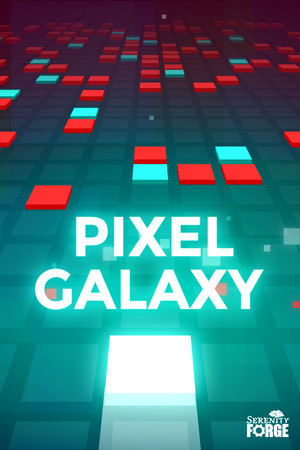
Pixel Galaxy
Forget the trigger finger: Serenity Forge's tiny bullet-hell flips the shmup formula so that every enemy you touch becomes your weapon, your shield, and your undoing all at once.
GamerScout Verdict
A tight, inventive arcade loop best suited to score-chasers who can live with limited mode variety and a controller in hand.
Compare Prices(8 stores)
Every store in this table quotes us in euros, so the EUR figure is the price the seller actually set, not our arithmetic — which is why EUR is also the currency we rank in. We only list an offer here when the store gives us its price in euros, so nothing in this table is a number we invented.
Pick USD, PLN, GBP, CAD or AUD in the header and we convert from EUR at the European Central Bank reference rate — converted amounts are prefixed with ~. Your bank or the store may apply a different rate at checkout. We never hide offers based on where you are: everyone sees this whole table.
We may earn a commission when you buy games through links on this page — at no extra cost to you. It never affects our rankings or verdicts.
Price History
Screenshots & Media
About Pixel Galaxy
I have a soft spot for games that discard a genre's most sacred rule and still manage to feel completely at home in it. Pixel Galaxy does exactly that with the shoot 'em up. You start as a lone white pixel in a box flooded with bullets, and the twist is disarmingly simple: you cannot fire a single shot on your own. Instead, you physically collide with enemy pixels and absorb them onto your body. Wherever they attach is where they stay, auto-firing back at their former allies. Grow too large and you become an unwieldy mass that can't dodge; stay small and nimble and you lack the firepower to survive the escalating waves. That tension, choosing when to collect and when to let pixels pass by, is the whole game, and it is genuinely clever. The mechanics carry an almost puzzle-logic to them once you settle in. Absorbed pixels fire in the direction they are facing, so placement matters. Shield pixels can absorb several hits before breaking, while laser pixels and bomb pixels each bring very different risk-reward trade-offs. Every wave is procedurally randomized, meaning no two runs open the same way, and roughly every 90 seconds a boss arrives, each with a distinct name, a distinct shape assembled from its own pixel parts, and a distinct attack pattern that can rearrange your whole strategy in seconds. There are six difficulty tiers (with names that slide from "Easiest" into the self-aware "Normalest") and a Boss Rush mode for players who want to skip the survival stretches and go straight to the part where the game absolutely does try to kill you. Local co-op for two controllers is also here, with a revival mechanic where a living player can resurrect their fallen partner simply by touching them, which is both thematically on-brand and practically chaotic in the best way. The soundtrack deserves a paragraph of its own. It blends chiptune and EDM across tracks that shift with the difficulty level, and more than one reviewer noted it stuck in their head long after the session ended. The minimalist visual design complements this: everything is a square of color, the screen pulses and recolors as you progress, and the bosses are these surprisingly characterful constructions of assembled geometry. It sounds cold on paper. In motion it has a strange, hypnotic warmth that I did not expect. One caveat worth flagging honestly: the color-reliance creates real friction for colorblind players, and the mid-session color shifts that tend to coincide with boss appearances can disorient anyone. Distinguishing your bullets from enemy bullets in a dense screen is also harder than it should be. Where the game runs into its ceiling is variety. The core loop is addictive but narrow. Critics comparing it to Geometry Wars 2 noted that title succeeded in large part because of its wide range of distinct modes, each with its own logic and feel. Pixel Galaxy has Boss Rush and a passive unlockable mode alongside the standard survival, but those options do not dramatically expand what you are actually doing from run to run. If you are the kind of player who needs a game to keep reinventing itself to hold your attention, the loop may wear thin before the higher difficulties open up. If you are the kind of player who finds meditative depth in mastering a single tight system, the boss designs and randomized wave structure will give you plenty to parse. For what it is, a compact, weird, musically alive little arcade experiment from a developer who clearly cared about craft even on a small budget, it earns its place on any short-session rotation. Put a controller in your hand, not a keyboard.

Indie & narrative
Tags
System Requirements
Minimum
- OS
- Windows 7
- Memory
- 4 GB RAM
- Storage
- 200 MB available space
- Graphics
- GeForce 8800 GT or better
- Processor
- Intel Core Duo
Keep exploring
Community Discussion
Be the first to comment on Pixel Galaxy.
Reviews & Ratings
Game Info
- Developer
- Serenity Forge
- Publisher
- Serenity Forge
- Release Date
- Oct 2, 2015