
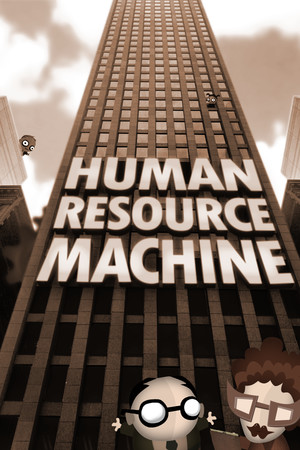
Human Resource Machine
A puzzle game that quietly teaches you assembly logic inside a soul-crushing corporate satire, hits harder than it looks, and the optimization rabbit hole is deep.
GamerScout Verdict
Best for logic-minded puzzle players willing to debug their own thinking; less rewarding if you expect the game to explain its own late jumps.
Compare Prices(0 stores)
Loading prices...
We may earn a commission when you buy games through links on this page — at no extra cost to you. It never affects our rankings or verdicts.
Price History
Screenshots & Media
About Human Resource Machine
I have a spreadsheet habit, so when a puzzle game dresses its core loop as a corporate performance review, I pay attention. Human Resource Machine wraps genuine assembly language concepts in the thinnest possible veneer of office drudgery, and the result is one of the more intellectually honest puzzle games released this decade. The structure is simple: you get an inbox conveyor belt, an outbox conveyor belt, and a small floor of numbered memory tiles. Your job is to write a program, using a drag-and-drop instruction list, that processes incoming values and ships out the correct outputs. Early puzzles hand you only INBOX and OUTBOX commands. Within a few levels you are composing conditional branch logic with JUMP, JUMP IF ZERO, and JUMP IF NEGATIVE, writing loops, and managing pointers. The game never uses those words, but that is exactly what you are doing. By the midpoint, the puzzles ask you to multiply numbers without a multiply command, sort zero-terminated strings, and eventually wrestle with Fibonacci sequences. The difficulty spike is real and the game's in-puzzle tutoring is almost nonexistent past the basics, so expect to hit a wall, stare at your instruction list, and debug line by line. The optimization layer is where the game earns genuine respect. Completing a level is one bar; the secondary challenges grade your solution on size (total commands written) and speed (total steps executed during a run), and some levels have a best score achievable for only one of those two metrics, not both. That is a clean design choice. Chasing the tighter size solution often requires a fundamentally different algorithm than chasing the faster one, which means you can revisit every solved puzzle and find new problems to think through. Every solution is saved automatically, so tinkering never risks losing prior work, a small but welcome detail. Who is this for? Honest answer: puzzle fans who are comfortable sitting with a problem they do not immediately understand. Programming experience helps but is not required. The early years hold your hand reasonably well, and the conceptual introduction to loops and conditionals is genuinely well-paced. Where the game stumbles is in its tutorial silence at harder jumps. The in-game comment system, where you can annotate your instruction list, is the only scaffolding provided, and a few of the later puzzles will send non-programmers searching for outside help. That is a real flaw worth naming. The audience gap critics identified is accurate: experienced developers may breeze the first half, while complete beginners may hit a wall in the back third and never recover without a hint. The game lands most cleanly on curious players who sit somewhere between those poles. The presentation punches above the game's price bracket. The visual style has a slightly gothic corporate-dystopia look, your character visibly ages across the forty-odd puzzles, and your bosses are quietly replaced by robots as you climb the ladder. The dark humor is understated and better for it. The puzzle-solving music is divisive, leaning toward generic electronic loops that some reviewers muted entirely, but the incidental cutscene audio is more characterful and fits the tone. No mods, no multiplayer, no post-launch content expansions worth noting, so what is in the box is the complete experience.

Strategy & simulation
Tags
System Requirements
Minimum
- OS
- XP or later
- Memory
- 1 GB RAM
- DirectX
- Version 9.0c
- Storage
- 200 MB available space
- Graphics
- graphics card that supports Shader Model 2.0 or greater
- Processor
- 1.5Ghz CPU
Keep exploring
Community Discussion
Be the first to comment on Human Resource Machine.
Reviews & Ratings
Game Info
- Developer
- Tomorrow Corporation
- Publisher
- Tomorrow Corporation
- Release Date
- Oct 15, 2015