
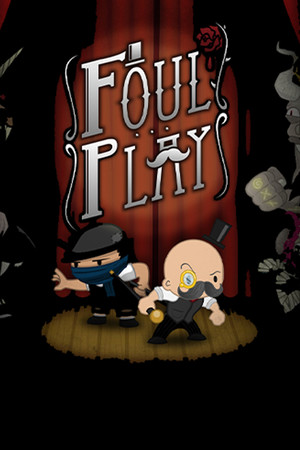
Foul Play
A Victorian brawler with a genuinely clever hook: your health bar IS the audience, and the crowd will boo you off the stage if you forget to perform. Worth picking up if the idea of Castle Crashers with theatre etiquette speaks to you.
GamerScout Verdict
Best for co-op brawler fans who want a clever theatrical gimmick executed with charm, not mechanical depth.
Compare Prices(4 stores)
Every store in this table quotes us in euros, so the EUR figure is the price the seller actually set, not our arithmetic — which is why EUR is also the currency we rank in. We only list an offer here when the store gives us its price in euros, so nothing in this table is a number we invented.
Pick USD, PLN, GBP, CAD or AUD in the header and we convert from EUR at the European Central Bank reference rate — converted amounts are prefixed with ~. Your bank or the store may apply a different rate at checkout. We never hide offers based on where you are: everyone sees this whole table.
We may earn a commission when you buy games through links on this page — at no extra cost to you. It never affects our rankings or verdicts.
Price History
Screenshots & Media
About Foul Play
My first impression of Foul Play was that the concept alone earns it a sit-down: Baron Dashforth, moustachioed daemon-hunter, is retelling his life story as a full stage production, and every fight you play out is a theatrical performance watched by a live crowd. That framing is not decoration. It is the entire mechanical soul of the game. Instead of a health bar, you manage a mood-o-meter that reflects audience engagement. Perform combos, land counters and reversals, chain attacks across enemy types, and the crowd applauds, throws hats, multiplies your score. Take too many hits and the curtain literally falls on you. It is a genuinely inspired twist on the beat-em-up formula, and in its best moments the combination of combo-chasing and crowd-pleasing creates a rhythm that feels closer to a performance score than a brawl. The combat toolkit deepens slowly across the game's twelve Fame ranks. Early on you get basic attacks (cane swings for Dashforth, chimney-sweep swats for Scampwick in co-op), a launch move to juggle enemies airborne, a dodge, and a parry. The parry is the heart of it: a lightning bolt appears above an enemy telegraphing their strike, and a well-timed counter opens up follow-up options. You can hurl the enemy into a group, smash them down into a crowd below, or chain a quick flurry for big combo ticks. Once you hit those mid-game Fame levels and unlock the Showstopper super mode, which temporarily doubles your combo multiplier, the pieces click into something satisfying. In two-player co-op, both players activating Showstopper simultaneously pushes the multiplier to 4x, and throwing enemies back and forth between Dashforth and Scampwick while the crowd loses its mind is the game at its absolute peak. Each of the five plays is broken into acts and capped by a boss, and three per-level challenges unlock equippable charms that meaningfully tweak your build (think things like boosted dodge distance or bonus combo multiplier on counter). It is a lean progression system, but it does reward completionists. Where the game earns its mixed scores is in the stretch between those highs. The combat, for all its theatrical dressing, does not have the mechanical depth to sustain the full campaign without fatigue. Enemy variety is limited, and the parrying system feels looser than the counter-focused combat demands, requiring a separate parry input for each simultaneous attacker rather than a single clean block. Solo play suffers most from this: Scampwick only appears as a narrative presence when you are running alone, and the campaign is clearly designed around two-player synergy. The story, a witty Victorian adventure involving werewolves, vampires, a Vampire King, and a missing father whose monocle ends up on a daemon, is charming enough to carry the pacing gaps, but the dialogue is text-only despite the characters absolutely crying out for voice acting. There are 17 regular stages and five boss levels, running to roughly three to four hours of campaign content, which feels proportionate to the depth on offer. The presentation itself is consistently delightful: enemies in obvious costumes crawl off stage when beaten, stagehands scurry about touching up cardboard backdrops, and the backgrounds are designed to look exactly like practical theatre sets. For a certain kind of player, those production values and the audience-management mechanic are enough to make Foul Play memorable. For players chasing Castle Crashers levels of mechanical variety or Streets of Rage depth, the thinness of the combat system will register before the credits roll. Treat it as a co-op novelty, a short two-player session game with a concept it commits to fully, and it delivers. Expect a genre landmark and it will disappoint. The Scout Team position: the idea deserved a sequel that never came, but what exists is a charming, under-explored oddity that co-op brawler fans will appreciate for a weekend.

Indie & narrative
Tags
System Requirements
Minimum
- OS
- Windows XP with SP3, Windows Vista / 7 / 8
- Memory
- 2 GB RAM
- Graphics
- GeForce 6200 / ATI Radeon X600 w/ 256 MB
- Processor
- 3GHz Intel or AMD CPU
Keep exploring
Community Discussion
Be the first to comment on Foul Play.
Reviews & Ratings
Game Info
- Developer
- Mediatonic
- Publisher
- Epic Games
- Release Date
- Sep 18, 2013