Back to Bed
Gorgeous surrealist puzzle art that runs out of ideas before it runs out of levels. Worth the trip if the aesthetic is your thing, but go in with eyes open about the runtime.
GamerScout Verdict
Built for players who treat art direction as gameplay, striking but shallow, best consumed in one focused sitting.
Compare Prices(8 stores)
Every store in this table quotes us in euros, so the EUR figure is the price the seller actually set, not our arithmetic — which is why EUR is also the currency we rank in. We only list an offer here when the store gives us its price in euros, so nothing in this table is a number we invented.
Pick USD, PLN, GBP, CAD or AUD in the header and we convert from EUR at the European Central Bank reference rate — converted amounts are prefixed with ~. Your bank or the store may apply a different rate at checkout. We never hide offers based on where you are: everyone sees this whole table.
We may earn a commission when you buy games through links on this page — at no extra cost to you. It never affects our rankings or verdicts.
Price History
Screenshots & Media
About Back to Bed
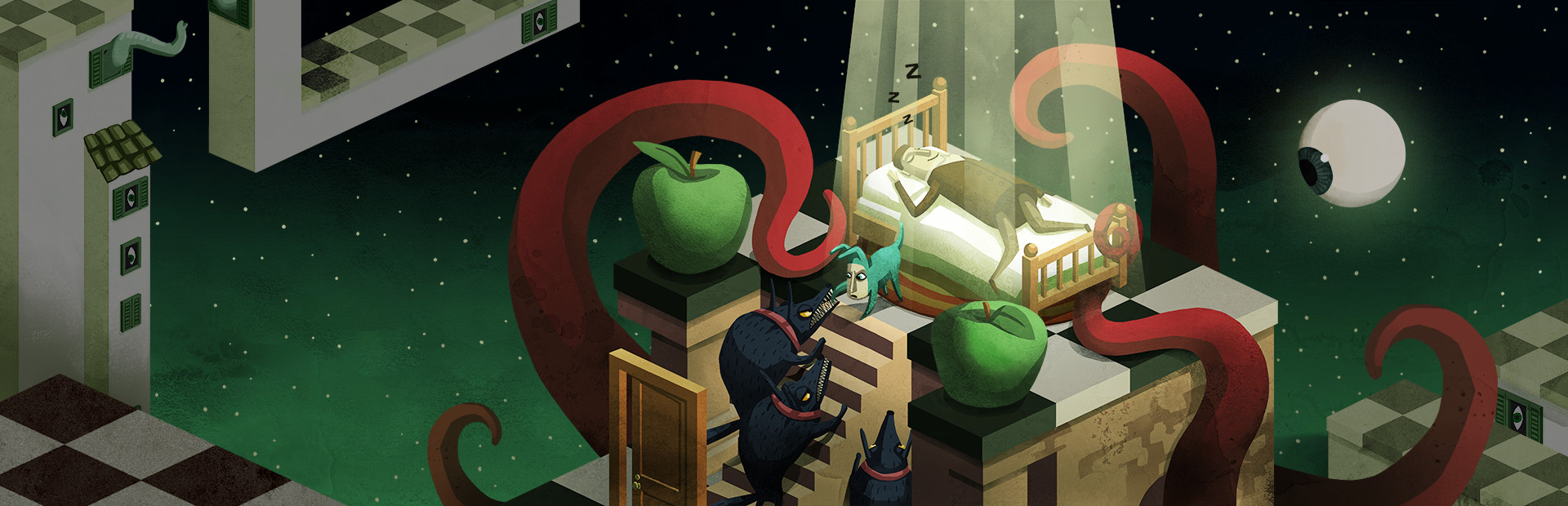
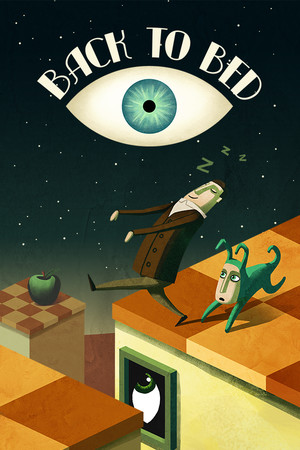
My first hour with Back to Bed felt like someone had handed me a playable M.C. Escher print and asked me to solve it with oversized Magritte apples. That first impression is genuine and worth something. The world Bedtime Digital Games built here, this liminal space where Bob's dreams and a dreary city skyline bleed into each other, has a specific, handcrafted mood that almost nothing else on the platform replicates. The music underlines it perfectly: unhurried, slightly off, like a lullaby played on the wrong instrument. If you are the kind of player who will pause mid-level just to rotate the camera and stare at a melting clock hanging in an impossible corner, this game speaks your language. The core mechanic is stripped bare in the best Sokoban tradition. Bob, a narcoleptic sleepwalker, marches forward without a care and only turns clockwise when he hits an obstacle. You control Subob, his subconscious guardian, a deeply strange four-legged creature whose job is to reposition giant apples as barriers and lay down fish-shaped bridges across gaps. That description sounds absurd because it is, and the game wears the absurdity lightly. The puzzle logic is clean: predict where Bob will go, place your objects, watch the dominoes fall. Early levels are satisfying precisely because the rules are so rigid and the spaces so small that each solution feels crisp. A handful of later stages push into Escher territory properly, where stairways wrap back on themselves and what looks like a wall turns out to be a floor, and those moments are the game at its most alive. Here is where honesty matters. The full run of thirty levels clears in roughly ninety minutes to two hours, and the mechanical vocabulary never really expands past apples and fish bridges. Critics noted consistently that new objects get introduced, used once or twice, then quietly dropped. The alarm-clock enemies that force a full level restart add a thin layer of time pressure, and some later stages genuinely demand quick repositioning rather than pure planning, but the promised complexity mostly stays out of reach. Nightmare Mode revisits all thirty levels with key-collection objectives layered on top, which genuinely reshapes the route planning and is worth your time if the normal run leaves you wanting, but it is still the same thirty rooms. The visual repetition is real. Two worlds, both reading as surreal dreamscape-cityscape hybrids, do not shift their palette or geometry enough to keep the eye interested for a full sitting. The movement controls on PC carry a slight clunkiness when navigating wall-stairs, and placing objects with precision before Bob rounds a corner can tip from frantic-fun into frantic-frustrating depending on your patience. There is also no story to speak of; the handful of cutscenes are static illustrations that gesture at meaning without delivering it. If you come to puzzle games for narrative payoff, this will leave you cold. Still, I defend this one for the audience it is actually made for. Back to Bed is a game that prioritises atmosphere and art direction the way a short film does: it knows what it wants to look and feel like, and it executes that vision without compromise. The handcrafted quality is palpable in every level's geometry. For a low-price, short-session game, that is a meaningful trade. Go in expecting a gallery piece with puzzle mechanics bolted on, not the other way around, and the runtime will feel appropriate rather than stingy.

Indie & narrative
Tags
System Requirements
Minimum
- OS
- Windows XP SP3
- Memory
- 2 GB RAM
- DirectX
- Version 9.0c
- Storage
- 600 MB available space
- Graphics
- Intel Core HD Graphics 3000/4000, NVIDIA 8800 GT, ATI Radeon HD 4850 or better
- Processor
- Intel Core 2 Duo 1.8Ghz or equivalent (lower
- Sound Card
- DirectX 9.0c compatible sound card
Keep exploring
Community Discussion
Be the first to comment on Back to Bed.
Reviews & Ratings
No ratings available
Game Info
- Developer
- Bedtime Digital Games
- Publisher
- Bedtime Digital Games
- Release Date
- Aug 6, 2014