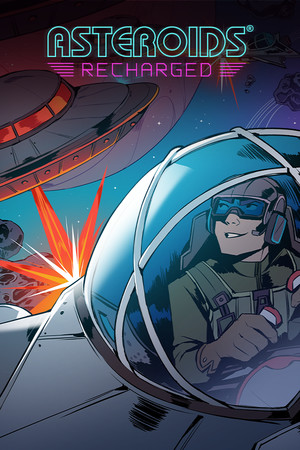
Asteroids: Recharged
If your idea of a good ten minutes is chasing a high score while neon rocks try to kill you, this budget revival delivers. Just don't come in expecting ranked ladders or online lobbies.
GamerScout Verdict
Worth it for budget-priced score-attack sessions with a couch partner; too shallow and too RNG-reliant to hold solo players for long.
Compare Prices(4 stores)
Every store in this table quotes us in euros, so the EUR figure is the price the seller actually set, not our arithmetic — which is why EUR is also the currency we rank in. We only list an offer here when the store gives us its price in euros, so nothing in this table is a number we invented.
Pick USD, PLN, GBP, CAD or AUD in the header and we convert from EUR at the European Central Bank reference rate — converted amounts are prefixed with ~. Your bank or the store may apply a different rate at checkout. We never hide offers based on where you are: everyone sees this whole table.
We may earn a commission when you buy games through links on this page — at no extra cost to you. It never affects our rankings or verdicts.
Price History
Screenshots & Media
About Asteroids: Recharged
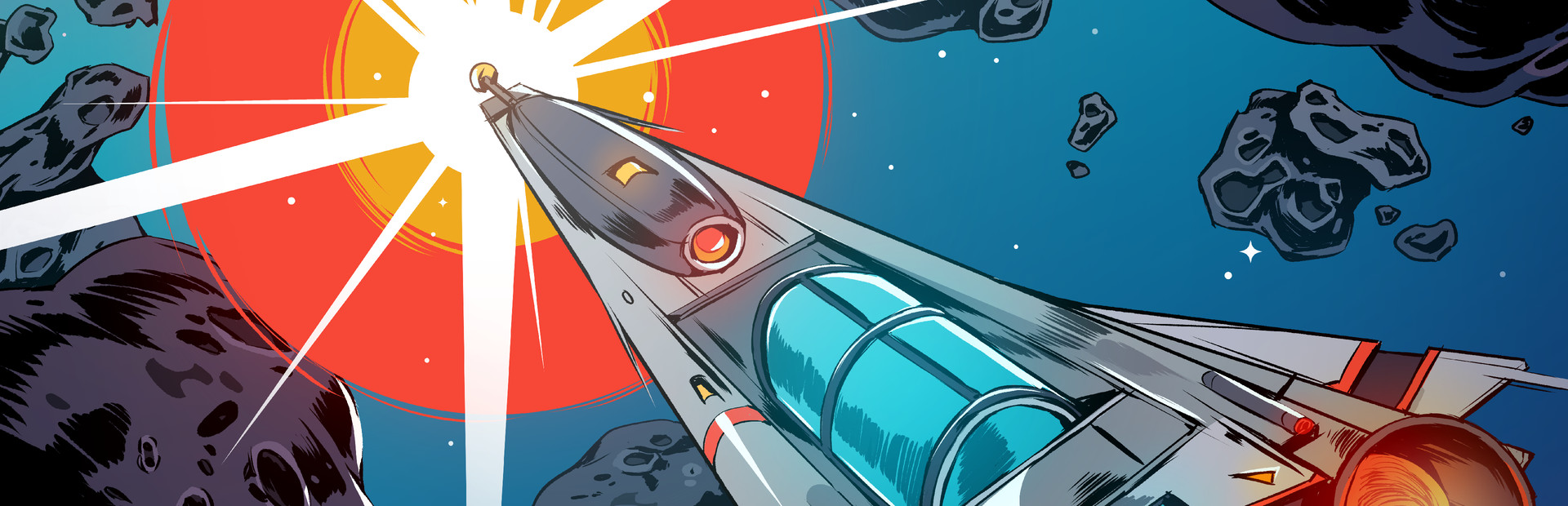
I'll be straight with you: Asteroids: Recharged is about as far from my usual beat as a game can get. No netcode to stress-test, no TTK spreadsheet to build, no ranked ladder to grind into the ground. What it is, is a tight single-screen arcade shooter that takes the 1979 original and coats it in neon particle effects, a synth-forward soundtrack by Megan McDuffee, and a small but purposeful handful of power-ups. If you can make peace with what it is rather than what it isn't, there is something genuinely satisfying here. The core loop is unchanged from the cabinet: you pilot a triangular ship, shoot rocks, the rocks split into smaller faster rocks, UFOs drift in and try to ruin your day. One life, no checkpoints. What Recharged adds are power-ups dropped by downed UFOs, and the roster is decent: spread shots, rail guns, reflector shields, explosive bullets, a black hole shot that pulls nearby debris into a singularity. The problem flagged by most reviewers, and one I find credible, is that power-up drops are heavily RNG-dependent. Some runs shower you with rail guns; others leave you firing a peashooter while a missile-spamming UFO formation ends your best attempt in about three seconds. That randomness is tolerable in the 30 challenge modes, where the objectives are specific enough to give you a target, but in straight arcade mode it means your ceiling is partly out of your hands. The challenge mode is where the game earns its money. Objectives range from score targets and timed survival to challenges built around specific power-ups, and they scale in difficulty quickly enough to keep competent players honest. Local and global leaderboards are attached to each one, which is the closest this game gets to competitive play. Bring a second player for local co-op and the whole thing becomes noticeably easier since you double the firepower, but it also becomes noticeably more fun, which is a fair trade. The screen fills up fast in co-op and the neon chaos is legitimately entertaining to look at. On the technical side, reviewers noted that the PC build ran cleanly under load with no framerate drops even when the screen was packed with debris and particle effects. There were some reported graphical stutter bugs tied to specific power-up activations at launch, so worth keeping an eye on patch notes if you are picking this up later. The visuals keep the vector-style line art of the original but add color-shifting nebula backdrops and particle density that make it feel like a natural step forward rather than a cheap coat of paint. McDuffee's score sits in the background without overpowering the action, which is the right call for this type of game. Who is this for? Primarily: people who played the original and want a clean modern version that respects the source material, fans of sub-ten-minute score-attack sessions, and anyone looking for a low-friction local co-op game that does not require onboarding a new player for forty minutes first. Who should skip it: anyone expecting online multiplayer, a campaign, or a mechanically deep shooter. The content ceiling is real. Once you have cleared the 30 challenges and found your arcade score plateau, the loop starts showing its age. At budget pricing it is a fair exchange. At full price it is a harder sell unless you are specifically here for the nostalgia hit.

Shooters
Tags
System Requirements
Minimum
- OS
- Windows 7
- Memory
- 4 GB RAM
- Processor
- Dual Core +
Keep exploring
Community Discussion
Be the first to comment on Asteroids: Recharged.
Reviews & Ratings
No ratings available
Game Info
- Developer
- Adamvision Studios
- Publisher
- Atari
- Release Date
- Dec 14, 2021