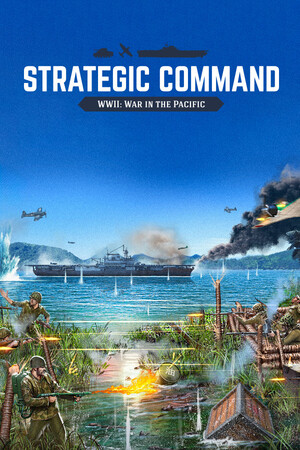
Strategic Command WWII: War in the Pacific
Six campaigns, 36,000 hexes, seven major powers, and supply lines that will haunt your dreams - the Pacific war done at mid-weight grand-strategy depth, no 2,000-hour commitment required.
Veredicto de GamerScout
Best for wargame players who want serious Pacific Theatre depth without a four-digit hour commitment - PBEM extends its lifespan considerably.
Comparar precios(6 tiendas)
Todas las tiendas de esta tabla nos dan el precio en euros, así que la cifra en EUR es el precio que fijó el vendedor, no un cálculo nuestro, y por eso EUR es también la moneda en la que calculamos el ranking. Solo incluimos aquí una oferta cuando la tienda nos da su precio en euros, de modo que ninguna cifra de esta tabla es inventada por nosotros.
Elige USD, PLN, GBP, CAD o AUD en la cabecera y convertimos desde EUR con el tipo de cambio de referencia del Banco Central Europeo — los importes convertidos llevan el prefijo ~. Tu banco o la tienda pueden aplicar un tipo distinto al pagar. Nunca ocultamos ofertas según dónde estés: todo el mundo ve esta tabla completa.
We may earn a commission when you buy games through links on this page — at no extra cost to you. It never affects our rankings or verdicts.
Historial de precios
Capturas y multimedia
Acerca de Strategic Command WWII: War in the Pacific
I have a colour-coded spreadsheet tracking every hex-based Pacific wargame released in the last decade, and the gap between approachable and serious has always been annoyingly wide. Gary Grigsby's War in the Pacific sits at one extreme - doctoral-thesis depth, punishing time sink. Shallow browser-tier stuff sits at the other. Strategic Command WWII: War in the Pacific lands somewhere genuinely useful in between, and that positioning is its biggest selling point. The flagship 1941 Day of Infamy campaign runs 75 turns at ten days per turn, played out across a 36,000-hex map stretching from Burma to the California coastline. You command one of seven major powers - Japan, USA, UK, Australia, China, Communist China, or the USSR - each with meaningfully different resource pressures and unit rosters. The unit roster covers about 21 types, including HQs representing named commanders like MacArthur, marines, engineers, fighters, tactical and strategic bombers, destroyers, cruisers, carriers, battleships, and submarines. Beyond the main campaign, five shorter mini-scenarios range from the 1939 Khalkhin Gol border clash to the Soviet invasion of Manchuria in 1945, which is a smart way to learn the system without committing to the full war. Airfields function as a distinct resource type with their own rules, the Doolittle Raid fires as a scripted event, and Naval Construction (the Seabees mechanic) directly affects how you project naval supply - all of which means the game is modelling Pacific-specific logistics rather than just bolting Pacific unit names onto a generic engine. The AI holds up better than I expected from a Matrix-published wargame at this price tier. Player reviews note it makes moves that genuinely require adjustment - it is not just shuffling counters toward objectives on a fixed script. That said, the real long-term value is PBEM. The Matrix forums have an active opponents-wanted board, and asynchronous play irons out any late-game AI predictability completely. Where the game earns criticism is on the Allied early-game: the "flattened" unit approach means you are managing grand-strategy blobs rather than distinct operational formations, which can feel thin when the Pacific war's character is really defined by operational decisions - which island chain to reinforce, which fleet to commit. The resource management is genuinely engaging; you feel the pressure of extended supply lines across open ocean in a way that makes every commitment feel like a real bet. Submarines feel slightly undertuned to some players, which is worth knowing if you plan to run a Pacific commerce-raiding strategy as Japan. On the mod and scenario side, the Matrix community forum has a dedicated scenario design board, and the game ships with enough scripting tools that modifying existing campaigns is reportedly straightforward even for newcomers to the editor. The series has been running since 2002, so the tooling is mature. Graphically, do not expect anything modern - 2D hex counters and 3D unit sprites that sit firmly in functional-not-pretty territory. That will not bother the target audience at all, but if you are coming from something like Panzer Corps 2 expecting polished visuals, recalibrate now. For someone completely new to hex-and-counter wargames, this is not the first game I would hand them, but it is closer to that than anything else covering this theatre. Start with one of the five mini-campaigns, read the PDF manual selectively, and you will be functional inside a session or two. The complexity sits comfortably between Warplan Pacific and the Grigsby behemoth - detailed enough to respect the subject, tractable enough to finish in a reasonable number of evenings.

Strategy & simulation
Etiquetas
Requisitos del sistema
Mínimos
- OS
- 64-bit Windows 10
- Processor
- 1.5GHZ Processor or Equivalent
- Memory
- 6 GB RAM
- Graphics
- 8mb video memory
- DirectX
- Version 9.0
- Sound Card
- DirectX Compatible Sound Card
Sigue explorando
Community Discussion
Be the first to comment on Strategic Command WWII: War in the Pacific.
Reseñas y valoraciones
No hay valoraciones disponibles
Información del juego
- Desarrolladora
- Fury Software
- Distribuidora
- Matrix Games
- Fecha de lanzamiento
- 18 jul 2024