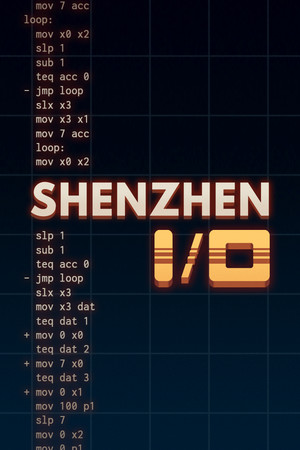
SHENZHEN I/O
Read the manual or stay unemployed: SHENZHEN I/O is a brutally honest programming-puzzle game that will make you feel like a genius when it clicks, and a fraud until it does.
Veredicto de GamerScout
Worth every frustrated hour for puzzle players who can commit to reading documentation before touching the circuit board.
Comparar precios(5 tiendas)
Todas las tiendas de esta tabla nos dan el precio en euros, así que la cifra en EUR es el precio que fijó el vendedor, no un cálculo nuestro, y por eso EUR es también la moneda en la que calculamos el ranking. Solo incluimos aquí una oferta cuando la tienda nos da su precio en euros, de modo que ninguna cifra de esta tabla es inventada por nosotros.
Elige USD, PLN, GBP, CAD o AUD en la cabecera y convertimos desde EUR con el tipo de cambio de referencia del Banco Central Europeo — los importes convertidos llevan el prefijo ~. Tu banco o la tienda pueden aplicar un tipo distinto al pagar. Nunca ocultamos ofertas según dónde estés: todo el mundo ve esta tabla completa.
We may earn a commission when you buy games through links on this page — at no extra cost to you. It never affects our rankings or verdicts.
Historial de precios
Capturas y multimedia
Acerca de SHENZHEN I/O
My first hour with SHENZHEN I/O ended with a 41-page PDF open on my second monitor and genuine respect for anyone who works in embedded systems for a living. Zachtronics built this as a spiritual successor to TIS-100, and where that game handed you a salvaged 1980s machine as an excuse for its austerity, SHENZHEN I/O drops you into a near-future Shenzhen electronics firm with a full cast of coworkers, a corporate email chain, and absolutely zero hand-holding on the actual engineering. The premise is simple: you are a new hire at Shenzhen Longteng Electronics, and clients need circuits built. The execution is anything but simple. Each assignment gives you a canvas on which to place components - microcontrollers, memory chips, logic gates, LCD screens - and wire them together. Then you write code for each microcontroller in a fictional assembly language that borrows heavily from real low-level programming. The smaller microcontroller holds nine instructions, the larger holds fourteen. Every instruction can be conditionally executed using a sleep/test register pair, which means the language is tiny but the decision space is enormous. After you get a solution passing all its test cases, the game shows you a histogram comparing your circuit cost, power consumption, and line count against every other player's solution. That histogram will immediately make you want to rebuild everything from scratch - and that compulsive optimization loop is where most of the serious hours go. Here is the honest pitch for players who are not professional programmers: the game does not actually require prior embedded-systems knowledge. The assembly language is invented specifically for the title and the datasheets in the PDF manual cover everything you need. What it does require is patience with documentation and comfort sitting with an unsolved problem for a while. The early assignments ramp up sensibly - a simple LED controller, a signal timer - and by the time the puzzles get genuinely nasty, you have enough vocabulary to attack them. The community consensus after years of play is that the difficulty is steep but fair, and the satisfaction of cracking a stubborn puzzle is proportional to how long it resisted you. A noted criticism, however, is that late-game puzzles force solutions tight enough that clean, principled code becomes impossible - you end up writing hacks that would fail any code review, which sits uncomfortably against the quasi-realistic framing. Some players find that thrilling; others find it philosophically irritating. Beyond the main campaign, there is a bonus campaign added post-launch with eleven harder puzzles and a math co-processor component, a sandbox mode for building your own devices and games using Lua scripts, Steam Workshop support for sharing custom challenges, and a built-in Mahjong-themed solitaire variant for decompressing between headache-inducing assignments. The narrative layer - delivered entirely through office emails from quirky colleagues - is light but genuinely funny. One assignment has you designing a vape pen for a musician client who subsequently gets arrested; another has a coworker pitching "ghost electronics" using chips of unknown origin. It never becomes a story in the traditional sense, but it gives the puzzle progression a dry, deadpan personality that fits the whole premise perfectly. The one persistent usability complaint worth flagging: on smaller displays, the text is eye-strainingly small and there are limited scaling options, which is a real friction point on laptops. For anyone who already loved TIS-100, SpaceChem, or any other Zachtronics title, this is the most accessible entry point in the lineup - better UI, more character, and a more grounded setting. For a complete newcomer to the genre, the commitment required is real, but the reward structure is designed around that investment. Open the manual, treat the first few puzzles as tutorial content whether the game calls them that or not, and give it four or five sessions before judging the difficulty curve. The histogram alone will keep you returning for one more optimization pass long after the campaign is finished.

Strategy & simulation
Etiquetas
Requisitos del sistema
Mínimos
- OS
- Windows Vista / 7 / 8 / 10
- Memory
- 4 GB RAM
- DirectX
- Version 11
- Storage
- 450 MB available space
- Graphics
- 1366 x 768
- Processor
- 2.0 GHz
Recomendados
- OS
- Windows Vista / 7 / 8 / 10
- Memory
- 4 GB RAM
- DirectX
- Version 11
- Storage
- 450 MB available space
- Graphics
- 1920 x 1080
- Processor
- 2.0 GHz
Sigue explorando
Community Discussion
Be the first to comment on SHENZHEN I/O.
Reseñas y valoraciones
No hay valoraciones disponibles
Información del juego
- Desarrolladora
- Zachtronics
- Distribuidora
- Zachtronics
- Fecha de lanzamiento
- 17 nov 2016