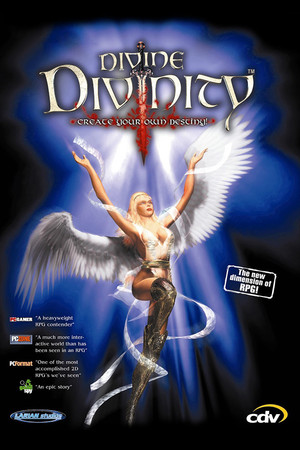
Divine Divinity
Larian's origin story, before BG3 made them gods: a sprawling solo CRPG that blends Diablo's loot loop with branching quests and a world that rewards the curious over the impatient.
Veredicto de GamerScout
Best for RPG fans tracing Larian's roots or anyone who wants a dense solo CRPG with genuine build flexibility and patient appetite for pacing dips.
Comparar precios(4 tiendas)
Todas las tiendas de esta tabla nos dan el precio en euros, así que la cifra en EUR es el precio que fijó el vendedor, no un cálculo nuestro, y por eso EUR es también la moneda en la que calculamos el ranking. Solo incluimos aquí una oferta cuando la tienda nos da su precio en euros, de modo que ninguna cifra de esta tabla es inventada por nosotros.
Elige USD, PLN, GBP, CAD o AUD en la cabecera y convertimos desde EUR con el tipo de cambio de referencia del Banco Central Europeo — los importes convertidos llevan el prefijo ~. Tu banco o la tienda pueden aplicar un tipo distinto al pagar. Nunca ocultamos ofertas según dónde estés: todo el mundo ve esta tabla completa.
We may earn a commission when you buy games through links on this page — at no extra cost to you. It never affects our rankings or verdicts.
Historial de precios
Capturas y multimedia
Acerca de Divine Divinity
I keep coming back to Divine Divinity whenever someone asks me where Larian Studios actually came from, and the answer is right here - a rough-edged, wildly ambitious action-RPG from the early 2000s that somehow predicted almost everything the studio would become famous for. This is not a museum piece you tolerate for historical context. It is a genuinely playable game with a personality of its own, even if that personality occasionally insists on padding the evening with filler encounters. The setup is your standard Chosen One arc - you play Lucian, a Marked One in the land of Rivellon tasked with uniting seven races and stopping the Black Ring cult from summoning a Lord of Chaos - but the world wrapped around that premise is the real draw. Rivellon is dense in the best way. Environmental interactivity that was unusual for its era lets you douse candles, brew potions from beehives and herbs, eat food to restore health (with an actual stuffed-stomach penalty if you overdo it), and click on almost any object with the reasonable expectation that something interesting will happen. The atmosphere, backed by a genuinely strong soundtrack, holds up in a way that a lot of its contemporaries do not. Character building sits in a satisfying middle zone between Diablo's randomised loot slot-machine and a proper CRPG's skill tree. You pick from three archetypes at the start - Warrior, Mage, or Survivor - but class is really just a starting nudge. Warriors lean into melee and get a whirlwind AoE attack, Mages open with spells like Meteorstrike and teleportation, and Survivors cloak in shadows and favour daggers and poison-based builds. The clever part is that skills are not class-locked: a sword-wielding mage with Heaven's Blessing stacked on top is a completely viable path, and a Survivor running Curse alongside elemental debuffs plays totally differently from a stealth-archer version of the same class. The late-game Path of the Divine skills, unlocked through the main quest, add another layer - though some of them (looking at you, Divine Eye and Translocate) are famously half-baked even in the remastered version. Combat runs in real-time with pause, which means you can breathe, switch skills mid-fight, and actually think before a boss deletes you. Where the game earns the roast is pacing. The world is enormous - advertised as 100-plus hours - and not all of that time is well-spent. Stretches of the mid-game lean hard on repetitive enemy encounters that exist mainly to burn through your stamina bar rather than test your build. The branching conversation trees and NPC disposition system are charming but nowhere near the reactive depth Larian would later achieve. You feel the seams of an ambitious studio that had not yet fully solved the problem of keeping every hour as interesting as the first ten. The UI, even in its remastered form, reflects its age: skill hotkeys require some patience to wire up, and inventory management at item-hoard scale is a minor chore. For players who came to Larian through Original Sin 2 or BG3 and want to trace the lineage, this is the cleanest starting point. The Rivellon mythology, the tactile world-building, the refusal to make a single flat combat class - it is all here in embryonic form. For players who simply want a meaty solo RPG with real exploration and a loot loop that stays engaging deep into the runtime, it holds up better than its reputation suggests. Just accept that some of those hundred hours will be more chore than adventure.
RPGs
Etiquetas
Requisitos del sistema
Mínimos
- OS
- Windows XP
- Sound
- DirectX compatible
- Memory
- 256 MB RAM
- DirectX®
- DirectX 9.0c
- Processor
- Pentium IV 1 GHz
- Video Card
- DirectX compatible 3D card
- Hard Disk Space
- 1.7 GB
Sigue explorando
Community Discussion
Be the first to comment on Divine Divinity.
Reseñas y valoraciones
Información del juego
- Desarrolladora
- Larian Studios
- Distribuidora
- Larian Studios
- Fecha de lanzamiento
- 5 jul 2012