W.A.N.D. Project
If you've ever wanted to redesign your entire attack chain mid-run while pixelated alien spiders swarm a neon Tokyo, W.A.N.D. Project has a very specific answer for you - and it's genuinely more interesting than the genre's crowded shelf suggests.
GamerScout Verdict
Worth it for Survivors-likers who want a crafting puzzle attached to their bullet-hell, less so if thin rosters kill your motivation fast.
Compare Prices(7 stores)
Every store in this table quotes us in euros, so the EUR figure is the price the seller actually set, not our arithmetic — which is why EUR is also the currency we rank in. We only list an offer here when the store gives us its price in euros, so nothing in this table is a number we invented.
Pick USD, PLN, GBP, CAD or AUD in the header and we convert from EUR at the European Central Bank reference rate — converted amounts are prefixed with ~. Your bank or the store may apply a different rate at checkout. We never hide offers based on where you are: everyone sees this whole table.
We may earn a commission when you buy games through links on this page — at no extra cost to you. It never affects our rankings or verdicts.
Price History
Screenshots & Media
About W.A.N.D. Project
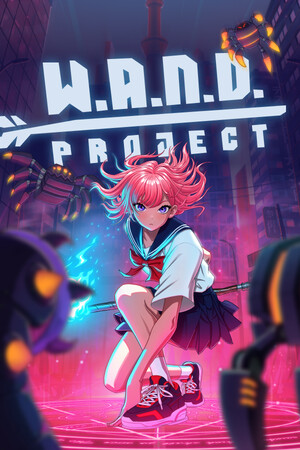
I went into W.A.N.D. Project expecting a Vampire Survivors reskin with a coat of anime paint, and came out genuinely absorbed by its spell-crafting board in a way I didn't predict. The core loop is familiar on the surface - move your sorceress, dodge waves of alien creatures, let your wand fire automatically - but the layer sitting underneath is where this game actually lives. Between each round you're shunted into a grid-based crafting interface where you assemble spells from interchangeable modules: Casters that define cooldown logic (fire on a timer, fire when idle, fire on dash), Spawners that determine the projectile type (fireballs, lightning, sonic arrows), and Effects that stack modifiers on top. The modules physically connect via input and output arrows on a shared board, and you rotate pieces to make chains fit. It's a tiny puzzle inside a bullet-hell, and finding a configuration that breaks the intended balance is satisfying in a way that passive item selection in the genre rarely matches. The visual identity earns respect. The main arena runs in a low-resolution, high-pixel-density 3D style that reads as deliberately stylised rather than technically humble, and the three playable sorceresses - Yumi being the first you unlock - are rendered in clean anime portrait art during dialogue sequences, creating a striking contrast with the chunky battlefield beneath. The spellcrafting UI leans into a neon-on-black aesthetic that feels like a retro circuit board, which suits the sci-fi Tokyo setting. The soundtrack shifts gears hard between the calm lo-fi texture of the crafting menus and the louder, pressure-forward music of active levels. That transition is abrupt rather than graceful - the music simply cuts - and it's one of several small production rough edges the game hasn't quite smoothed out yet. The criticisms are real and worth knowing before you spend money. Steam user reception sits in mixed territory, and the concerns that surface most often are fair ones: the number of playable characters (three) and wands (four) feels thin for a genre where Vampire Survivors grew its content over years. Arena sizes are compact, which limits how dramatically runs differentiate visually. Enemy readability under large spell-effect explosions can degrade into pixel noise, which is a legitimate frustration when you're trying to track your dodge window. Some reviewers noted the game still carries an early-access energy despite shipping as a full release. The inability to pause and resume a run mid-session has also drawn specific complaints from PC players. That said, the crafting system is doing something structurally different enough that I'd push back on simple dismissal. Over one hundred magical elements exist to combine, and the three-axis customisation of character, wand choice, and live spell board means each run offers real decision branches rather than a lottery. Permanent meta-progression upgrades carry between runs and shorten the ramp without defanging the difficulty. Each map rotates enemy types and objectives, which nudges you toward different build priorities across playthroughs. An "overtime" phase at the end of each level removes cooldowns and floods the screen with your full chain firing continuously - it's a brief cathartic moment that smartly rewards a well-built board. First-time completion runs land around ten hours; replaying with alternate sorceresses and wands pushes that further. Who is this for, practically speaking. Survivors-like fans who have exhausted the genre's bigger names and want something that asks more of them between fights. Players who enjoy the puzzle of min-maxing a system rather than passively collecting power. Anyone drawn to mahou-shojo aesthetics applied to an alien invasion premise will find genuine personality here. If thin content rosters frustrate you or you need a big map to feel like you're going somewhere, the cracks will show faster.

Indie & narrative
Tags
System Requirements
Minimum
- OS
- Windows 10/11 (64 bit)
- Memory
- 8 GB RAM
- Storage
- 2 GB available space
- Graphics
- NVIDIA GeForce GTX 660 or AMD Radeon R7 265
- Processor
- AMD Ryzen 3 3100 or Intel i3 12100
Recommended
- OS
- Windows 10/11 (64 bit)
- Memory
- 8 GB RAM
- Storage
- 2 GB available space
- Graphics
- GeForce 2060 or better
- Processor
- AMD Ryzen 5 3600 or Intel i5 12400
Keep exploring
Community Discussion
Be the first to comment on W.A.N.D. Project.
Reviews & Ratings
No ratings available
Game Info
- Developer
- The Knights of Unity
- Publisher
- Untold Tales
- Release Date
- Nov 29, 2024