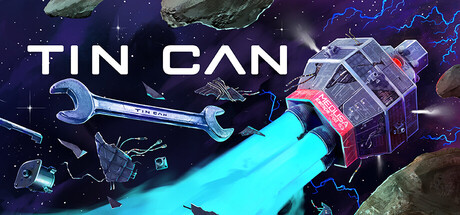
Tin Can: Escape Pod Simulator
A claustrophobic first-person survival sim where your only tools are an in-pod technical manual, your hands, and a ticking clock. Die, learn, repeat until oxygen stops being optional.
GamerScout Verdict
Best for players who treat a death summary screen as a debrief and find joy in tracing a cascade failure back to one blown fuse.
Compare Prices(1 stores)
Every store in this table quotes us in euros, so the EUR figure is the price the seller actually set, not our arithmetic — which is why EUR is also the currency we rank in. We only list an offer here when the store gives us its price in euros, so nothing in this table is a number we invented.
Pick USD, PLN, GBP, CAD or AUD in the header and we convert from EUR at the European Central Bank reference rate — converted amounts are prefixed with ~. Your bank or the store may apply a different rate at checkout. We never hide offers based on where you are: everyone sees this whole table.
We may earn a commission when you buy games through links on this page — at no extra cost to you. It never affects our rankings or verdicts.
Price History
Screenshots & Media
About Tin Can: Escape Pod Simulator
Tin Can is a first-person survival simulator built around a single, brutally honest premise: you escaped your exploding transport ship, but the escape pod you landed in is barely better. There is no campaign, no progression tree, no level-up screen. Each run drops you into a cramped metal cylinder drifting through space, and you survive for as long as you can figure out what is failing before it kills you. The game tracks O2, CO2, cabin pressure, temperature, and radiation as physically simulated values, not as abstract meters draining in the background. When oxygen drops, you breathe harder and your vision blurs, not because a health bar hit 30%, but because hypoxia is modeled with real physiological thresholds. That distinction is the entire soul of the game. The pod itself is the puzzle. Over a dozen interconnected components, from fuses and air filters to electrical connectors and oxygen canisters, each capable of failing independently and cascading into other systems. A defective button might not register a press. A faulty electrical connector might starve the emergency lights. Diagnosing a failure means cross-referencing error codes against the physical manual sitting in the pod, then tracing the problem upstream to its root cause, then dismantling, swapping, or fabricating a fix using a repair device that feels like a microwave crossed with a component bench. The whole sequence is closer to a systems-troubleshooting exercise than a reflex challenge, which is exactly why it holds attention. Events are procedurally generated, so asteroid fields, overheating from stellar proximity, and hull breaches hit at different moments each run, meaning pattern memorization only gets you so far. The community has noted that the real expertise is understanding the logic of the system, not scripted solutions, and that knowledge compounds satisfyingly across deaths. The tutorial covers four structured tasks and is worth completing twice, because the gap between understanding a repair in calm conditions and executing it with blurring vision and a sparking panel is enormous. Replayability leans entirely on that knowledge accumulation loop. There is no RPG layer, no unlocks, no meta-progression currency. Your only asset is what you remember from the last run, checked against a post-death summary screen that shows time survived, cause of death, and resource states. For a certain kind of player that loop is addictive. For everyone else, the absence of any long-term carrot will feel like a hard stop. The limits are real and worth naming. There is no story mode or campaign, so players who need narrative scaffolding to stay invested will bounce quickly. The game functions best in short sessions, twenty to thirty minutes at a time, rather than extended marathons. Community feedback has flagged the manual's error-code lookup as friction that can feel unfair under time pressure, and a VR mode with component-spawning bugs has frustrated some users. The game is also genuinely niche: it will click immediately for people who enjoy engineering problems, systems thinking, and iterative failure, and it will feel opaque and punishing to everyone else. No mod ecosystem exists to widen that window. For the right player, though, Tin Can does something almost no other sim attempts. It collapses the complexity of a full vessel simulation into a space the size of a wardrobe, and makes every individual component matter. The decision-making is tight, the stakes are tactile, and each death teaches you something specific. That is rarer than it sounds.

Strategy & simulation
Tags
System Requirements
Minimum
- Memory
- 8 GB RAM
- Storage
- 2 GB
- Graphics
- GTX 960
- Processor
- Core I5
- System requirements
- Windows 7
Keep exploring
Community Discussion
Be the first to comment on Tin Can: Escape Pod Simulator.
Reviews & Ratings
No ratings available
Game Info
- Developer
- Tin Can Studio
- Publisher
- Tin Can Studio
- Release Date
- Oct 30, 2020