Tin Can
If the idea of cross-referencing a technical manual while your CO2 scrubber fails and an asteroid field punches through your hull sounds like fun, Tin Can has your number. Everyone else will asphyxiate in under six minutes and quit.
GamerScout Verdict
Best for sim fans who read manuals before touching buttons and don't mind dying twenty times to master a four-wall classroom.
Compare Prices(6 stores)
Every store in this table quotes us in euros, so the EUR figure is the price the seller actually set, not our arithmetic — which is why EUR is also the currency we rank in. We only list an offer here when the store gives us its price in euros, so nothing in this table is a number we invented.
Pick USD, PLN, GBP, CAD or AUD in the header and we convert from EUR at the European Central Bank reference rate — converted amounts are prefixed with ~. Your bank or the store may apply a different rate at checkout. We never hide offers based on where you are: everyone sees this whole table.
We may earn a commission when you buy games through links on this page — at no extra cost to you. It never affects our rankings or verdicts.
Price History
Screenshots & Media
About Tin Can
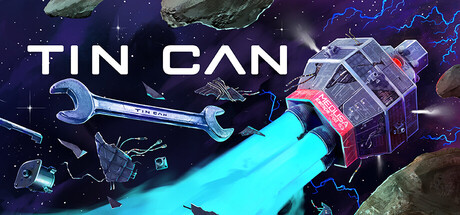
My first instinct when loading Tin Can was to treat it like a grand-strategy game: read the documentation, understand the systems, build a mental model before touching anything. That instinct is exactly right, and it separates players who will love this from players who will refund it inside an hour. Tin Can is a first-person escape-pod survival simulator where every run begins with sixty seconds of frantic looting aboard a doomed colony ship, followed by however long you can keep a barely functional Medusa-class pod alive until rescue arrives or, far more often, until you do not. The systems model is the game's real achievement. Oxygen, CO2, cabin pressure, temperature, and radiation are all simulated without abstract health bars or percentage meters you can game by rote. Instead the pod communicates through physical symptoms: hypoxia blurs your vision and slows your limbs before you black out; overheating triggers cascading component failures. Every subsystem is built from interchangeable parts, fuses, air filters, data connectors, oxygen cylinders, and to fix one thing you frequently have to cannibalize another. Deciding whether to rob the lighting circuit to keep the CO2 scrubber running is exactly the kind of triage decision I live for. The comparison reviewers reach for, FTL: Faster Than Light, is apt at the mechanical level, though Tin Can swaps FTL's bird's-eye abstraction for sweaty hands-on physicality inside a broom-closet-sized hull. The mode structure is sensible for newcomers. Four dedicated tutorial tasks walk you through the core component logic, and a sandbox mode lets you poke at systems without a death clock ticking. Rescue mode offers timed scenarios ranging from surviving six minutes up to thirty before extraction, which makes the difficulty curve accessible to people who have never touched a sim like this. Ranking mode is the endgame: pure survival against procedurally generated cosmic events including asteroid fields, electrical nebulae, and near-star overheating, until the pod finally wins. The procedural failure generation means runs feel distinct even if the pod layout never changes, though critics are right that the environmental variety is thin and the setting never expands beyond those four walls. The honest criticism, and it is a real one, is that Tin Can tips from deliberate system management into frantic plate-spinning faster than the tutorial implies. Veteran players internalize the component maps and error codes to the point where consulting the manual mid-run means you have already lost. New players will die repeatedly from causes they cannot yet diagnose, and the steep knowledge gradient deters anyone who wanted a thoughtful Apollo 13 experience over a speed-repair arcade loop. Visually the game is functional rather than impressive, a generation behind peers of similar scope, and the VR mode has historically shipped in rough condition. For PC, the mouse-and-keyboard controls are noticeably tighter than the console ports, so this is a context where platform matters. That said, the Steam community sits at a strong 85 percent positive rating, and the satisfaction curve is real. Each death teaches you something concrete: which fuse protects the oxygen generator, what the radiation alarm code actually means, how long you can delay fixing the hull breach before pressure drops critical. Learning through failure here feels earned rather than arbitrary. If you approach Tin Can the way you approach a new Paradox title, absorb the manual first, run a few sandbox sessions, then graduate to timed Rescue scenarios, the click of competence arrives faster than the early chaos suggests. It is a niche game, decisively so, but within that niche it does something almost no other title attempts.

Strategy & simulation
Tags
System Requirements
Minimum
- OS
- Windows 10
- Memory
- 8 GB RAM
- Storage
- 12 GB available space
- Graphics
- GTX 970 or equivalent
- Processor
- Core I7
Keep exploring
Community Discussion
Be the first to comment on Tin Can.
Reviews & Ratings
No ratings available
Game Info
- Developer
- Tin Can Studio
- Publisher
- Tin Can Studio
- Release Date
- May 12, 2022