The Sun and Moon
One mechanic, ruthlessly perfected across 150+ levels: what happens when a solo dev treats gravity as a suggestion rather than a law.
GamerScout Verdict
Worth it for precision platformer fans who can read a level's physics like sheet music; everyone else may bounce off the wall.
Compare Prices(4 stores)
Every store in this table quotes us in euros, so the EUR figure is the price the seller actually set, not our arithmetic — which is why EUR is also the currency we rank in. We only list an offer here when the store gives us its price in euros, so nothing in this table is a number we invented.
Pick USD, PLN, GBP, CAD or AUD in the header and we convert from EUR at the European Central Bank reference rate — converted amounts are prefixed with ~. Your bank or the store may apply a different rate at checkout. We never hide offers based on where you are: everyone sees this whole table.
We may earn a commission when you buy games through links on this page — at no extra cost to you. It never affects our rankings or verdicts.
Price History
Screenshots & Media
About The Sun and Moon
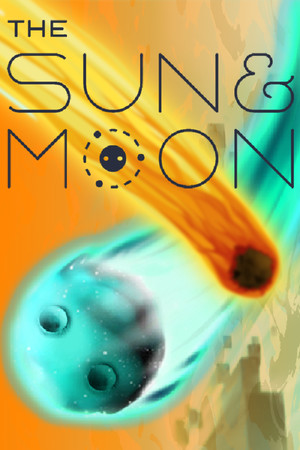
I keep coming back to the question of how much a single idea can carry a game. Daniel Linssen answered it in 48 hours, and then spent the months after Ludum Dare 29 proving the answer was "quite a lot." The core of The Sun and Moon is simple enough to sketch on a napkin: press a button to phase into the ground, and while you're inside it, gravity flips. Momentum carries through, so diving from height flings you upward when you exit, like a stone skipped in reverse. That's it. That's the whole machine. And yet watching that machine unfold across more than 150 levels, teaching you things about itself without a single text prompt, is genuinely one of the quieter pleasures indie platformers have offered in recent memory. The level structure is non-linear, built around a solar-system-style map where clearing a stage opens adjacent ones rather than forcing you down a corridor. That design choice matters more than it sounds. When you're stuck on a stage, the architecture of the map gives you a way out: circle around, try something else, return later with momentum (in both the literal and psychological sense) and the solution often clicks. The medal system pulls in the other direction, demanding crescent, full-moon, and sun-tier completion times that escalate from "tricky" to "please demonstrate inhuman reflex precision." Casual finishers will reach the credits. Speed-runners and completionists will lose weeks to the leaderboards. Both audiences are genuinely served. The presentation is intentionally spare. Clean pixel art, high contrast, no narrative scaffolding, no characters. Some reviewers have found this austere to the point of coldness, and there's truth in that. Stages can start blending together in the mid-game, especially when the difficulty ramps before the visual variety does. The soundtrack by Dubmood grows and evolves as you progress through systems, which is the one element of the game that quietly does emotional heavy-lifting the visuals don't attempt. There is also a legitimate difficulty wall: one-hit spikes, bottomless drops, and disappearing platforms that can feel punishing before you've fully internalized the physics. The game is always fair in principle, but it does not slow down to check on you. Where The Sun and Moon earns its place is in those moments where everything compounds: a long falling arc into a wall, a gravity-reversed exit that threads between two spike columns, a precise landing on a distant platform you weren't sure you could reach. The rhythm that emerges when you play a level well feels almost musical, like the mechanic was designed to produce a specific sensation and the levels are arrangements written around it. For the right player, that sensation becomes the whole reason to be here. For someone who wants context, story, or escalating mechanical variety, the game will feel like a very clever design exercise that ran out of things to say. This is a game that knows exactly what it is and commits completely. It will not apologize for its difficulty, its minimalism, or its refusal to explain itself. I find that kind of conviction genuinely rare, and genuinely worth supporting.

Indie & narrative
Tags
System Requirements
Minimum
- OS
- Windows XP / Vista / 7 / 8
- Memory
- 1 GB RAM
- DirectX
- Version 9.0c
- Storage
- 50 MB available space
- Graphics
- Dedicated graphics card 4 years or younger
- Processor
- 2.5 GHz
Keep exploring
Community Discussion
Be the first to comment on The Sun and Moon.
Reviews & Ratings
No ratings available
Game Info
- Developer
- Daniel Linssen
- Publisher
- Daniel Linssen
- Release Date
- Nov 14, 2014