Leap Year
What looks like a joke about bad jumping is actually one of the most quietly ingenious puzzle-platformers in recent indie memory. Two hours that will rearrange how you think about falling.
GamerScout Verdict
Worth every minute for puzzle-platformer fans who can tolerate a slow-burn opening and resist the urge to look anything up.
Compare Prices(2 stores)
Every store in this table quotes us in euros, so the EUR figure is the price the seller actually set, not our arithmetic — which is why EUR is also the currency we rank in. We only list an offer here when the store gives us its price in euros, so nothing in this table is a number we invented.
Pick USD, PLN, GBP, CAD or AUD in the header and we convert from EUR at the European Central Bank reference rate — converted amounts are prefixed with ~. Your bank or the store may apply a different rate at checkout. We never hide offers based on where you are: everyone sees this whole table.
We may earn a commission when you buy games through links on this page — at no extra cost to you. It never affects our rankings or verdicts.
Price History
Screenshots & Media
About Leap Year
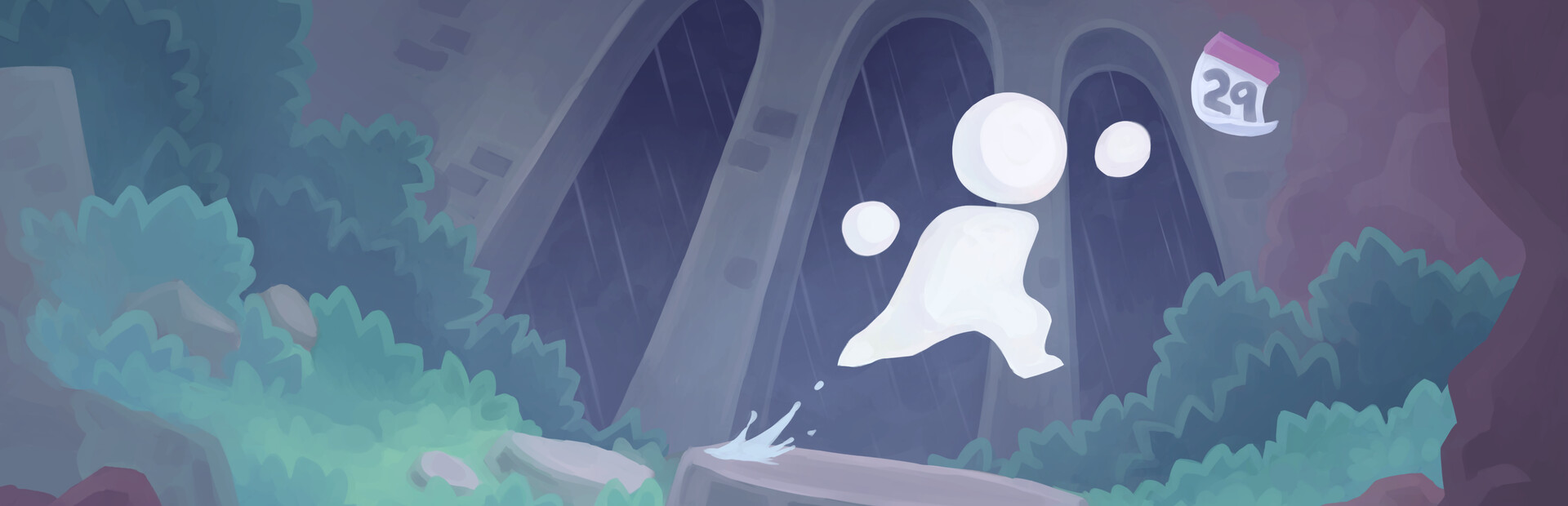
I went in expecting a charming oddity and came out genuinely floored. The premise sounds almost throwaway: collect the pages of a February calendar scattered across a hand-drawn world, except your tiny blocky character can jump roughly twice their own height but only survive a fall of one. That single, absurd rule is the seed for everything, and Daniel Linssen and Sokpop Collective let it grow without ever stopping to explain themselves. The opening rooms are designed to make you feel incompetent, and that is completely intentional. Jumping across flat ground sends your character on what one reviewer aptly called a parabolic flight of death. Slopes and single-block steps become your best friends. You will faceplant. You will groan. You will also start paying very close attention to the architecture, because every room in this game's 40-plus screens has been placed with purpose. Weird symbols on walls, oddly-shaped empty rooms, peculiar ledge configurations: none of it is decorative. The game has been called a "Knowledgevania" by its own community, and that label fits better than any genre tag I could reach for. Progress is gated not by keys or power-ups but by understanding, by the slow accumulation of physical and mechanical literacy that the world quietly teaches you through your own failures. The secrets layer in a way that genuinely surprised me. Going back to early rooms with new knowledge feels like lifting a veil: clues that were invisible become obvious, and the level design rewards the backtrack rather than punishing it. There is a moment involving what falling actually does to your character that I will not spoil, because its discovery is the heart of the whole experience. What the game has led you to believe about yourself, and then quietly contradicts, is the kind of design move that stays with you. One critic drew a comparison to Outer Wilds in terms of how irreversible that first discovery is, and it is not an overreach. The hand-drawn visual style sits somewhere between a Flash animation notebook and a schoolroom diagram, lo-fi enough to feel personal and precise enough to communicate intent. The six-track soundtrack shifts between the game's distinct biomes without ever overstaying itself: quiet, slightly peculiar, the kind of music that knows it is there to support discovery rather than announce itself. The whole package clocks in at roughly two hours on a first run, with speed-runners reportedly completing it in under twenty minutes once the mechanics are fully internalized. There is also a DLC expansion called Leap Year: March that adds over fifty new rooms and around four more hours for players who want to stay in this world longer. If I have a reservation it is the one note of frustration some players report with the snow section, which leans harder on precision than the rest of the game and can feel like the design slipping out of its own gentle rhythm for a moment. A minor complaint against a near-immaculate whole. This is a game that knows exactly what it is, knows exactly when to end, and trusts you completely, which is rarer than it has any right to be.

Indie & narrative
Tags
System Requirements
Minimum
- OS
- Windows 7+
- Memory
- 1 GB RAM
- DirectX
- Version 10
- Storage
- 50 MB available space
- Graphics
- GPU with at least 256MB of VRAM
- Processor
- 3.0 GHz Dual Core CPU
Keep exploring
Community Discussion
Be the first to comment on Leap Year.
Reviews & Ratings
No ratings available
Game Info
- Developer
- Daniel Linssen
- Publisher
- Daniel Linssen
- Release Date
- Jun 13, 2024