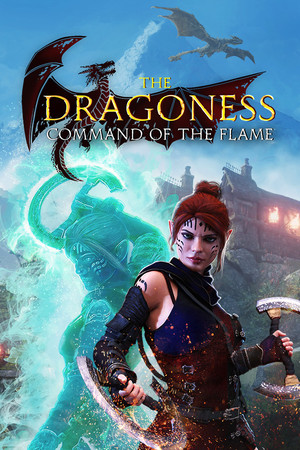
Compare The Dragoness: Command of the Flame prices across 50+ stores and find the best deal. Developed by Crazy Goat Games. Published by PQube. Released on 9/1/2022. Available on PC. Genres: RPG, Strategy. Metacritic score: 59/100.
If your HOMM backlog is exhausted and you need a turn-based fix with roguelite structure, Dragoness scratches the itch, but don't expect it to replace the classics it borrows from.
I keep a short list of games I call 'spreadsheet-worthy', titles where the decision surface is deep enough to justify tracking builds, unit compositions, and economy turns. The Dragoness: Command of the Flame flirted with making that list and then, frustratingly, pulled back just before earning a spot.
The structural pitch is genuinely interesting. Three interlocking systems, overworld exploration on a turn-limited tile grid, city rebuilding at your capital Níwenborh, and small-scale tactical combat, cycle in a roguelite loop where your Commander's skills and army reset at the start of every mission. Meta-progression comes from the city: structures like the Forge, the Oracle, and the Mercenary Camp carry over between runs, expanding your starting options each time you set out. On paper, that produces the kind of compounding decision-making I live for. In practice, the reset mechanic is the game's most divisive design choice. Starting each mission with a randomised Revival Spell and rebuilding your party from scratch can feel like meaningful variation one run and pure tax on your time the next. Players who treat each mission as a self-contained puzzle will tolerate it better than anyone expecting persistent hero growth.
Combat is where the math gets rougher. Battles are six-units-a-side affairs on flat, mostly featureless boards. The tactical logic, concentrate fire to eliminate enemies one at a time, exploit the six schools of magic (Necromancy, Stealth, Restoration, Manoeuvres, Field Impact, Strength) for spell synergies, manage the binary health-and-shield stat system, is sound in outline. <br>The problem is execution: unit movement ranges are short enough that early turns are largely wasted marching, animations are slow, and the maps cycle through the same visual templates with minimal terrain variation. Most reviewers converged on the same complaint: the overworld exploration loop is the genuinely engaging part, and combat starts to feel like an obstacle between resource runs rather than the main event. You can speed animations up, which helps, but it doesn't fix the underlying sameness of the arenas across biomes, Grassholt forests, Frosthyll peaks, Watan deserts, Zildarya blight zones, that ought to feel distinct but largely play identically.
The city-building layer is lighter than the genre pedigree implies. Building and upgrading structures at Níwenborh to unlock new beast types, artefact slots, and Commander talents is satisfying in the early hours. Late-game, several unlocks stop mattering, and the capital never quite reaches the strategic weight of a Heroes of Might and Magic town screen where every structure decision carries real campaign cost. The artefact system, looting shards on the overworld, smelting or combining them at the Ancient Forge, adds some build variety, but the palette of options is narrow enough that most runs converge on similar loadouts once you understand which synergies work. There is a genuinely odd and charming unit in Natiq, your guide and battle pangolin companion, though his commentary gets repetitive faster than the developers probably intended.
For a complete newcomer to the HOMM-derived subgenre, this is actually a reasonable entry point. The tutorial explains its systems with patience, the difficulty on normal is forgiving enough to absorb mistakes, and the 'just one more turn' pull is real despite the game's rough edges. Veterans of Heroes, King's Bounty, or Age of Wonders will spot every shortcut and feel the missing depth acutely. The 59 Metacritic score and Mixed Steam rating (67% positive across a thin review pool) paint an accurate picture: there is a functional, occasionally engaging game here, but one that consistently stops short of what its own concept promises.
Diego, Scout Team