
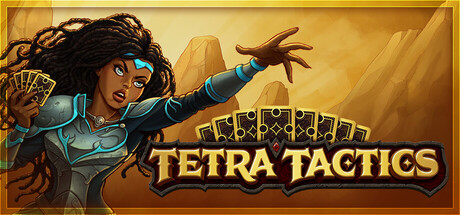
Compare Tetra Tactics prices across trusted key stores and find the best deal. Developed by Jabari Alii, Adrian Marple, manadream. Published by indie.io. Released on 4/9/2024. Available on PC. Genres: Indie, Strategy.

If Triple Triad ever deserved a full roguelite treatment, this is the closest anyone has come. Roughly 78% of Steam reviewers agree, though the review count is small enough to take that with a grain of salt.

My first instinct when I saw a Triple Triad-inspired roguelite was mild skepticism. Card minigames get expanded into full releases constantly, and most of them forget to add a reason to keep playing past hour two. Tetra Tactics earns its running time by treating the 4x4 grid as a genuine strategy puzzle rather than a nostalgia delivery vehicle. The core loop is tighter than it sounds: you place cards on a 16-square board, adjacent enemy cards flip ownership when your numbers beat theirs, and the player with majority control when the board fills wins. That base is straight from Final Fantasy VIII's Triple Triad, but the roguelite scaffolding layered on top is the actual product. The four elemental symbols are where the strategic tension lives. Sword beats all numerical values, Magic always wins when attacking but folds completely on defense, Shield absorbs every attack regardless of numbers, and Bow hits non-adjacent squares two or three spaces away. What this means in practice is that raw card strength is almost a trap. A reviewer in the Steam community put it well: board positioning routinely matters more than the numbers printed on the card. A mid-tier card that plants a Shield symbol on a flanked side can be worth more than a high-value card that doubles up on a strength you already have. That kind of counter-intuitive selection decision is exactly the sort of thing I look for in a deckbuilder. Combos are geometric, not just numerical: Bow flips require specific board configurations, and cascading captures can swing the entire board in one placement if you have set the geometry up correctly. The meta-progression is functional if modest. Shards earned across runs unlock permanent perks and new heroes, each hero carrying a distinct playstyle. Community feedback singles out the hero whose power lets you reposition and rotate cards mid-board as the strongest option by a noticeable margin, which is honest to say up front since that kind of dominant pick can flatten build diversity over time. The three maps scale in difficulty and the procedural challenge structure means run-to-run variance is real. Over 100 cards in the pool across upgrades, relics for passive bonuses, and potions for spot advantages give you enough levers to feel like you are building something rather than just reacting. A dedicated practice mode is included, which is a genuine courtesy for new players who want to internalize the symbol interactions before their shard bank is on the line. The honest concerns: the review sample on Steam is small, which makes the mostly-positive rating encouraging but not conclusive. A YouTube reviewer noted that late-game sessions can surface AI decision-lag bugs where the game stalls calculating its next move. That kind of issue in longer runs is worth knowing about before committing hours to a deep run. The game also spent 18 months in early access before its April 2024 launch, so the foundations were tested, but a small indie team means patch velocity is whatever the three developers can manage alongside other work. For strategy players who have never touched Triple Triad: the rules genuinely take minutes to understand. The grid is 4x4, the deck is 8 cards, and the win condition is simple majority. The complexity comes from symbol interactions and spatial planning, not from reading walls of tooltips. I would put this in the same accessibility bracket as Slay the Spire's early floors. The ceiling, however, is meaningfully higher than it looks at first. If you are the kind of player who maps out card synergies before committing to a pick, this will hold your attention across multiple heroes and runs. Diego, Scout Team

Tetra Tactics

Tetra Tactics

Apr 9, 2024Jabari Alii, Adrian Marple, manadreamindie.io
GamerScout Says

If Triple Triad ever deserved a full roguelite treatment, this is the closest anyone has come. Roughly 78% of Steam reviewers agree, though the review count is small enough to take that with a grain of salt.

PC
Best Price Available
€1.79
at Electronic First

GamerScout Verdict

Worth a run for deckbuilder fans who want spatial strategy over raw number-crunching, assuming the late-game AI bug gets patched.

Compare Prices(4 stores)

StandardGlobalSteam KeyKey
€1.79
Priced in EUR by the store
Buy
StandardGrenadaSteam KeyKey
€10.76
Priced in EUR by the store
Buy
StandardGlobalSteam KeyKey
€11.07-25%
Priced in EUR by the store
Buy
StandardGlobalSteam KeyKey
€13.90-6%
Priced in EUR by the store
Buy
StandardGlobalSteam KeyKey
€14.79
Priced in EUR by the store
Buy

Every store in this table quotes us in euros, so the EUR figure is the price the seller actually set, not our arithmetic — which is why EUR is also the currency we rank in. We only list an offer here when the store gives us its price in euros, so nothing in this table is a number we invented.

Pick USD, PLN, GBP, CAD or AUD in the header and we convert from EUR at the European Central Bank reference rate — converted amounts are prefixed with ~. Your bank or the store may apply a different rate at checkout. We never hide offers based on where you are: everyone sees this whole table.

We may earn a commission when you buy games through links on this page — at no extra cost to you. It never affects our rankings or verdicts.

Screenshots & Media

About Tetra Tactics

My first instinct when I saw a Triple Triad-inspired roguelite was mild skepticism. Card minigames get expanded into full releases constantly, and most of them forget to add a reason to keep playing past hour two. Tetra Tactics earns its running time by treating the 4x4 grid as a genuine strategy puzzle rather than a nostalgia delivery vehicle. The core loop is tighter than it sounds: you place cards on a 16-square board, adjacent enemy cards flip ownership when your numbers beat theirs, and the player with majority control when the board fills wins. That base is straight from Final Fantasy VIII's Triple Triad, but the roguelite scaffolding layered on top is the actual product. The four elemental symbols are where the strategic tension lives. Sword beats all numerical values, Magic always wins when attacking but folds completely on defense, Shield absorbs every attack regardless of numbers, and Bow hits non-adjacent squares two or three spaces away. What this means in practice is that raw card strength is almost a trap. A reviewer in the Steam community put it well: board positioning routinely matters more than the numbers printed on the card. A mid-tier card that plants a Shield symbol on a flanked side can be worth more than a high-value card that doubles up on a strength you already have. That kind of counter-intuitive selection decision is exactly the sort of thing I look for in a deckbuilder. Combos are geometric, not just numerical: Bow flips require specific board configurations, and cascading captures can swing the entire board in one placement if you have set the geometry up correctly. The meta-progression is functional if modest. Shards earned across runs unlock permanent perks and new heroes, each hero carrying a distinct playstyle. Community feedback singles out the hero whose power lets you reposition and rotate cards mid-board as the strongest option by a noticeable margin, which is honest to say up front since that kind of dominant pick can flatten build diversity over time. The three maps scale in difficulty and the procedural challenge structure means run-to-run variance is real. Over 100 cards in the pool across upgrades, relics for passive bonuses, and potions for spot advantages give you enough levers to feel like you are building something rather than just reacting. A dedicated practice mode is included, which is a genuine courtesy for new players who want to internalize the symbol interactions before their shard bank is on the line. The honest concerns: the review sample on Steam is small, which makes the mostly-positive rating encouraging but not conclusive. A YouTube reviewer noted that late-game sessions can surface AI decision-lag bugs where the game stalls calculating its next move. That kind of issue in longer runs is worth knowing about before committing hours to a deep run. The game also spent 18 months in early access before its April 2024 launch, so the foundations were tested, but a small indie team means patch velocity is whatever the three developers can manage alongside other work. For strategy players who have never touched Triple Triad: the rules genuinely take minutes to understand. The grid is 4x4, the deck is 8 cards, and the win condition is simple majority. The complexity comes from symbol interactions and spatial planning, not from reading walls of tooltips. I would put this in the same accessibility bracket as Slay the Spire's early floors. The ceiling, however, is meaningfully higher than it looks at first. If you are the kind of player who maps out card synergies before committing to a pick, this will hold your attention across multiple heroes and runs.

Diego
Diego · Scout Team

Strategy & simulation

Tags

auto-admittedTriple Triad-inspiredGrid PositioningSymbol InteractionsHero Unlock SystemShard ProgressionCombo ChainingRun-based DeckbuildingPractice Mode

System Requirements

Minimum

Processor
2.0 Ghz
Memory
2 GB RAM
Graphics
1Gb Video Memory
Storage
3 GB available space

Recommended

Requires a 64-bit processor and operating system

Keep exploring

Community Discussion

Be the first to comment on Tetra Tactics.

Reviews & Ratings

No ratings available

Game Info

Developer
Jabari Alii, Adrian Marple, manadream
Publisher
indie.io
Release Date
Apr 9, 2024

Features

Single-playerSteam AchievementsSteam CloudFamily Sharing

Price Alert

Get notified when the price drops below your target!

Create Alert
Best price€1.79
See offer

No card? Pay another way

Top up your Steam Wallet or buy crypto with any card — instant delivery, no bank account needed.

Buy smarter: helpful guides

Frequently asked questions about Tetra Tactics

How much does Tetra Tactics cost?

As of 3 August 2026, the cheapest in-stock offer for Tetra Tactics is €1.79 at Electronic First, out of 5 live offers we track across verified key stores. Prices change daily — the table on this page is refreshed continuously.

Where can I buy Tetra Tactics cheapest?

The lowest in-stock price we track for Tetra Tactics is €1.79 at Electronic First (3 August 2026). We compare 5 live offers from verified key stores — the full table with every store and its trust score is on this page.

What platforms is Tetra Tactics available on?

Tetra Tactics is available on PC.

When was Tetra Tactics released?

Tetra Tactics was released on 9 April 2024.

Who developed Tetra Tactics?

Tetra Tactics was developed by Jabari Alii, Adrian Marple, manadream and published by indie.io.