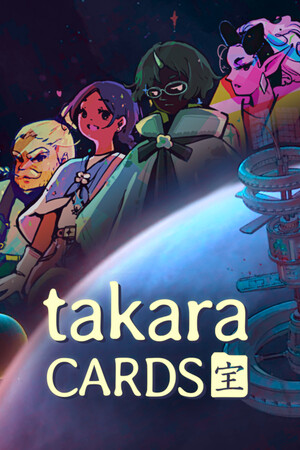
Takara Cards
FTL's evasion anxiety meets Slay the Spire's deck sculpting, wrapped in hand-painted 80s anime art and pointed at space dragons. Shallow grinders need not apply, but patient tacticians will find a surprisingly chewy puzzle box here.
GamerScout Verdict
Best for fans of spatial puzzlers and casual roguelites who want FTL-lite tension without the brutal difficulty ceiling.
Compare Prices(5 stores)
Every store in this table quotes us in euros, so the EUR figure is the price the seller actually set, not our arithmetic — which is why EUR is also the currency we rank in. We only list an offer here when the store gives us its price in euros, so nothing in this table is a number we invented.
Pick USD, PLN, GBP, CAD or AUD in the header and we convert from EUR at the European Central Bank reference rate — converted amounts are prefixed with ~. Your bank or the store may apply a different rate at checkout. We never hide offers based on where you are: everyone sees this whole table.
We may earn a commission when you buy games through links on this page — at no extra cost to you. It never affects our rankings or verdicts.
Price History
Screenshots & Media
About Takara Cards
My instinct when I see 'roguelite deck-builder' is to check how deep the decision tree actually goes before the genre label starts lying to me. With Takara Cards, Post Mortem Pixels from Brazil built something genuinely off the beaten path: combat resolves on a compact 3x3 grid where positioning your ship is just as load-bearing as the cards you throw down. That spatial wrinkle is what separates it from the pile. You are not clicking 'attack' into a static enemy row - you are reading telegraphed movement patterns, predicting collisions (enemy projectiles merge when they meet, compounding the threat), and trying to string together a hand that clears the board in a single chained turn. That last part is the design's central promise, and when it clicks, the satisfaction is real. The character layer has more texture than the sub-5-dollar price bracket usually delivers. Pick a race - Dwarves, Humans, Orks, or Elves - and each comes with a distinct ship, passive trait, and card pool. Elves, for instance, can pull cards from every other race's deck, which opens cross-faction combo lines that no other class gets. Your deck is split between Maneuver cards and Equipment cards, and the ratio shifts as you load or drop gear in your six equipment slots. Scrap collected from destroyed enemies can be sold or repurposed as ammunition, so resource decisions compound across jumps rather than resetting cleanly each fight. The navigation map is more open than genre convention, letting you revisit previous star systems at the cost of credits per jump - a small but meaningful routing puzzle that rewards players who track guild locations. The Karma system is where the RPG label earns a little more credit. Seven karma types - Bless, Curse, Guts, Kind, Rational, Intuition, and Rich - accumulate from your event choices and actively change what encounters you see, what you can steal, and what penalties or perks follow you into combat. It is not Mass Effect-depth morality, but it does mean two runs of the same race can feel meaningfully different depending on how you handle the tabletop-RPG-style voiced events. A single voice actor reads those events with enough personality to make you stop and listen rather than spam the skip button. That is a low bar, but Takara Cards clears it with charm. Here is where the honest accounting comes in. The critical consensus, while generally warm, lands around 'interesting but not a genre-topper.' Several reviewers noted that once you crack the systems after a handful of runs, the difficulty curve does not keep pace with your growing competence. The run length - two sector maps plus a two-phase dragon boss - is manageable, but post-boss endless mode is where long-session players will find any real staying power. The UI sits in a strange middle zone: the hand-painted card art and character portraits are genuinely attractive, carrying clear 80s anime energy, while the surrounding ship-panel interface reads flat and under-animated by comparison. The boss encounter itself is a highlight structurally - breach the dragon's shields, board the vessel, then hunt the dragon itself across a second phase without being able to hit it directly - but a few edge-case card interactions were still generating bugs at launch, with the developer (running Godot under the hood) pushing patches actively. Steam user reviews sit at 89 percent positive across 93 reviews, which for a sub-5-dollar indie is a decent trust signal, not a rubber stamp. For the audience this is actually aimed at - players who found FTL too punishing and Slay the Spire too abstract, and who want something that feels closer to a physical board game on a screen - Takara Cards lands with surprising confidence. The tutorial is functional and mandatory, which I respect: it does not let you fumble blindly through the grid systems and then blame the game for feeling opaque. The in-game Codex covers lore and strategy references without making you tab out to a wiki. If you want 200-hour build optimization, this is not your game. If you want a couple of focused, crunchy afternoons chasing dragons across a galaxy that looks like it escaped from a VHS rental shelf in 1987, the price-to-content ratio works in your favor.

Strategy & simulation
Tags
System Requirements
Minimum
- OS
- Win 7+ 64bits
- Memory
- 4 GB RAM
- Storage
- 2 GB available space
- Graphics
- Intel UHD graphics 620+ (1gb vram)
- Processor
- i3 2.5ghz or AMD Equivalent
Recommended
- OS
- Win 7+ 64bits
- Memory
- 8 GB RAM
- Storage
- 2 GB available space
- Graphics
- Any modern Nvidia oy AMD GPU (2gb+ vram)
- Processor
- i5 3ghz or AMD Equivalent
Keep exploring
Community Discussion
Be the first to comment on Takara Cards.
Reviews & Ratings
No ratings available
Game Info
- Developer
- Post Mortem Pixels
- Publisher
- GrabTheGames
- Release Date
- Jan 17, 2025