Tactical Breach Wizards
Throwing a warlock through a fourth-floor window has never been this satisfying or this mechanically rich - a tight tactics game that earns its 87 Metacritic with precision design, not padding.
GamerScout Verdict
The tactics genre's best-designed accessibility feature wrapped around a deep combo system - worth it for XCOM fans and genre newcomers in equal measure.
Compare Prices(5 stores)
Every store in this table quotes us in euros, so the EUR figure is the price the seller actually set, not our arithmetic — which is why EUR is also the currency we rank in. We only list an offer here when the store gives us its price in euros, so nothing in this table is a number we invented.
Pick USD, PLN, GBP, CAD or AUD in the header and we convert from EUR at the European Central Bank reference rate — converted amounts are prefixed with ~. Your bank or the store may apply a different rate at checkout. We never hide offers based on where you are: everyone sees this whole table.
We may earn a commission when you buy games through links on this page — at no extra cost to you. It never affects our rankings or verdicts.
Price History
Screenshots & Media
About Tactical Breach Wizards
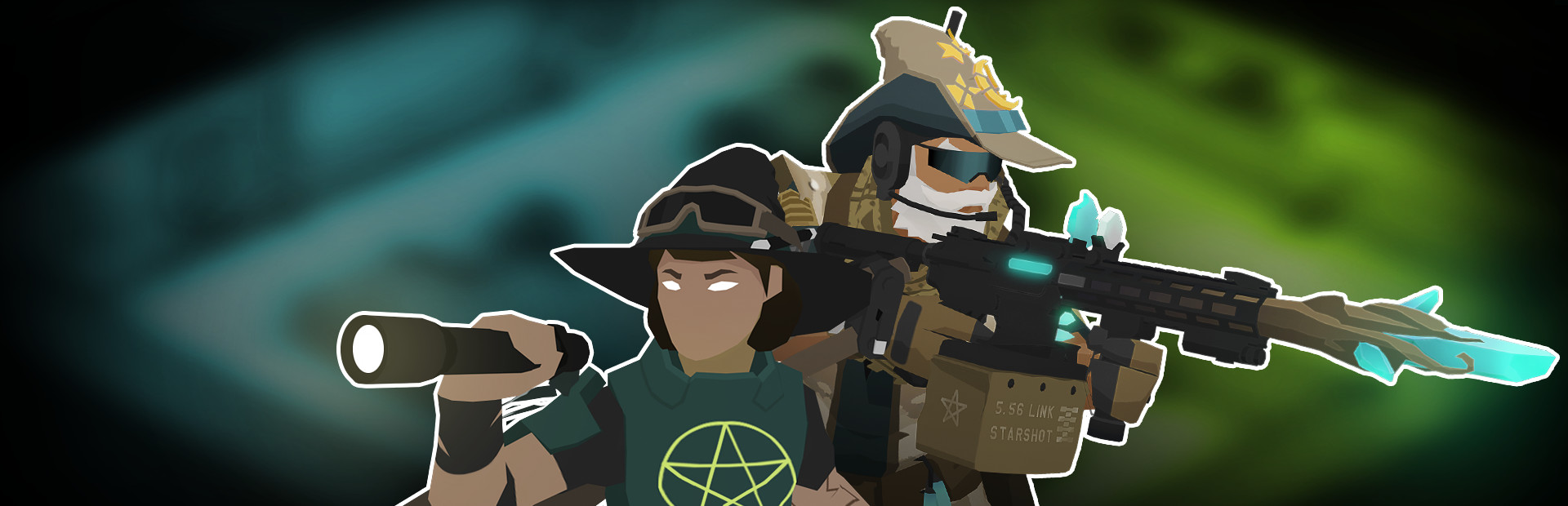
My spreadsheet instincts told me to be skeptical. Turn-based tactics games this accessible usually trade depth for accessibility and leave the hard-mode crowd feeling cheated. Tactical Breach Wizards does not do that. Suspicious Developments - the same solo operation that made Gunpoint and Heat Signature - built a system where every fight is simultaneously approachable on first contact and genuinely rewarding to optimise. That tension is the whole game. The core loop is room-clearing: breach a location, seal reinforcement doors, hit laptops and objectives, then find your escape route. Each character gets one move and one action per turn, and the action economy sounds thin until you realise how much the cross-character combos stretch it. Zan, the Navy Seer protagonist, fires a Shotgun Spell that blasts wide knockback, which chains into Jen the storm witch's Static Blast or Gale Grenade to shove multiple enemies toward a window simultaneously. Windows are the centrepiece mechanic - throwing anyone through one is an instant kill regardless of remaining HP or armour, which means every map is secretly a physics puzzle about lining up the most elegant chain kill you can construct. The Necromedic Banks brings sedative flasks and a spectral skull called Gary that bounces off walls, applying Unsteady to targets so they take extra knockback. Sterling's Shield Bash triggers reactively on the enemy turn. The kit variety across the five playable characters is sharp enough that you will genuinely debate perk investment between missions. The Confidence system deserves a paragraph of its own because it solves the single worst thing about the tactics genre. Rather than reloading saves after a bad move, you spend Confidence points - earned by performing well in missions - to rewind any action taken during your current turn. The rewind is scoped to the active turn only, which means past decisions are locked in, but it removes the tedium of reload screens entirely. You can also use a foresight preview to see how end-of-turn effects play out before committing. The result is a game that actively wants you to try something stupid. Infinite ability combos that clear entire maps on turn one are documented in the community guides, and the optional Confidence Goals - bonus objectives like clearing a room without the enemy ever firing a shot, or finishing in a single turn - exist precisely to push you toward those high-variance lines. Difficulty settings and a flat level-skip option mean newcomers never hit a wall, while the Confidence Goals keep theory-crafters busy well past the credits. Where the game earns the minority of its criticism is around replayability and puzzle density. At 20-30 hours for a standard run and 30-50 hours for full completion, this is not a grand-strategy sandbox with emergent runs. There is effectively one clean solution per map, even if the rewind system makes finding it forgiving. Players who specifically want open-ended faction management or roguelike variance will not find it here. The between-mission anxiety dreams, which function as character-specific mechanical challenges and double as genuinely well-written story beats, help with variety, but the campaign is a fixed arc, not a systemic sandbox. The writing quality - sharp, sarcastic, unexpectedly humane - carries a lot of weight in keeping the structure from feeling repetitive, and the minimalist colourful art style is consistent and clean throughout. It earned multiple strategy game of the year nods from outlets in 2024 and the reception was broadly strong, though a small contingent found it sat closer to puzzle game than tactics sim. For strategy-focused players: the action economy and perk investment loops are genuinely deep enough to satisfy, the Confidence Goal system rewards efficiency-obsessed play in ways XCOM never bothered with, and the writing respects your intelligence. For newcomers to the tactics genre: the rewind feature and difficulty options make this one of the safest entry points available. The runtime is finite and the structure is tight. That is not a weakness unless you specifically want 200 hours of content.

Strategy & simulation
Tags
System Requirements
Minimum
- OS
- Windows 7
- Memory
- 8 GB RAM
- DirectX
- Version 11
- Storage
- 3 GB available space
- Graphics
- 1GB ATI Radeon HD 5770, 1GB NVIDIA GeForce GTX 460 or better
- Processor
- Intel Core 2 Duo E4700 2.6 GHz or AMD Phenom 9950 Quad Core 2.6 GHz
Keep exploring
Community Discussion
Be the first to comment on Tactical Breach Wizards.
Reviews & Ratings
Game Info
- Developer
- Suspicious Developments
- Publisher
- Suspicious Developments
- Release Date
- Aug 22, 2024