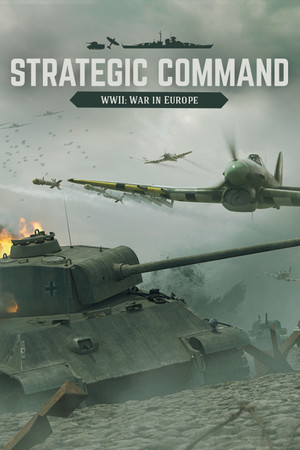
Strategic Command WWII: War in Europe
If you want to fight WWII at the grand strategic level without drowning in spreadsheets, this hex-based wargame from Fury Software hits a rare sweet spot. Just bring patience and read the manual twice.
GamerScout Verdict
Rewarding hex-based WWII strategy for patient wargamers; frustrating for anyone expecting fast-moving alternate history sandbox freedom.
Compare Prices(8 stores)
Every store in this table quotes us in euros, so the EUR figure is the price the seller actually set, not our arithmetic — which is why EUR is also the currency we rank in. We only list an offer here when the store gives us its price in euros, so nothing in this table is a number we invented.
Pick USD, PLN, GBP, CAD or AUD in the header and we convert from EUR at the European Central Bank reference rate — converted amounts are prefixed with ~. Your bank or the store may apply a different rate at checkout. We never hide offers based on where you are: everyone sees this whole table.
We may earn a commission when you buy games through links on this page — at no extra cost to you. It never affects our rankings or verdicts.
Price History
Screenshots & Media
About Strategic Command WWII: War in Europe
I came into this one expecting a dry, manual-heavy slog aimed at grognards who own physical copies of Avalon Hill games. What I found is something more interesting: a hex-based grand strategy title that actually wants you to understand what it's doing, even when its systems are running six layers deep under the hood. That accessibility push is real, and it matters. The supply system, which would be a thirty-page chapter in a lesser game, is abstracted cleanly enough that new players can track it without a spreadsheet open on the second monitor. That said, do not walk in expecting a gentle learning curve. The manual is not optional. The core loop is managing the Axis or Allied coalition across land, sea, and air on a hex map where each tile covers roughly twenty miles of European theater. Turn lengths shift by season, one week in summer, two in spring and autumn, four in winter, which gives the pacing a genuine rhythm. The unit roster is wide: you are moving armies, corps, mechanized divisions, paratroopers, heavy armor, rocket artillery, anti-aircraft guns, partisans, and more. Combat resolves sequentially unit by unit rather than through stacked odds, which creates a very different feel from what Hearts of Iron players expect. Breakthrough attempts require setup and timing. Get it wrong and you get attritional slogging that more than a few players have compared, not entirely unfairly, to the Western Front of an earlier war. The AI on higher difficulties is genuinely solid. In testing it historically plausible: Poland gone by October 1939, France by June 1940, Leningrad threatened in Barbarossa. That is a higher bar than most genre competitors clear. Diplomacy is not window dressing here. Convincing Spain to join your side, pressuring neutral powers, managing your U-boat convoy interdiction campaign as Germany, pulling Franco toward the Axis through a chain of decision events all of these have real downstream consequences on your military fronts. Miss your diplomatic targets and your supply lines suffer for it. The scripted decision events system gives the game structure and historical texture, though it also creates tension with the fantasy of fully open-ended alternate history. Scripting cuts both ways: it keeps novices oriented, but players who want total freedom to rewrite the war from scratch will find the rails chafe. The built-in scenario editor and custom map tools at least give the community an outlet for that frustration. The weak points are consistent and reported across years of reviews. The presentation is genuinely dated: flat visuals, a forgettable audio track, and a UI that feels like it escaped from 2008. Combat stats and calculations sit mostly buried in the manual rather than surfaced on-screen, which means a lot of context-switching for newer players. Late-game pacing is the bigger structural problem. As either side approaches a decisive advantage, turns grow longer and less interesting. The Axis endgame in particular tends to drag into a war of attrition against dwindling reserves with no real comeback mechanic. Naval AI also draws criticism, with the German surface fleet notably reluctant to leave the Baltic regardless of game state. For multiplayer, PBEM is the format of choice and the community around the Matrix Games forums is still active as of 2026, which is a real endorsement for a game this old. Head-to-head play smooths out nearly every AI complaint and the asymmetric design, Axis racing against time while Allies absorb punishment and build strength, makes for genuinely tense opponent-driven sessions. If your target is solo-only, the game is still worth the time for any serious wargame fan. If you are a shooter player who wandered in here by accident, keep wandering. This one rewards people who think in supply chains, not reaction times.

Shooters
Tags
System Requirements
Minimum
- OS
- Windows Vista / 7 / 8/ 10
- Memory
- 6 GB RAM
- DirectX
- Version 9.0c
- Storage
- 2.20 GB available space
- Graphics
- 8MB video memory
- Processor
- 1.5 GHZ Processor or Equivalent (Running the game in higher resolution requires more processing power.)
- Sound Card
- DirectX Compatible Sound Card
DLC & Add-ons for Strategic Command WWII: War in Europe1
Expansions, DLC packs and add-on content for this game. Click any item to see store offers.
Keep exploring
Community Discussion
Be the first to comment on Strategic Command WWII: War in Europe.
Reviews & Ratings
No ratings available
Game Info
- Developer
- Fury Software
- Publisher
- Matrix Games
- Release Date
- Jun 6, 2017