Star Overdrive
Riding a hoverboard across an alien desert to a synth-rock soundtrack sounds like a dream pitch -- the reality lands somewhere between genuinely exhilarating and frustratingly undercooked, and knowing which camp you fall into matters before you buy.
GamerScout Verdict
Best for players who want a zen, momentum-driven open world with a haunting soundscape and can forgive thin combat and patchy dungeons.
Compare Prices(3 stores)
Every store in this table quotes us in euros, so the EUR figure is the price the seller actually set, not our arithmetic — which is why EUR is also the currency we rank in. We only list an offer here when the store gives us its price in euros, so nothing in this table is a number we invented.
Pick USD, PLN, GBP, CAD or AUD in the header and we convert from EUR at the European Central Bank reference rate — converted amounts are prefixed with ~. Your bank or the store may apply a different rate at checkout. We never hide offers based on where you are: everyone sees this whole table.
We may earn a commission when you buy games through links on this page — at no extra cost to you. It never affects our rankings or verdicts.
Price History
Screenshots & Media
About Star Overdrive
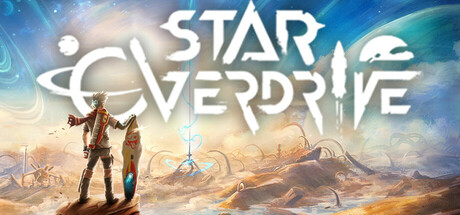
My first hour with Star Overdrive had me convinced I'd found something quietly special. You are Bios, a cassette-toting, headphone-wearing space wanderer who crash-lands on the sun-bleached planet Cebete chasing a distress signal from his missing partner Nous. The setup is lean, the loneliness is immediate, and the moment the grav-board slides under your feet and you crest your first sand dune at velocity, something clicks. The traversal system is the undeniable heart of this game: chaining backflips and kickflips off the terrain fills a boost meter, the world is essentially one giant organic skate park of dunes, ruins, and boost gates, and the physics reward reading the landscape in a way that feels genuinely satisfying once internalized. Slopes into air into trick into speed is a loop that never quite gets old, and the music shifting from ambient wind textures to full-tilt retro rock when you hit the board is exactly the kind of intentional sound design I will go to bat for every time. The structure draws heavily from the Breath of the Wild template -- towers that expand the map, 31 Mine dungeons that work like shrines and reward Power Cores for unlocking Keytar abilities, and an open world that lets you sequence-break and tackle areas in your own order. Caracal Games are open about that lineage, and honestly the Zelda DNA is not the problem here. The Mine dungeons are the tempo-shifters: you ditch the board, walk slowly through enclosed puzzle spaces, and manipulate objects and abilities to progress. Some of them are genuinely clever. Others are sluggish, visually samey, and expose how heavy Bios feels on foot compared to the weightless grace of the board. The contrast is stark enough that it splits the experience almost down the middle. The story is delivered almost entirely through Nous's cassette tapes scattered across the world, and this is where the game earns real emotional credit. Her voice logs, found among abandoned mining rigs and forgotten biodomes, build a portrait of someone sharp and increasingly overwhelmed. There is real loneliness encoded into the sound of the wind and those scattered tapes -- it reminded me of games that know how to make a place feel haunted without spelling it out. Bios himself is a silent protagonist with barely any personality, which costs the relationship dynamic some of its pull, but Nous carries enough weight for both of them. Where Star Overdrive stumbles harder is in its combat and progression systems. The Keytar-based combat -- basic combos plus hot-swappable abilities unlocked from Mines -- is functional but paper-thin. Most encounters can be resolved by spamming the same attacks, and boss fights that should feel climactic instead feel like minor speed bumps. The hoverboard crafting system, with six modular slots covering Engines, Boosters, Wings, Plates, Bouncers, and Mods, is paradoxically both the deepest system in the game and the most obtuse -- materials need balancing, mismatched types penalize stats, and the whole loop tips into grind territory faster than it should. The open world, while visually distinct across its biomes -- scorching sands, watery expanses, gravity-bending ruins -- can feel emptier than its scale deserves. The PC and Xbox versions launched with improvements over the original Switch release, including a lock-on mechanic, rebalanced difficulty, and camera tweaks, which matters if you bounced off early coverage. For players who want a chill, momentum-driven exploration game with a genuinely lovely soundscape and a mystery worth piecing together, Star Overdrive does something no other open-world game this year does quite the same way. For players expecting combat depth or a world dense with things to do, the gaps will frustrate. The board is the ticket. Everything else is the price of admission.

Indie & narrative
Tags
System Requirements
Minimum
- OS
- Windows 10 64-bit
- Memory
- 8 GB RAM
- DirectX
- Version 12
- Storage
- 22 GB available space
- Graphics
- NVIDIA GeForce GTX 1050 Ti / AMD Radeon RX 570
- Processor
- Intel Core i5-3400 / AMD Ryzen 3 1300X
Recommended
- OS
- Windows 11 64-bit
- Memory
- 16 GB RAM
- DirectX
- Version 12
- Storage
- 22 GB available space
- Graphics
- NVIDIA GeForce RTX 2060 / AMD Radeon RX 5700
- Processor
- Intel Core i7-9700K / AMD Ryzen 5 3600
Keep exploring
Community Discussion
Be the first to comment on Star Overdrive.
Reviews & Ratings
Game Info
- Developer
- Caracal Games
- Publisher
- Dear Villagers
- Release Date
- Jun 19, 2025