Space Siege
A sci-fi isometric action-RPG with a genuinely interesting cyborg-or-stay-human hook that the rest of the game never lives up to. Metacritic 60 says it all.
GamerScout Verdict
Worth considering only for forgiving fans of 2008-era isometric ARPGs; everyone else will hit the wall of corridor repetition fast.
Compare Prices(4 stores)
Every store in this table quotes us in euros, so the EUR figure is the price the seller actually set, not our arithmetic — which is why EUR is also the currency we rank in. We only list an offer here when the store gives us its price in euros, so nothing in this table is a number we invented.
Pick USD, PLN, GBP, CAD or AUD in the header and we convert from EUR at the European Central Bank reference rate — converted amounts are prefixed with ~. Your bank or the store may apply a different rate at checkout. We never hide offers based on where you are: everyone sees this whole table.
We may earn a commission when you buy games through links on this page — at no extra cost to you. It never affects our rankings or verdicts.
Price History
Screenshots & Media
About Space Siege
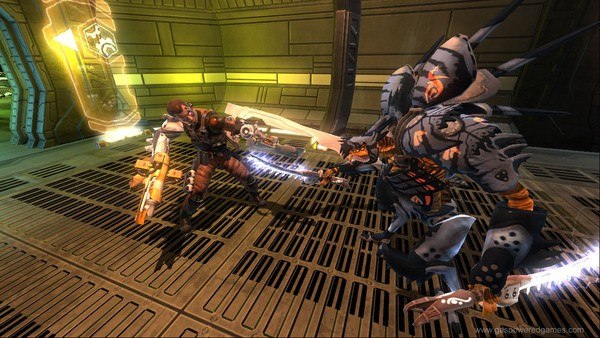
I went into Space Siege genuinely curious: Gas Powered Games had Dungeon Siege and Supreme Commander on their resume, and the pitch of playing a security officer who has to decide how much of his humanity to trade for combat power is a solid one. Twenty minutes into the corridors of the ISCS Armstrong, that curiosity started curdling. The setup is serviceable enough. Earth is gone, wiped out by the insect-like Kerak aliens seeking revenge for humanity colonizing their homeworld. You are Seth Walker, a combat engineer on the last surviving colony ship, and your constant companion is HR-V, a customizable robot sidekick players nicknamed Harvey. HR-V can be fitted with new armor, weapons, and special abilities, and Seth himself can be outfitted with cybernetic upgrades that make him meaningfully stronger at the cost of his humanity score. Three different endings hinge on how far down that path you go, and on paper that is a compelling design idea. In practice, the humanity system feels underdeveloped. The trade-offs between staying human and going full cyborg never produce the tension the concept promises, and the choice at the end reads more like a dialog box than a dramatic payoff. The core loop is click-to-move, right-click-to-shoot, isometric hack-and-slash, directly in the lineage of Dungeon Siege. The problem is that Space Siege stripped out much of what made that formula work. The skill bar is shallow, with too few abilities that rarely change how you play. Seth stops moving the moment he fires, which makes combat feel rigid rather than kinetic. The level design is largely corridor after corridor inside the Armstrong, occasionally broken up by a lab or arboretum, but the enemy variety never compensates for the repetition. The Kerak, despite having a reasonably interesting lore reason to exist, are functionally just waves of similar-looking bugs to click through. A four-player co-op multiplayer mode exists, but it runs as separate mission instances without Harvey, and that absence kills much of what distinguishes the single-player experience. What Space Siege does right is narrow but real. The physics engine still produces satisfying ragdoll chaos, blowing enemies into scenery with the right weapon feels punchy, and the atmospheric audio inside the ship corridors has a claustrophobic tension that the visuals alone never manage. The full voice acting keeps the pacing moving even when the script is generic. If you want to see a 2008 action-RPG try something different with a morality mechanic before games like BioShock popularized it, there is archaeological value here. But the core gameplay loop wears out long before the credits. This is a title for players who are already fans of the era, who find something comforting in the click-heavy isometric formula even when it is at its thinnest, or who want a short 10-to-15-hour sci-fi romp without high expectations. Anyone who comes to it hoping the cyborg system delivers on its premise, or expecting the depth of Dungeon Siege, is going to be disappointed. The Metacritic score of 60 is a fair landing.

Catch-all
Tags
System Requirements
Minimum
- Processor
- 2.6 GHz processor
- Memory
- 512MB RAM
- Graphics
- 128 MB video RAM or greater, with DirectX 9 Vertex Shader / Pixel Shader 2.0 support (Nvidia 6800/ATI 9800 or better) Di…
Keep exploring
Community Discussion
Be the first to comment on Space Siege.
Reviews & Ratings
Game Info
- Developer
- SEGA
- Publisher
- Sega
- Release Date
- Aug 14, 2008