
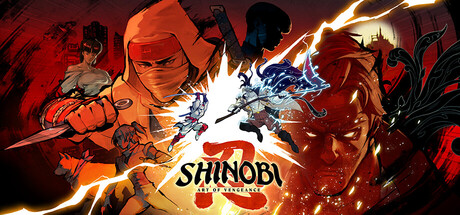
SHINOBI: Art of Vengeance
Fourteen years dormant, Joe Musashi comes back swinging with some of the sharpest 2D combat of 2025 - if you can live with a game that prioritizes style and flow over white-knuckle challenge.
GamerScout Verdict
A visually spectacular and mechanically sharp action platformer that shines brightest once you turn on Hardcore Mode.
Compare Prices(0 stores)
Loading prices...
We may earn a commission when you buy games through links on this page — at no extra cost to you. It never affects our rankings or verdicts.
Price History
Screenshots & Media
About SHINOBI: Art of Vengeance
I went into Art of Vengeance half-expecting a nostalgia cash-in. What I got was a tight, hand-drawn action platformer that earns its 86 Metacritic on the back of genuinely great combat design, even if a few rough edges keep it from being the definitive statement the franchise deserves. Lizardcube - the Paris studio that already pulled this trick with Streets of Rage 4 - has built a game where every input feels deliberate, every animation has weight, and the whole thing moves at a pace that makes you feel like the most dangerous person in any room. The combat system is the clear star. Joe Musashi works through a toolkit of light and heavy sword strikes, kunai throws, and chained combos that feed into the Shinobi Execution mechanic - tag enough enemies, fill the meter, and Joe darts around the screen finishing them all at once in a single kinetic burst. On top of that, elemental Ninpo spells (unlocked and purchased with Oboro Relics collected across stages) add screen-clearing fire, water, and lightning options, while Amulets slot in passive combat bonuses to let you nudge your playstyle. The upgrade loop is present but not overbearing - gold earned in stages buys new traversal tools and moves at the Yokai Shop, and it generally feels like progression rather than padding. Some critics have noted the sheer number of unlockable trinkets can clutter menus in a way that rarely justifies the real estate, which is a fair knock. Movement is equally generous. Joe can double jump, air-dash, wall-jump, slide, and dodge-roll with a few invincibility frames - a full modern action-platformer kit. Stages are discrete rather than open-world, but the game seeds them with areas gated behind tools you earn later, so revisiting levels to reach locked rooms and collectibles gives it a light metroidvania texture without fully committing to that structure. The level variety holds up across a dozen-plus stages: neon city blocks, a scorching desert, a horror-adjacent ENE Corp lab, and runner stages where you ride Yamato the dog through gauntlets of projectiles (neat as a novelty, a little repetitive by the second or third visit). Visual variety is genuinely impressive, with each zone carrying its own color palette and the hand-drawn ink-line aesthetic giving every attack animation a sense of crafted intention. The main criticism you will keep reading across reviews is the difficulty curve, or lack of one. On the default Shinobi mode, most encounters - even boss fights - telegraph so clearly and punish so lightly that the game risks feeling like a power fantasy rather than a challenge. That is partly by design (the developers explicitly wanted to sell the idea of an unstoppable ninja), and the multiple difficulty settings, including a granular custom option, do offer some headroom. The April 2026 free update also added Hardcore Mode, which rebalances the entire campaign with tighter damage, revised enemy placement, and new boss patterns - so if you want the game to actually test you, that option now exists at no extra cost. The SEGA Villains Stage DLC, which pits Musashi against Majima, Death Adder, and Dr. Eggman, is available separately and is worth it for the crossover spectacle alone. Soundtrack opinions split the community more than anything else - Tee Lopes brings modern flair and Yuzo Koshiro grounds it in series history, but several reviewers found the track-to-track consistency a little flat compared to the Genesis classics. For anyone who loved Streets of Rage 4, this is an easy recommendation - same studio, same philosophy of using hand-drawn craft to make a 2D action game feel premium. For newcomers to the Shinobi franchise, the learning curve is gentle enough that you do not need any historical context. Hardcore purists who want the precision and risk of the Genesis originals should check that Hardcore Mode is available before buying, because the base campaign plays closer to a breezy action game than a punishing old-school platformer. As a pure spectacle - kinetic combat, world-class art direction, responsive controls - it is one of the best 2D action releases of the year.

Catch-all
Tags
System Requirements
Minimum
- OS
- Windows 10
- Memory
- 6 GB RAM
- DirectX
- Version 11
- Storage
- 20 GB available space
- Graphics
- NVIDIA GeForce GT 730, 2 GB or AMD Radeon R7 240, 2 GB Intel Arc A310 LP, 4 GB
- Processor
- Intel Core 2 Quad Q9400 or AMD Phenom II X3 720
Recommended
- OS
- Windows 10 or higher
- Memory
- 8 GB RAM
- DirectX
- Version 11
- Storage
- 20 GB available space
- Graphics
- NVIDIA GeForce GTX 650 Ti, 2 GB or AMD Radeon HD 7770, 1 GB or Intel Arc A310 LP, 4 GB
- Processor
- Intel Core i5-2300 or AMD FX-4350
DLC & Add-ons for SHINOBI: Art of Vengeance1
Expansions, DLC packs and add-on content for this game. Click any item to see store offers.
Keep exploring
Community Discussion
Be the first to comment on SHINOBI: Art of Vengeance.
Reviews & Ratings
Game Info
- Developer
- SEGA
- Publisher
- SEGA
- Release Date
- Aug 28, 2025