Sir, We Have an Orc Problem
Tower defense stripped to its most compulsive form: build a kill-zone, watch tens of thousands of orcs get pulverized by it, pocket the resources whether you win or lose, and repeat until the numbers get absurd.
GamerScout Verdict
Ideal for players who want a tight incremental tower-defense hit with genuine upgrade decisions, just don't expect an endless sandbox.
Compare Prices(0 stores)
Loading prices...
We may earn a commission when you buy games through links on this page — at no extra cost to you. It never affects our rankings or verdicts.
Screenshots & Media
About Sir, We Have an Orc Problem
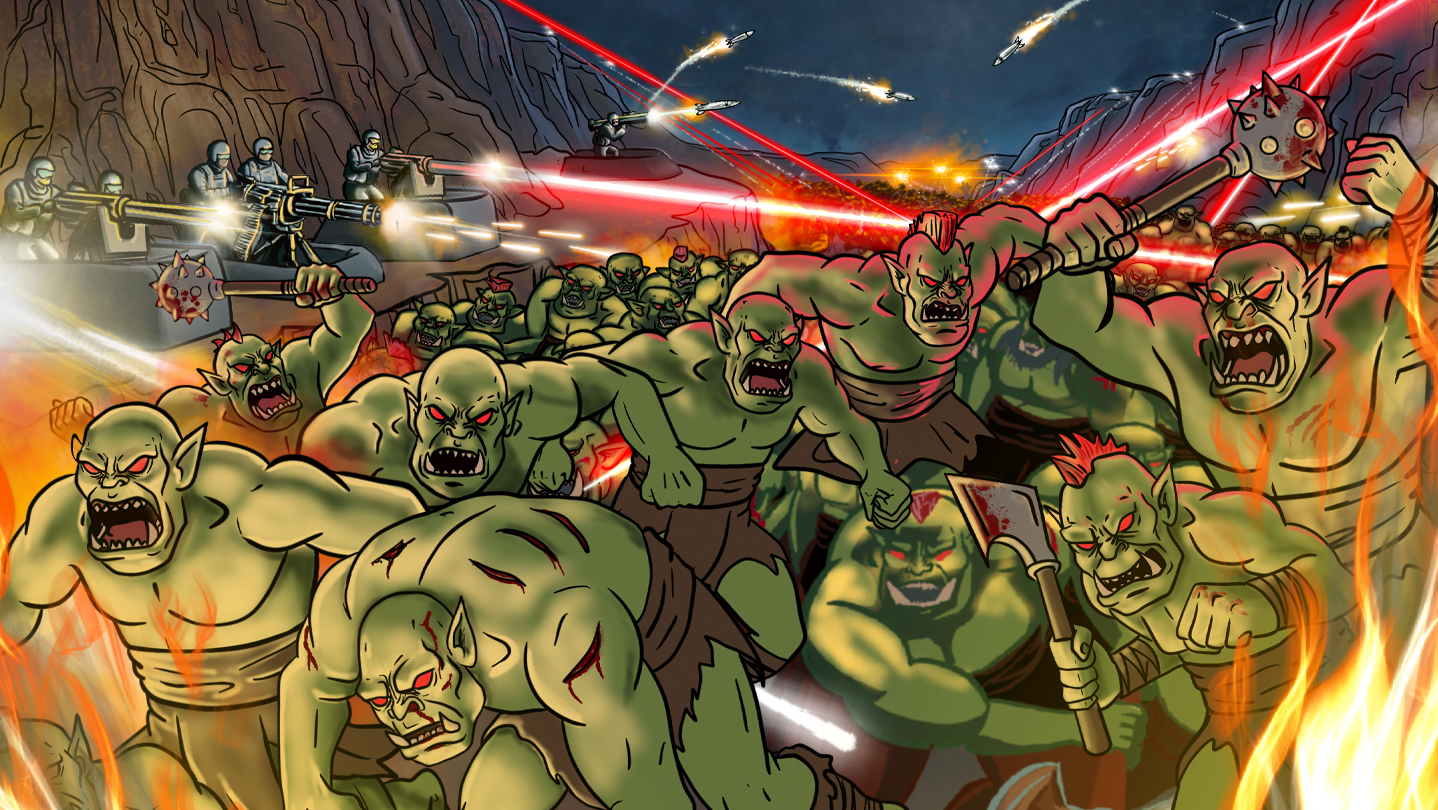
I have a spreadsheet problem, and Sir, We Have an Orc Problem just made it worse. Within the first thirty minutes I was already mapping out upgrade-tree priority: economy nodes first, Gunner penetration second, Flamethrower unlock third. That is exactly the kind of thinking this game rewards, and it is also the reason a four-to-six-hour campaign punches well above its short runtime. The structure is a clean two-phase loop. During the build phase you place turrets across the map, thinking hard about choke points and tower type combinations. Flamethrowers belong at the front of a narrow corridor, Mortars and Cannons layer behind them for area knockback, and the Machine Gun handles stragglers that survive your main kill-zone. Then the battle phase begins and the orcs arrive as a literal fluid mass, streaming through the terrain until they hit your defenses or your base health bar. When your static turrets are not enough, you reach for the active abilities: missiles for early crisis management, strafing runs when lanes split mid-campaign, orbital lasers and nukes once the late-game orc counts tip past five digits. The physics simulation underneath all of this is what separates the game from a dry number-push: dead orcs get launched, crushed, and scattered, and a perfectly timed bombing run on a dense pack produces the kind of immediate satisfaction that keeps you hitting retry instead of quitting. The meta-progression is the spine of everything. Resources earned from each run, won or lost, feed directly into a persistent upgrade tree that carries between missions. The tree branches into economy nodes that increase end-of-battle payouts and raise tower caps, and combat paths that push damage, fire rate, explosion radius, and tower-specific stats for the Gunner, Flamethrower, Mortar, and Cannon. The correct call, almost always, is to front-load economy upgrades so that future runs pay faster. That design choice makes the "number go up" itch genuinely strategic rather than just cosmetic: a five-percent income node often pays for itself in two retries, which means you are making real decisions, not just clicking the shiniest upgrade. The honest criticism from the player community is consistent: the game is short and can nudge you toward grind when a difficulty spike hits. Some stages create sharp escalations that push under-upgraded players into repetitive farm runs on earlier levels before the late waves become survivable. Players who clear everything and go for achievements find themselves wanting more maps, more tower types, and a level editor or challenge mode that does not yet exist. The developer has flagged post-launch content, but at launch the campaign is a compact proposition, not an endless sandbox. For the right audience, none of that is a dealbreaker. If you have ever prioritized an economy tech in a grand-strategy game so that your mid-game snowball comes online faster, you already understand the core loop here. The approachability is genuine: the tutorial is light but the mechanics are readable within one or two runs, and the failure state is forgiving because every lost battle still pays resources. Anyone who bounces off it will do so within an hour, which makes the short runtime a feature as much as a limitation. Mumpitz Games built something tight and honest about what it is, and that matters.

Strategy & simulation
Tags
System Requirements
Minimum
- OS
- 10
- Memory
- 4 GB RAM
- Storage
- 200 MB available space
- Graphics
- Vulkan 1.3 support
- Processor
- Any x86_64 CPU
Recommended
- OS
- 11
- Memory
- 4 GB RAM
- Storage
- 200 MB available space
- Graphics
- Dedicated graphics card with Vulkan 1.3 support
- Processor
- Any x86_64 CPU
Keep exploring
Community Discussion
Be the first to comment on Sir, We Have an Orc Problem.
Reviews & Ratings
Game Info
- Developer
- Mumpitz Games
- Publisher
- Mumpitz Games
- Release Date
- Jul 28, 2026


