
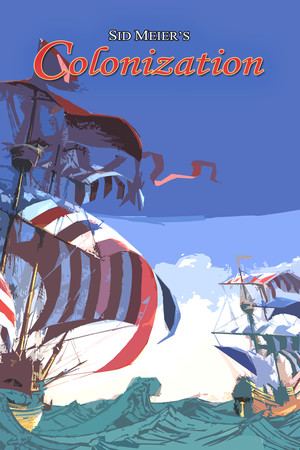
Sid Meier's Colonization (Classic)
Trade routes, rebel sentiment, and a war of independence you'll spend 30 turns dreading - this 1994 DOS classic still plays better than half the strategy releases from the last decade.
GamerScout Verdict
Best for 4X fans who want a focused economic campaign with a hard deadline - just read a strategy guide before turn one.
Compare Prices(0 stores)
Loading prices...
We may earn a commission when you buy games through links on this page — at no extra cost to you. It never affects our rankings or verdicts.
Price History
Screenshots & Media
About Sid Meier's Colonization (Classic)
I've spent more hours than I care to admit optimizing lumber mills and Custom Houses in a game that renders at 320x240, and I have no regrets. Sid Meier's Colonization, originally developed by Brian Reynolds and Sid Meier in 1994 and released on Steam as an unchanged DOS classic, is a turn-based strategy game that pulls off something most modern 4X titles fumble: it gives you a single, concrete win condition and then makes every systemic decision feed into it. You sign a Declaration of Independence, you defeat the Royal Expeditionary Force, and you walk away. Clean. Focused. Brutal on higher difficulties. The economic loop is where this game lives or dies, and for strategy players it is genuinely fascinating. You manage 16 distinct trade goods - fur, tobacco, sugar, silver, tools, muskets, horses and more - across a web of coastal colonies, each staffed by specialist units like Expert Fur Trappers, Master Distillers, and Jesuit Missionaries. Shipping goods back to Europe generates gold, but the King continuously hikes your taxes, and refusing a tax increase triggers a boycott on that commodity. The Custom House, which lets you sell directly without sailing to Europe, is the mid-game pivot that changes everything. On top of that, Liberty Bells generated by Elder Statesmen build rebel sentiment and unlock Founding Fathers - think Adam Smith cutting production costs or Ferdinand Magellan granting extra ship movement - which function as the game's tech-tree equivalent. It is compact, legible, and surprisingly layered for a game that fits on a floppy disk. For newcomers, the lower difficulty levels are genuinely forgiving. You start with a ship, two colonists, and an open map, and the other European powers (England, France, Spain, the Netherlands, each with distinct traits) are mostly focused on their own expansion rather than harassing you early. The interface borrows directly from Civilization's tile-based vocabulary, so anyone who has touched a Civ game will be oriented within minutes. That said, the tutorial is effectively nonexistent by modern standards, so first-timers should find one of the many surviving community strategy guides before committing to a full campaign. The strategic depth becomes apparent around the mid-game once you are managing wagon train logistics across five or six colonies and trying to keep rebel sentiment above 50% before the King prices you out of every commodity. The weaknesses are real and worth flagging. The AI for rival European powers has a habit of parking units around your settlements without declaring war, which creates a quietly infuriating pressure that the game's diplomacy system can't cleanly resolve. Combat resolution carries a frustrating streak of randomness - veteran Dragoons losing to a ragtag militia is not uncommon - and the naval layer is shallow enough that privateers become almost useless after you field four of them. The independence war endgame, where the King simply deposits waves of Regulars and Cavalry directly adjacent to your colonies, removes any opportunity for open-field maneuvering and turns the final act into a fortification holding exercise. It works thematically but feels mechanically inelegant. There are also hard-coded unit caps that bite you in large late-game empires, and the Mac compatibility notice on Steam is worth reading before you buy on that platform. The Steam release is the original DOS build running through DOSBox. No remaster, no quality-of-life patches, no mod support through a workshop. If you want modernized graphics and updated mechanics, the Civilization IV: Colonization remake exists, though community opinion is divided on whether it captures what made the original click. The hardcore consensus tends to favor this version's tighter resource economy and the argument is not unreasonable. The colonial folk soundtrack is also, genuinely, one of the better ambient game scores of the era - sparse, period-appropriate, and impossible to shake after a few sessions.

Strategy & simulation
Tags
System Requirements
Minimum
- OS
- Windows XP / Vista / 7
- Memory
- 512 MB RAM
- Storage
- 100 MB available space
- Graphics
- 100% DirectX compatible graphics
- Processor
- 1.0 GHz Processor
- Sound Card
- 100% DirectX compatible card or onboard sound
Recommended
- OS
- Windows 7
- Memory
- 1 GB RAM
- Storage
- 100 MB available space
- Graphics
- 100% DirectX compatible graphics
- Processor
- 1.5 GHz Processor
- Sound Card
- 100% DirectX compatible card or onboard sound
Keep exploring
Community Discussion
Be the first to comment on Sid Meier's Colonization (Classic).
Reviews & Ratings
No ratings available
Game Info
- Developer
- MicroProse Software, Inc
- Publisher
- Atari
- Release Date
- Oct 9, 2014


