SHOWTIME 2073
Pac-Man with a rocket launcher and a crowd baying for your blood - SHOWTIME 2073 is a weird, scrappy little idea that lands harder than it has any right to, as long as you check your expectations at the door.
GamerScout Verdict
Worth one run for fans of stripped-back arcade FPS concepts, but the absent save system and technical instability will push most players away after that.
Compare Prices(8 stores)
Every store in this table quotes us in euros, so the EUR figure is the price the seller actually set, not our arithmetic — which is why EUR is also the currency we rank in. We only list an offer here when the store gives us its price in euros, so nothing in this table is a number we invented.
Pick USD, PLN, GBP, CAD or AUD in the header and we convert from EUR at the European Central Bank reference rate — converted amounts are prefixed with ~. Your bank or the store may apply a different rate at checkout. We never hide offers based on where you are: everyone sees this whole table.
We may earn a commission when you buy games through links on this page — at no extra cost to you. It never affects our rankings or verdicts.
Price History
Screenshots & Media
About SHOWTIME 2073
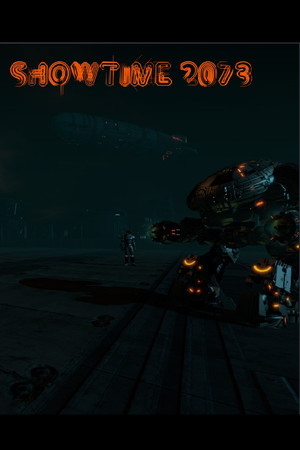
I went in expecting nothing and came out genuinely charmed, which is the best possible outcome for a sub-two-dollar solo project from a single developer. SHOWTIME 2073 casts you as a contestant in a dystopian spectator sport: a futuristic arena maze, an invisible crowd, five levels of escalating chaos, and you are very much the entertainment. The concept is immediately legible - collect orbs to clear each level, survive everything the arena throws at you - and the first sixty seconds communicate it cleanly. That clarity is a small craft win. The mechanical heart of it is a first-person shooter wired to Pac-Man logic. You sprint through procedurally constructed mazes collecting white orbs to hit your quota, while red orbs unlock rockets and green orbs top up your health. The rockets are the game's best idea: you can punch holes through walls to open new routes, blow floor tiles out from under enemies, or carve shortcuts through the geometry on the fly. The catch is that rubble from a demolished wall can snag your movement and kill you as efficiently as any enemy, which gives every explosive decision a satisfying risk texture. Enemy variety escalates across the five levels - karate robots give way to mech units, spider drones, gun turrets, and human clones - and the pacing of that escalation genuinely works. Level five in particular shifts the tempo into something frenetic enough to feel like a different game. Here is where honesty takes over. The technical foundation is shaky. Progress does not save between sessions, so closing the game means restarting from level one every time, which will end most people's patience faster than the difficulty does. Framerate instability that some players read as an intentional slow-motion kill effect is almost certainly just the engine struggling. The music loops with an audible restart seam - it has the right driving energy for arena combat but the production cuts off abruptly and circles back. There is a single weapon with two fire modes, no upgrades, no unlocks, and the enemy respawn behaviour can tip from tense into arbitrary. These are real problems, and they kept a genuinely novel micro-game from finding the wider audience it briefly deserved. What it does right: the destructible geometry is tactile and satisfying in a way that still surprises for a project this size. The cyberpunk visual aesthetic, all sharp angles and neon-adjacent arena lighting, punches above its weight. Controls are responsive. The difficulty curve, bugs aside, is honest - each death teaches you something about spacing and movement priority. For the right player, the five-level run functions as a pure, stripped-back score-chase loop that holds up for several sittings. For most, the technical rough edges and total absence of any save system will make a single run feel like enough.

Indie & narrative
Tags
System Requirements
Minimum
- OS
- 7 ++
- Memory
- 2000 MB RAM
- Graphics
- FX
- Processor
- Dual Core
- Sound Card
- ANY
Keep exploring
Community Discussion
Be the first to comment on SHOWTIME 2073.
Reviews & Ratings
No ratings available
Game Info
- Developer
- Nicolas Bernard
- Publisher
- N.INDIES
- Release Date
- Feb 12, 2016