Compare Run Build Pew! prices across 50+ stores and find the best deal. Developed by Knight Owl Games. Published by Knight Owl Games. Released on 6/6/2022. Available on PC. Genres: Action, Casual, Indie, Strategy.

A micro-priced top-down roguelite that asks you to build a spaceship mid-firefight and pick battles you can actually survive. Smarter than it looks, rougher than it should be.

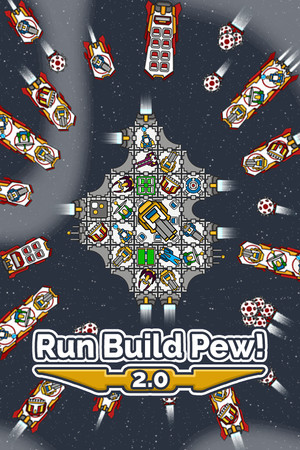
My first few runs of Run Build Pew! felt like someone had thrown a strategy game and a shoot-em-up into a blender and then removed the instruction manual. You drop onto a top-down map being actively hunted, with a barely-armed ship and drones that need to collect scrap before your factory can spit out parts. There is no gentle on-ramp. The game throws enemy fleets at you immediately and trusts you to figure out that holding shift makes you faster, that module placement matters directionally, and that not every fight on the map is a fight worth taking. That last part is where the strategy brain kicks in. The core loop is genuinely clever for what is, at heart, a budget indie. Your ship factory generates a random selection of parts, you pick one, and you physically place it on your hull. Placement is not decorative. Weapons fire based on their orientation, and modules expand your buildable surface, so each pick is a small spatial puzzle layered on top of the moment-to-moment shooting. Synergies exist between parts and players have documented everything from EMP gun combos to full nuke loadouts. The randomness keeps runs from feeling identical, though after several hours the build variety does start to narrow into a handful of dominant configurations. That is the honest ceiling of the system. Balance is the game's most persistent criticism from the community, and it is fair. Early runs feel punishing in a way that is more opaque than intentional. Once you accumulate enough run XP to unlock permanent upgrades in the lab, the difficulty curve smooths out considerably, but the game does a poor job of communicating that this meta-progression exists. Some players report late-game frame rate drops when the screen fills with enemies, which is a technical wrinkle worth knowing about before you get attached to a run. Sessions clock in at roughly 20 to 30 minutes, which keeps the damage limited when a run collapses, and the game is verified for Steam Deck if that is your preferred hardware. For the price point and the sub-30-minute session format, the value calculation is straightforward. You are getting a tight, original concept that combines spatial ship-building with active evasion in a way you do not see often. It is Knight Owl Games' debut, built over years of effort by a small team, and the craft shows even where the polish does not. The roguelite audience that treats the first few deaths as a tutorial rather than a failure will find a satisfying loop here. Survivors-like fans in particular have flagged it as one of the earlier examples of that blend done with genuine mechanical intent. Diego, Scout Team

Run Build Pew!
ActionCasualIndieStrategy

Run Build Pew!

Jun 6, 2022Knight Owl Games
GamerScout Says

A micro-priced top-down roguelite that asks you to build a spaceship mid-firefight and pick battles you can actually survive. Smarter than it looks, rougher than it should be.

PC
Best Price Available
0.00
at N/A
Historical low: $3.99

Compare Prices(0 stores)

Loading prices...

We may earn a commission when you buy games through links on this page — at no extra cost to you. It never affects our rankings or verdicts.

Screenshots & Media

Screenshot

About Run Build Pew!

My first few runs of Run Build Pew! felt like someone had thrown a strategy game and a shoot-em-up into a blender and then removed the instruction manual. You drop onto a top-down map being actively hunted, with a barely-armed ship and drones that need to collect scrap before your factory can spit out parts. There is no gentle on-ramp. The game throws enemy fleets at you immediately and trusts you to figure out that holding shift makes you faster, that module placement matters directionally, and that not every fight on the map is a fight worth taking. That last part is where the strategy brain kicks in. The core loop is genuinely clever for what is, at heart, a budget indie. Your ship factory generates a random selection of parts, you pick one, and you physically place it on your hull. Placement is not decorative. Weapons fire based on their orientation, and modules expand your buildable surface, so each pick is a small spatial puzzle layered on top of the moment-to-moment shooting. Synergies exist between parts and players have documented everything from EMP gun combos to full nuke loadouts. The randomness keeps runs from feeling identical, though after several hours the build variety does start to narrow into a handful of dominant configurations. That is the honest ceiling of the system. Balance is the game's most persistent criticism from the community, and it is fair. Early runs feel punishing in a way that is more opaque than intentional. Once you accumulate enough run XP to unlock permanent upgrades in the lab, the difficulty curve smooths out considerably, but the game does a poor job of communicating that this meta-progression exists. Some players report late-game frame rate drops when the screen fills with enemies, which is a technical wrinkle worth knowing about before you get attached to a run. Sessions clock in at roughly 20 to 30 minutes, which keeps the damage limited when a run collapses, and the game is verified for Steam Deck if that is your preferred hardware. For the price point and the sub-30-minute session format, the value calculation is straightforward. You are getting a tight, original concept that combines spatial ship-building with active evasion in a way you do not see often. It is Knight Owl Games' debut, built over years of effort by a small team, and the craft shows even where the polish does not. The roguelite audience that treats the first few deaths as a tutorial rather than a failure will find a satisfying loop here. Survivors-like fans in particular have flagged it as one of the earlier examples of that blend done with genuine mechanical intent. Diego, Scout Team

Tags

singleplayerachievementscontroller-supporttrading-cardscloud-savestier:sub-5Bounty-Hunter PremiseSpatial Ship-BuildingMeta-Progression UnlocksModule PlacementSurvivors-likePart SynergiesEvasion-Focused

Steam Deck & Linux

Steam Deck VerifiedProtonDB Platinum

Valve rates this game Steam Deck Verified. Runs flawlessly on Linux out of the box. Based on 3 ProtonDB community reports.

System Requirements

Minimum

OS
Windows 10
Memory
4 GB RAM
Graphics
Intel HD Graphics 4000 or equivalent, Integrated cards also work
Processor
Core i3

Community Discussion

Be the first to comment on Run Build Pew!.

Reviews & Ratings

No ratings available

Game Info

Developer
Knight Owl Games
Publisher
Knight Owl Games
Release Date
Jun 6, 2022

Price Alert

Get notified when the price drops below your target!

Create Alert

Price History

2026-06-103.99(lowest)
2026-06-093.99(lowest)

More from Knight Owl Games

Buy smarter: helpful guides

Looking for more? See games like Run Build Pew!

Frequently asked questions about Run Build Pew!

How much does Run Build Pew! cost?

Run Build Pew! pricing changes often and varies by store, edition and region. The live price table on this page compares the cheapest in-stock key and store offers across 50+ verified shops, so you always see the current lowest price before you buy.

Where can I buy Run Build Pew! cheapest?

Compare Run Build Pew! prices across every verified store in the price table on this page. We list the cheapest in-stock key and store offers, updated regularly, so you always see the best current deal before you buy.

What platforms is Run Build Pew! available on?

Run Build Pew! is available on PC.

When was Run Build Pew! released?

Run Build Pew! was released on 6 June 2022.

Who developed Run Build Pew!?

Run Build Pew! was developed by Knight Owl Games.