Ritual: Crown of Horns
Weird West atmosphere so thick you can smell the brimstone, wrapped around a horde shooter that will wall you hard unless precision and pattern memory are your idea of fun.
GamerScout Verdict
Best for horde-mode veterans who can trade mechanical variety for atmosphere, committed world-building, and a satisfying charged-aim system.
Compare Prices(5 stores)
Every store in this table quotes us in euros, so the EUR figure is the price the seller actually set, not our arithmetic — which is why EUR is also the currency we rank in. We only list an offer here when the store gives us its price in euros, so nothing in this table is a number we invented.
Pick USD, PLN, GBP, CAD or AUD in the header and we convert from EUR at the European Central Bank reference rate — converted amounts are prefixed with ~. Your bank or the store may apply a different rate at checkout. We never hide offers based on where you are: everyone sees this whole table.
We may earn a commission when you buy games through links on this page — at no extra cost to you. It never affects our rankings or verdicts.
Price History
Screenshots & Media
About Ritual: Crown of Horns
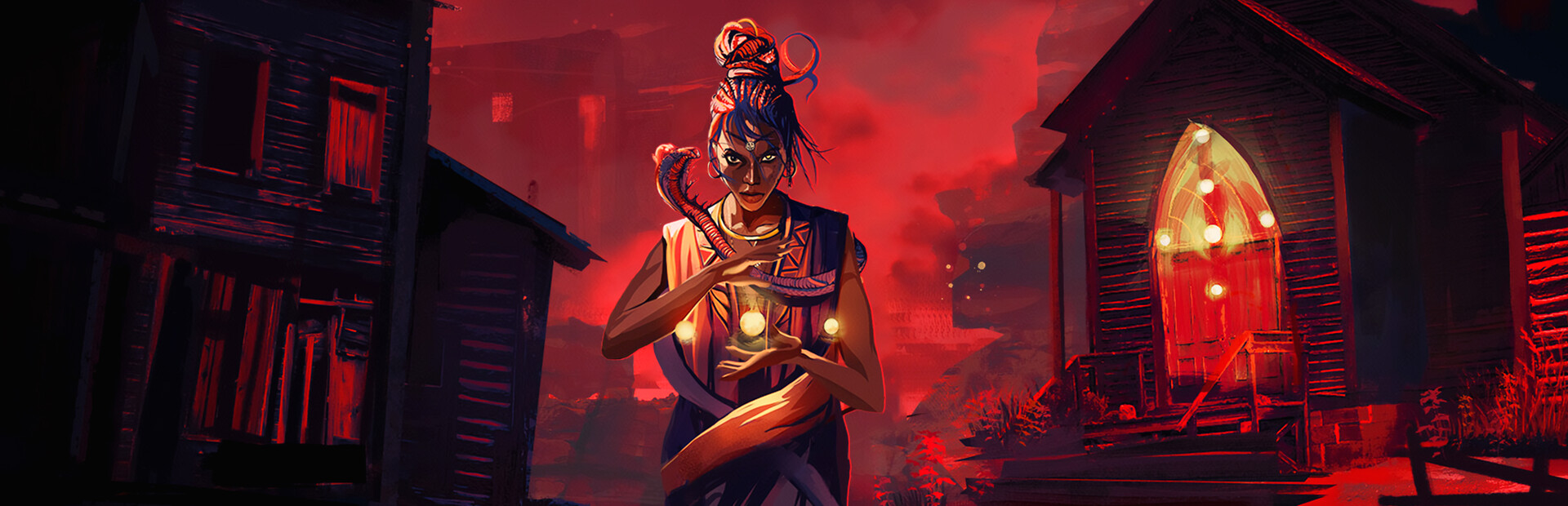
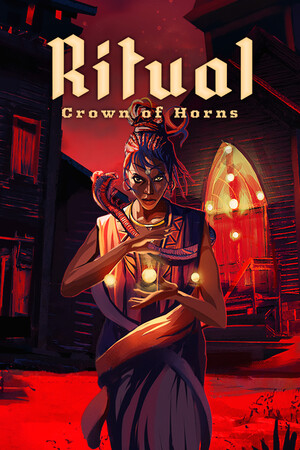
I keep coming back to games that feel hand-authored, where every decision in the design has a point of view behind it. Ritual: Crown of Horns has that quality in places, and then in other places it makes you question why you bothered. That tension is basically the whole review. The premise is genuinely delicious. Bounty hunter Daniel Goodchild rides out to kill a witch for the US government, gets ambushed and butchered by antler-wearing cultists instead, and wakes up as the witch's reluctant undead bodyguard. The illustrated cutscenes that carry the story between missions are the best-looking thing in the package, and the writing has a dry, pulpy humor that draws from the same well as old dime novels. The soundtrack sits in that sweet spot between Ennio Morricone homage and something punchier, weirder, and more acid-tinged, and the sound design gives each weapon its own personality: the crack of a six-shooter is genuinely satisfying, the sawed-off lands with weight. If you are the kind of player who reads flavor text and lingers on cutscenes, the atmosphere here will reward you. The gameplay structure is a loop of arena defense missions. Each stage drops you in a tight, enclosed space and asks you to keep the witch alive while she completes her ritual before a timer runs out. Enemies spawn in fixed patterns, which means the game rewards memorization over improvisation. The signature mechanic is a charged-aim system: hold your aim on an enemy long enough and you land a one-shot critical instead of chipping through their health bar. It is a deliberate, almost slow decision-making layer grafted onto what your hands expect to be a fluid shooter, and it genuinely distinguishes the game from genre peers. The arsenal includes revolvers, shotguns, rifles, crossbows, and a handful of era-inappropriate surprises, plus equipable spells that pull from souls collected off fallen enemies. Gear upgrades come from completing challenge maps, which are replays of existing arenas with new modifiers attached, like clearing a level without taking a single hit. Here is where the honesty comes in. The arenas are small, the camera sits close, and the fixed enemy routing means each death is effectively a tutorial rather than a punishment, but only if you have the patience for that rhythm. Players who want procedural variety, build diversity across multiple runs, or a sense of escalating spectacle will find the loop wears thin quickly. The auto-aim occasionally latches onto the wrong target in a crowd, and while the character art in cutscenes is beautiful, the in-game models are noticeably rougher. Critics landed all over the map on this one, with the split falling roughly along lines of horde-mode tolerance. If you have spent hours mastering fixed-pattern arcade games and find pleasure in optimizing a single tight encounter, the challenge maps offer genuine replayability. If you need mechanical variety to stay engaged beyond a couple of hours, the game runs out of surprises. For the right player, the world Draw Distance built here is worth visiting. The Weird West aesthetic is committed, the soundtrack holds up as standalone listening, and there is enough pulpy narrative charm to carry the quieter moments. It is a game made by people who clearly loved their source material, and that love is audible and visible even when the mechanics underneath it strain. Go in with clear expectations about what a horde-defense twin-stick shooter can and cannot give you, and it might just be your kind of strange.

Indie & narrative
Tags
System Requirements
Minimum
- OS
- Windows 7 SP1
- Memory
- 4 GB RAM
- Storage
- 2 GB available space
- Graphics
- 1 GB VRAM OpenGL 2.1+
- Processor
- Dual Core 3 GHz
Recommended
- OS
- Windows 7 SP1
- Memory
- 8 GB RAM
- Storage
- 2 GB available space
- Graphics
- 2 GB VRAM OpenGL 2.1+
- Processor
- Dual Core 3,4 GHz
Keep exploring
Community Discussion
Be the first to comment on Ritual: Crown of Horns.
Reviews & Ratings
Game Info
- Developer
- Draw Distance
- Publisher
- Feardemic
- Release Date
- Nov 7, 2019