Project: Snowblind
A forgotten mid-2000s FPS with a Deus Ex skeleton rattling around inside it - worth five hours of your life if you like gadget-layered gunfights and don't mind wrestling with Windows compatibility first.
GamerScout Verdict
Best for solo FPS fans who want a short, gadget-rich campaign and can handle some legacy PC compatibility fiddling upfront.
Compare Prices(5 stores)
Every store in this table quotes us in euros, so the EUR figure is the price the seller actually set, not our arithmetic — which is why EUR is also the currency we rank in. We only list an offer here when the store gives us its price in euros, so nothing in this table is a number we invented.
Pick USD, PLN, GBP, CAD or AUD in the header and we convert from EUR at the European Central Bank reference rate — converted amounts are prefixed with ~. Your bank or the store may apply a different rate at checkout. We never hide offers based on where you are: everyone sees this whole table.
We may earn a commission when you buy games through links on this page — at no extra cost to you. It never affects our rankings or verdicts.
Price History
Screenshots & Media
About Project: Snowblind
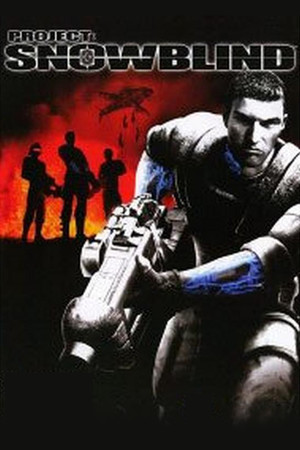
I went into Project: Snowblind expecting a bargain-bin curio and came out genuinely annoyed it never found its audience. Crystal Dynamics built this as an action-forward FPS stripped of the RPG overhead that made Deus Ex: Invisible War divisive, and the result is a tight, fast campaign where every fight has more tactical texture than the genre usually bothers with. You are Nathan Frost, a grunt who survives a battlefield explosion only to wake up rebuilt as the Liberty Coalition's first nano-augmented soldier, set loose on 2065 Hong Kong against a rogue regime called the Republic. The setup is boilerplate, the villain is telegraphed two missions in, and nobody is writing term papers on the narrative. None of that matters much once the shooting starts. The combat toolkit is where the game earns its keep. Every weapon carries a secondary fire - the HERF gun can lay EMP zap mines, the Flechette Gun releases homing insects that track down enemies, and even the standard carbine has an alt-mode worth using. Layered on top of that are the nano-augmentations: Reflex Boost for bullet-time firefights, Cloak for repositioning, Electrical Storm for area denial, and Ballistic Shielding that makes you briefly unkillable in close quarters. The Icepick hacking tool lets you flip enemy cameras, turrets, and security bots to your side mid-fight, which is a legitimate power move when the level drops eight soldiers on you at once. The dual-resource system - red health restored by scattered packs or a Nano Boost, blue bio-energy that gates your augmentation use - means you are constantly managing aggression vs. patience in a way most shooters at this level don't ask for. The chaos is sustained and fun, not punishing for its own sake. There are real problems to flag. The campaign runs five to eight hours depending on how aggressively you explore, and the save-point system - no quicksave, checkpoints spread far apart - will make you replay chunks you already cleared. The PC port was built with consoles as the primary platform, and it shows: the mouse-feel is acceptable but not crisp, and running on anything newer than Windows XP requires a compatibility fix involving CPU affinity adjustment that you will need to look up before your first session. Crash-to-desktop behavior on modern systems is a documented issue. The AI reads enemy positioning reasonably well early on but does not scale difficulty in any meaningful way, and there is no difficulty selector anywhere in the menus. Multiplayer - Deathmatch, Hunter mode, team variants for up to 16 players with co-op vehicle turret use - is functionally dead. You are not buying this for online play in 2024. For a shooter fan approaching this as a single-player historical artifact, it delivers a surprisingly punchy six-hour window. The level variety across 11 missions and 16 maps - converted opera house, Buddhist temple militarized, rain-soaked urban streets - keeps the pacing honest. The augmentation combo play is genuinely interesting, not a cosmetic layer. If you appreciated the action rhythm of mid-era Deus Ex titles but wished they had less menu friction and more pure firefight intensity, this hits that specific gap. Just do the compatibility fix before you launch it, or you will spend the first hour staring at crash reports instead of playing the game.

Shooters
Tags
System Requirements
Minimum
IBM PC or 100% compatible, Microsoft Windows 2000/XP, Pentium IV, 1.5 GHz (Or AMD Athlon XP equivalent) processor, 100% DirectX 64 MB 3D Accelerated video card with Pixel Shader v1.1 Capability, 256 MB System R…
Keep exploring
Community Discussion
Be the first to comment on Project: Snowblind.
Reviews & Ratings
Game Info
- Developer
- Crystal Dynamics
- Publisher
- Square Enix
- Release Date
- Mar 29, 2007