Pixel Puzzles 2: Space
A low-stakes digital jigsaw with 25 space-themed puzzles and a clever payload mechanic that forces you to choose between power-ups and rocket achievements. Relaxing in short bursts, thin on depth, but honest about what it is.
GamerScout Verdict
Best for jigsaw fans who want a relaxing, space-themed puzzler with a light achievement hook and zero spreadsheet required.
Compare Prices(0 stores)
Loading prices...
We may earn a commission when you buy games through links on this page — at no extra cost to you. It never affects our rankings or verdicts.
Price History
Screenshots & Media
About Pixel Puzzles 2: Space
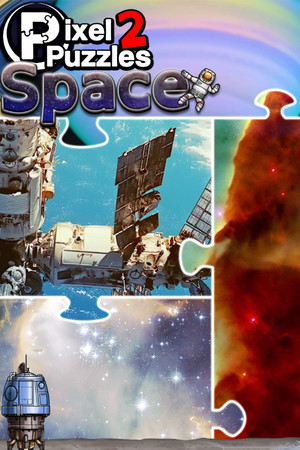
My spreadsheet instincts fired up a warning the moment I saw 'Strategy' in the genre tags for this one. Pixel Puzzles 2: Space is, unambiguously, a digital jigsaw puzzle game. No build orders, no late-game economy, no AI to outwit. What you get instead is a quiet corner of your Steam library where 25 space-photography images get cut into anywhere from 60 to 350 uniquely shaped pieces, all floating weightlessly around a central board while ambient music hums in the background. If you came here looking for grand strategy, keep scrolling. If you need something to run on a second monitor while a podcast plays, keep reading. The core loop is exactly what it says on the tin: drag pieces from the floating field onto the board, right-click to rotate, snap into place. What makes the Space entry modestly interesting compared to a plain jigsaw app is the payload mechanic. Rocket part capsules drift around with your puzzle pieces, and you can feed them into power-up satellite launchers to activate one of three assists: a ghost overlay that briefly shows the completed image, a location highlight that marks the correct board position for the piece you are currently holding, or an angle fix that auto-rotates the held piece to the correct orientation. The catch is that those same payloads can instead be loaded into the rocket on the left side of the screen. Fill the rocket and it launches, unlocking an extra achievement on top of the standard puzzle completion. That one trade-off decision, power-up now or chase the rocket achievement, is the closest thing to strategic decision-making in the entire package, and it is genuinely a nice touch for a game at this price tier. The image selection is the headline strength. Planets, deep-space nebulae, shuttle launches, Earth from orbit, astronauts mid-EVA. The photos are colourful and detailed enough that the harder puzzles in the 200-350 piece range genuinely challenge you on the sections dominated by uniform structure or near-black starfield. A rocket-and-scaffolding puzzle near the top of the difficulty curve is the most cited frustration in the community, and fairly so: large uniform-grey sections become a chore rather than a challenge. The flip side is that the piece shapes are genuinely distinct in each puzzle, meaning there is no copy-paste cut pattern across the set. Progress saves automatically, so you can abandon mid-puzzle without penalty. All 25 puzzles are available from the start with no unlock gating, which is a small but meaningful quality-of-life win that earlier entries in the series lacked. Where the game earns its critical split is the floating-piece system. Pieces orbit the board rather than sitting in a static tray, and while a sorting tray is available to park pieces you have picked out, new players often find the constant gentle drift disorienting rather than atmospheric. Mouse-only control makes precise grabbing in a crowded field tedious, and critics are right that a touchscreen input would feel more natural. There is also zero replay value once the 25 puzzles are done and the 55 achievements are swept up, which takes most players somewhere between five and fourteen hours depending on how methodically they work. No difficulty scaling per puzzle, no custom piece counts, no randomised cuts. What you complete once is complete forever. For the strategy-and-sim crowd I typically write for, this is a palate cleanser, not a main course. But for the person who loves physical jigsaws and wants a zero-mess, auto-saving, space-flavoured version with a light achievement hook, it does exactly that job without pretending to be more. The Steam user base rates it very positively, and the community sentiment earned over years of play broadly holds up. Approach it as a wind-down tool, not a puzzle-design showcase, and the expectations land correctly.

Strategy & simulation
Tags
System Requirements
Minimum
- OS
- Windows 10, 8.1, 8, 7, Vista, XP
- Memory
- 2 GB RAM
- Storage
- 250 MB available space
- Graphics
- DirectX 9.0 Compatible
- Processor
- Intel® Core 2 Duo
- Sound Card
- Generic Sound Device
Recommended
- OS
- Windows 10, 8.1, 8, 7, Vista, XP
- Memory
- 4 GB RAM
- Storage
- 250 MB available space
- Graphics
- DirectX 9.0 Compatible
- Processor
- Intel® Quad Core
- Sound Card
- Generic Sound Device
Keep exploring
Community Discussion
Be the first to comment on Pixel Puzzles 2: Space.
Reviews & Ratings
No ratings available
Game Info
- Developer
- Pixel Puzzles
- Publisher
- Pixel Puzzles
- Release Date
- Feb 19, 2016