On Rusty Trails
A compact, twitchy platformer with a genuine heart: Elvis the triangle-robot navigates a segregated world by swapping skins, and the mechanic carries both the gameplay and the allegory.
GamerScout Verdict
Best for twitch-platformer fans who want a 2-3 hour precision game with something genuine to say between the jumps.
Compare Prices(8 stores)
Every store in this table quotes us in euros, so the EUR figure is the price the seller actually set, not our arithmetic — which is why EUR is also the currency we rank in. We only list an offer here when the store gives us its price in euros, so nothing in this table is a number we invented.
Pick USD, PLN, GBP, CAD or AUD in the header and we convert from EUR at the European Central Bank reference rate — converted amounts are prefixed with ~. Your bank or the store may apply a different rate at checkout. We never hide offers based on where you are: everyone sees this whole table.
We may earn a commission when you buy games through links on this page — at no extra cost to you. It never affects our rankings or verdicts.
Price History
Screenshots & Media
About On Rusty Trails
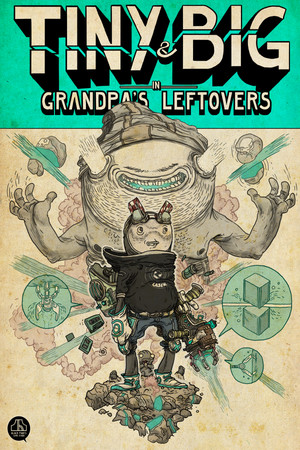
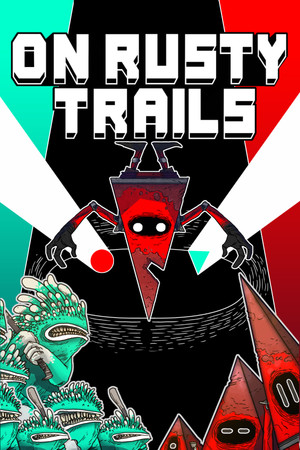
My first instinct with On Rusty Trails was to write it off as one more color-swap platformer dressed up in a cute art style. I was wrong, and I am glad the game made me admit it. Black Pants Studio, the small German outfit behind Tiny and Big: Grandpa's Leftovers, built something here that operates on two frequencies at once: a fast, die-and-retry precision platformer on the surface, and a quietly melancholy fable about conformity and faction hatred underneath. The setup is deceptively mundane. You play Elvis, a red triangular robot whose house gets destroyed in a storm. He has a warranty. He needs to find the manager. That is the whole premise, and it is enough. The world Elvis moves through is split between two peoples, the angular red Spikes and the blue furry Hairys, and the architecture reflects their enmity in every detail. Propaganda billboards line the levels. Crowds react with hostility when you approach in the wrong color. The game earns its themes through its mechanics rather than through cutscenes or dialogue, which is exactly how a platformer should do it. Elvis's Shifty Suit, found early, lets him switch between red and blue forms at a button press. Red-only platforms materialize under a red Elvis; blue waterfalls become lethal when you are the wrong color; jump pads flip into traps. The shift is not just a puzzle toggle, it is the literal act of passing. What makes the design click is how Elvis moves in relation to surfaces. He magnetizes to any block he touches, meaning he can walk on ceilings, hug walls, and loop around platforms entirely. Combined with the color-shift, this opens up routes that a traditional gravity-bound platformer simply cannot offer. Each of the roughly 110 levels has multiple valid lines through it: the fast route for leaderboard chasers, a token-hunting route for completionists, and a checkpoint-friendly route for players who want to absorb the world. The checkpoint system itself has a cost, requiring tokens collected from the level to unlock, so there is a small but meaningful tradeoff between safety and score. The game introduces hazards like red lasers, blue waterfalls, crumbling platforms, and missile sentries across its multiple chapters, and each new element arrives cleanly without a tutorial dump. Later sections ask you to mid-air swap colors while threading through stacked hazards, and those sequences produce the kind of twitchy flow state that the soundtrack seems specifically composed to induce. That soundtrack deserves its own paragraph: industrial percussion and melodic bass lines that shift in tempo as the chapters progress, creaky and crunching in the quieter suburbs, frenetic in the factories. It is the kind of score that makes you realize you have been nodding your head without knowing it. The criticisms are real and worth naming. The game is short, completable in two to three hours on a first run even for players who are not rushing. Seasoned platformer veterans may find the core campaign mild, with the true difficulty hidden in the optional no-checkpoint and score-attack layers. A handful of late-game sections place hazards just beyond the camera's edge, making a few deaths feel less like a skill read and more like trial-by-information. And while the thematic backdrop is genuinely affecting, players hoping for a fleshed-out narrative will find it stays impressionistic throughout. The storytelling is environmental and minimal, which is a deliberate choice, but it does leave the faction conflict feeling underexplored by the ending. For the right person, none of that is a dealbreaker. This is a handcrafted small game that knows what it is, runs beautifully on low-spec hardware across PC, Mac, and Linux, and carries a Metacritic score of 77 that feels honestly earned rather than inflated. The wall-magnetism alone does enough to separate it from the genre pack, and the allegory sitting beneath all the speed running gives it a texture that most pure platformers simply do not have.

Indie & narrative
Tags
System Requirements
Minimum
- OS
- Windows XP or newer, 32 or 64 bit
- Memory
- 2048 MB RAM
- Storage
- 2 GB available space
- Graphics
- OpenGL 3.1 or higher required (Intel HD series, NVIDIA GeForce 8000 series, AMD Radeon HD series or newer)
- Processor
- CPU with SSE2 support required (Core 2 Duo, Athlon X2 or newer).
Recommended
- Memory
- 4096 MB RAM
- Graphics
- NVIDIA GeForce or AMD Radeon with 1024MB VRAM recommended.
- Processor
- Quad core processor, Intel Core i5, AMD Athlon X4 or better
Keep exploring
Community Discussion
Be the first to comment on On Rusty Trails.
Reviews & Ratings
Game Info
- Developer
- Black Pants Studio
- Publisher
- Black Pants Studio
- Release Date
- Jun 13, 2016