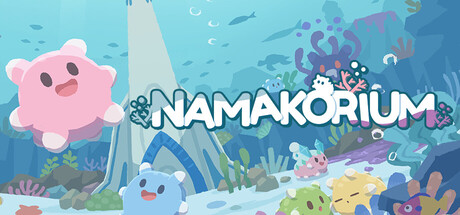
NAMAKORIUM (ナマコリウム)
Forget base-building marathons: NAMAKORIUM condenses co-op RTS tension into compact ocean-cleanup missions where a wrong build order at minute three will cascade into beautiful, team-wide disaster.
GamerScout Verdict
Best for co-op squads who want short, replayable RTS puzzles with genuine role coordination and can tolerate a still-growing content library.
Compare Prices(2 stores)
Every store in this table quotes us in euros, so the EUR figure is the price the seller actually set, not our arithmetic — which is why EUR is also the currency we rank in. We only list an offer here when the store gives us its price in euros, so nothing in this table is a number we invented.
Pick USD, PLN, GBP, CAD or AUD in the header and we convert from EUR at the European Central Bank reference rate — converted amounts are prefixed with ~. Your bank or the store may apply a different rate at checkout. We never hide offers based on where you are: everyone sees this whole table.
We may earn a commission when you buy games through links on this page — at no extra cost to you. It never affects our rankings or verdicts.
Price History
Screenshots & Media
About NAMAKORIUM (ナマコリウム)
My first instinct when I saw 'sea cucumbers' as the unit roster was to dismiss this as a novelty skin over a shallow co-op game. I was wrong, and I spent a couple of evenings learning that lesson the hard way. NAMAKORIUM is a compact, planning-heavy real-time tactics game where you and up to three other players command specialized Namako units across polluted underwater maps, racing to purify contamination before your food supply runs dry. The RTS label is accurate but needs a qualifier: this is closer to a co-op puzzle-efficiency game than a base-builder. There is no fog-of-war to scout, no opponent AI to crush. The map itself is your adversary, and the clock is its weapon. The unit variety is where the strategy sits. Shell Namako gathers limestone, Iron Namako handles heavy mining, and Flame and Ice variants push into temperature-locked zones that other units simply cannot enter. Each type has a defined role, and the game's central tension is deciding who unlocks which upgrade path. In a three or four-player session, upgrades are unlocked per player, meaning a specific tool or ability becomes one teammate's exclusive responsibility. You need to supply them, protect their supply line, and call on them at the right moment. That role-locking mechanic is the thing that separates a casual run from a coordinated one, and it produces genuine communication. Players who enjoy that Pikmin-style 'efficiently dispatch the right unit to the right node' feeling will find a strong loop here. The solo mode deserves a mention, because the marketing buries it. There is a relaxed single-player option for learning the maps without social pressure, plus an optimization mode for players who want to chase clear-time rankings on each of the eight current stages. That is your tutorial replacement: run solo first, learn the map geometry, understand where the Blight Namako (corrupted units that re-contaminate zones and spoil your food) spawn, then bring that knowledge into co-op. The tutorial itself is short, five to ten minutes at most, and does a reasonable job of explaining the basics without overwhelming newcomers. For a game that sits at the intersection of casual and real-time tactics, the on-ramp is gentler than the genre reputation suggests. The caveats are real, though. Content volume is still Early Access thin: eight maps is a complete evening with friends, maybe two if you chase optimal times. The game launched May 18, 2026 as a full release after a January 2026 Early Access window, but the developer's own roadmap signals that new biomes, stage mechanics, buildings, and possible versus or time-attack modes are still under consideration. There is also AI-generated content in some graphic assets and translation work, which drew some community friction around disclosure timing during Early Access. Worth knowing before purchase. Matchmaking with randoms works and the community is small but active, though the experience predictably scales with how well your group communicates. Coordination gaps in the mid-to-late portion of a map, where tasks multiply and zones diverge, will surface any weak links in a pickup group fast. For the asking price and the session length per map, the raw fun-per-hour on a coordinated run is high. The post-apocalyptic world hiding under the cute aesthetic, the Blight Namako as an active threat rather than just a timer, and the per-player upgrade economy all add up to more decision-making than the visual style implies. It is not a deep grand strategy game with 200-hour legs. It is a tightly designed co-op efficiency puzzle with a strong core loop and an Early Access content library that needs time to grow.

Strategy & simulation
Tags
System Requirements
Minimum
- OS
- Windows 10 or later (64-Bit)
- Memory
- 16 GB RAM
- DirectX
- Version 12
- Storage
- 4 GB available space
- Graphics
- GeForce GTX 1050 (2GB)
- Processor
- i5-3570K 3.4 GHz 4 Core
Recommended
- OS
- Windows 10 or later (64-Bit)
- Memory
- 32 GB RAM
- DirectX
- Version 12
- Storage
- 4 GB available space
- Graphics
- GeForce RTX 2070
- Processor
- i9-9900K 3.6 GHz 8 Core
Keep exploring
Community Discussion
Be the first to comment on NAMAKORIUM (ナマコリウム).
Reviews & Ratings
No ratings available
Game Info
- Developer
- Polyscape Inc.
- Publisher
- Polyscape Inc.
- Release Date
- May 18, 2026