My Time at Sandrock
Sixty-plus hours of desert crafting, genuinely charming townsfolk, and a post-apocalyptic world that earns its warmth - if life-sim fatigue hasn't set in yet, Sandrock will swallow your evenings whole.
GamerScout Verdict
Best for patient builders who want a life-sim with genuine story stakes and a cast of NPCs worth actually knowing.
Compare Prices(10 stores)
Every store in this table quotes us in euros, so the EUR figure is the price the seller actually set, not our arithmetic — which is why EUR is also the currency we rank in. We only list an offer here when the store gives us its price in euros, so nothing in this table is a number we invented.
Pick USD, PLN, GBP, CAD or AUD in the header and we convert from EUR at the European Central Bank reference rate — converted amounts are prefixed with ~. Your bank or the store may apply a different rate at checkout. We never hide offers based on where you are: everyone sees this whole table.
We may earn a commission when you buy games through links on this page — at no extra cost to you. It never affects our rankings or verdicts.
Price History
Screenshots & Media
About My Time at Sandrock
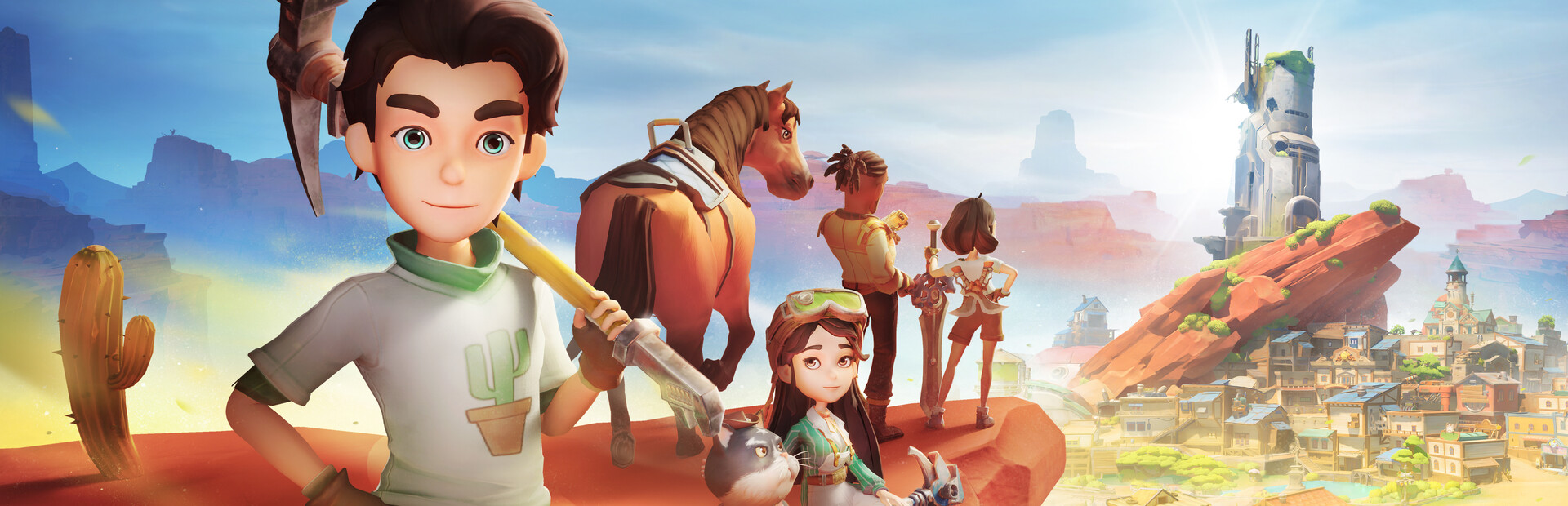
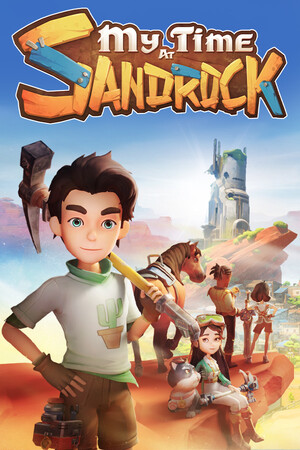
I went in expecting a cozy builder with shallow NPC banter and came out three seasons later having named my horse, memorized Amirah's gift schedule, and actually cared whether the town's water supply held up. That sneaky emotional investment is what Sandrock does better than most games in its genre. The premise is deceptively simple: you arrive as a newly licensed Builder in a sun-scorched desert community and start climbing a commission ladder to keep the town solvent. But the world sitting underneath that loop is a thoughtfully constructed post-apocalyptic setting, roughly 330 years after an event called the Day of Calamity wiped out advanced civilization. Water is scarce, trees are a luxury, and your entire production line runs on dew collectors and water tanks rather than the usual pastoral abundance. That environmental constraint reshapes what crafting feels like compared to competitors - you are not just farming crops, you are managing an industrial supply chain in a drought. The workshop loop is the backbone and it holds up for a long time. You gather raw materials from the Abandoned Ruins, smelt them through an interconnected chain of machines, and assemble commissions piece by piece. Research is gated behind Data Discs, which means expansion feels earned rather than arbitrary. Four knowledge trees - Gathering, Workshop, Combat, and Social - level independently based on what you actually do, so a player who lives in the quarry will develop a very different character from someone who spends mornings chatting at the Commerce Guild. The Combat tree unlocks combo attacks and stat bonuses tied to your preferred weapon, with four melee options to specialize in: daggers, spears, sword-and-shield, and heavy swords. The BREAK system adds a layer of real depth - every enemy has a Toughness gauge, and depleting it stuns them for a burst damage window, but your own BREAK meter works the same way in reverse. It is casual-friendly but not brain-dead, which is exactly the calibration this audience needs. Where Sandrock genuinely outperforms its predecessor and many genre peers is in its cast. Over 40 NPCs can be befriended, a couple dozen are romanceable, and nearly all of them have distinct voiced dialogue and their own ongoing storylines. Befriending them is not just flavor - relationship levels passively boost your stamina, and some unlock quest lines with actual narrative stakes. The main story itself threads a mystery around bandits, ancient tech, and the politics of the Free Cities, and it mostly lands its emotional beats without leaning on filler. There are some side quests that exist purely to pad commission counts, and the early-game building grind before your machine network hits critical mass can feel slow if you are pushing the story forward rather than exploring. The dungeons, meanwhile, are the weakest pillar: Hazardous Ruins are functional combat dives but they are boxy, repetitive, and exist more as knowledge-farming tools than compelling level design. The co-op mode deserves a mention because it is genuinely distinct from the solo campaign rather than a tacked-on second player slot. The multiplayer world is set earlier in Sandrock's timeline - major town landmarks are missing and up to four players collectively build them from scratch, sharing resources and using a streamlined skill progression. Friends can also drop in and out of a hosted world asynchronously, which is a small but meaningful design decision. On PC the game runs well enough, though some graphical pop-in and occasional menu sluggishness showed up in reviews at launch - patches have smoothed most of it since. The Steam Deck experience is workable but not perfectly optimized, so factor that in if portability is your plan. At 88 percent positive across nearly 29,000 Steam reviews and an 80 on Metacritic, the consensus is warm and consistent: this is a refined, heartfelt life-sim that rewards patience and punishes players who want their dopamine loops delivered instantly.

RPGs
Tags
System Requirements
Minimum
- OS
- Win 10
- Processor
- Intel Core i3-2100 | AMD FX-6300
- Memory
- 8 GB RAM
- Graphics
- Nvidia GeForce GTX760 | AMD Radeon 7950
- DirectX
- Version 11
- Storage
- 20 GB available space
Recommended
- OS
- Win 10
- Processor
- Intel Core i7-9700K | AMD Ryzen 7 2700X
- Memory
- 16 GB RAM
- Graphics
- Nvidia GeForce GTX1060 | AMD Radeon RX 580
- DirectX
- Version 11
- Storage
- 50 GB available space Additional Notes…
Keep exploring
Community Discussion
Be the first to comment on My Time at Sandrock.
Reviews & Ratings
Game Info
- Developer
- Pathea Games
- Publisher
- Pathea Games, Focus Entertainment, PM Studios, Inc., DMM Games
- Release Date
- Nov 2, 2023