

Musaic Box
An IGF award-winner from 2009 that most people slept on: part hidden-object scavenger hunt, part spatial-audio puzzle, entirely its own quiet thing.
GamerScout Verdict
Best for patient puzzle fans who want a short, handcrafted game where listening is just as important as looking.
Compare Prices(6 stores)
Every store in this table quotes us in euros, so the EUR figure is the price the seller actually set, not our arithmetic — which is why EUR is also the currency we rank in. We only list an offer here when the store gives us its price in euros, so nothing in this table is a number we invented.
Pick USD, PLN, GBP, CAD or AUD in the header and we convert from EUR at the European Central Bank reference rate — converted amounts are prefixed with ~. Your bank or the store may apply a different rate at checkout. We never hide offers based on where you are: everyone sees this whole table.
We may earn a commission when you buy games through links on this page — at no extra cost to you. It never affects our rankings or verdicts.
Price History
Screenshots & Media
About Musaic Box
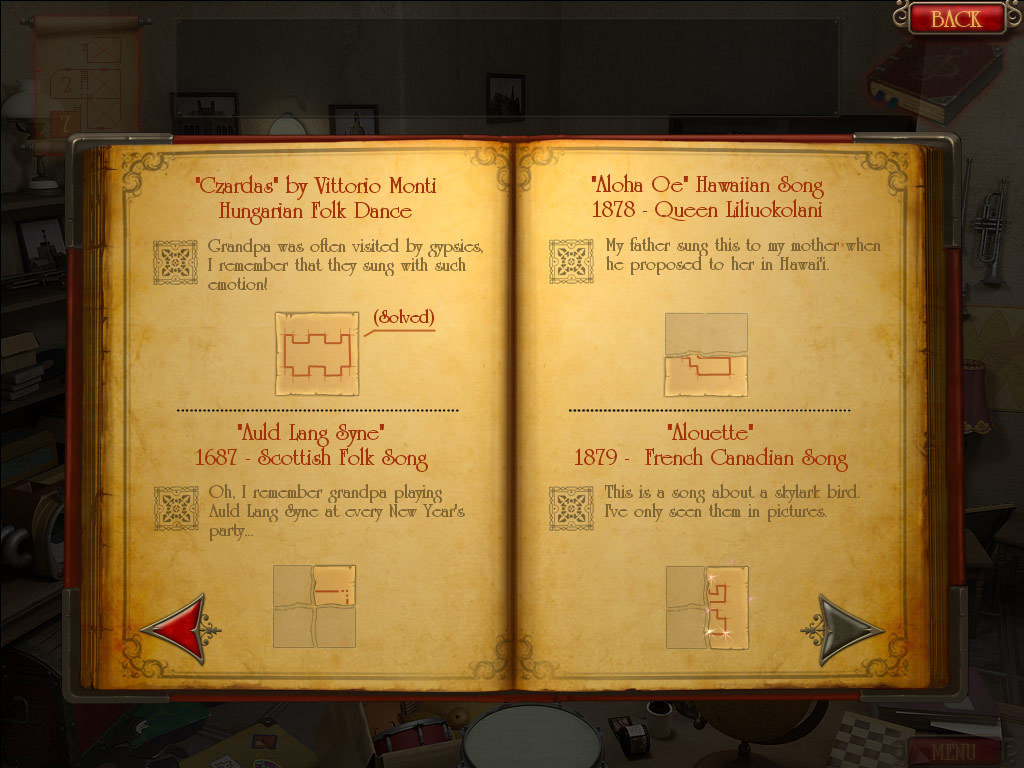
I keep coming back to Musaic Box the way you keep humming a tune you can't quite place. It won the IGF Excellence in Design award in 2009, got named Best Casual Game at the Russian KRI conference, and then somehow faded into the kind of obscurity that only the most specific genre hybrids tend to suffer. That's worth correcting. The loop works like this: you comb through the antique-cluttered rooms of your grandfather's house, finding scattered fragments of sheet music in classic hidden-object fashion. Once you've assembled enough pieces of a composition, you move to the musaic box itself, where the real game lives. The puzzle screen presents tetrimino-shaped tile groups, each carrying a snippet of one of four instrumental parts: melody, countermelody, bassline, or percussion. Your job is to arrange those Tetris-like blocks on a grid so that no two same-colored (same-instrument) tiles share a column and the whole eight-bar piece resolves correctly. A guide track plays the lead melody so you know what you're aiming for. Solve it, and the musicians animate and the full arrangement rings out. That payoff moment is genuinely lovely. The spatial-logic side of the puzzle is accessible enough that players with no musical training can brute-force their way through early compositions using geometry alone. Later puzzles, longer pieces like "Czardas" or "Ode to Joy," demand that you actually listen: a bassline tile with nothing to anchor it visually only slots correctly when your ear tells you where it belongs. That dual demand, eyes and ears working together, is where Musaic Box earns its design pedigree. The color-coded instrument system is clean and communicates clearly, and the hint button that darkens misplaced pieces keeps things from tipping into frustration. It is worth noting that the hidden-object half of the game is the weaker limb: the hint system surfaces solutions almost before you want them, and seasoned hidden-object players will find those rooms thin. A minority of contemporary reviewers also felt the musical arrangements of the public-domain songs (Yankee Doodle, Mary Had a Little Lamb, Blue Danube) were too sparse to carry the audio half with confidence. That criticism has real merit in a handful of later puzzles where the guide track disappears and multiple tile configurations become technically valid. What nobody disputes is the craft in the quieter details. The in-game musicians are skeletal-animated likenesses of the five-person development team, each playing their real instrument, which gives the whole thing a handmade warmth that big-studio casual games never bother with. The soundscape between puzzles, the creak of antique furniture, the distant music box ticking, is exactly the kind of intentional atmosphere I want from a small studio swinging for something original. After you finish all 27 compositions, a Creative Mode unlocks, letting you rearrange pieces across a free board to compose your own arrangements. It is a light sandbox, not a DAW, but it extends the life of the core mechanic past the credits in a way that feels honest rather than padded. Musaic Box runs short by modern standards and the hidden-object rooms are a thin wrapper around the puzzle core. If you need mechanical depth or high replayability, look elsewhere. But if you have a couple of quiet evenings and any affection for the idea of reassembling music the way you'd reassemble a mosaic, this is one of those small, finished, intentional games that does exactly what it set out to do and then stops. Those are rarer than they should be.

Indie & narrative
Tags
System Requirements
Minimum
- Sound
- DirectX® compatible Sound Card
- Memory
- 256 MB RAM (512+MB recommended)
- Graphics
- DirectX® compatible with 16 MB of Video Memory
- Processor
- 800Mhz
- Hard Drive
- 54 MB or more
- Supported OS
- Microsoft® Windows® 2000/XP/Vista
- DirectX® Version
- DirectX 8.0
Keep exploring
Community Discussion
Be the first to comment on Musaic Box.
Reviews & Ratings
No ratings available
Game Info
- Developer
- KranX Productions
- Publisher
- KranX Productions
- Release Date
- Mar 19, 2009
