
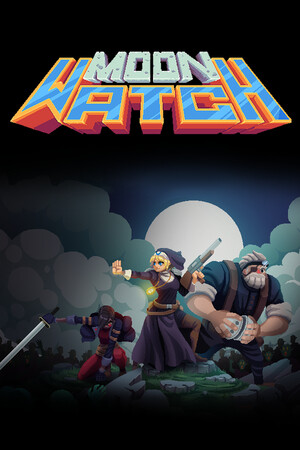
Moon Watch
Vampire Survivors meets Slay the Spire, then Superhot walks in and slows everything down. If you ever wished bullet heaven games would let you actually think, Moon Watch is built for you.
GamerScout Verdict
Promising Early Access pick for deckbuilder fans who want positioning and planning over twitch reflexes, with more content still on the way.
Compare Prices(6 stores)
Every store in this table quotes us in euros, so the EUR figure is the price the seller actually set, not our arithmetic — which is why EUR is also the currency we rank in. We only list an offer here when the store gives us its price in euros, so nothing in this table is a number we invented.
Pick USD, PLN, GBP, CAD or AUD in the header and we convert from EUR at the European Central Bank reference rate — converted amounts are prefixed with ~. Your bank or the store may apply a different rate at checkout. We never hide offers based on where you are: everyone sees this whole table.
We may earn a commission when you buy games through links on this page — at no extra cost to you. It never affects our rankings or verdicts.
Price History
Screenshots & Media
About Moon Watch
I respect any three-person studio willing to throw three genre rulebooks into a blender and call the result a feature. Moon Watch does exactly that: it borrows the endless-horde feel of bullet heaven games, grafts on a card-based combat system, then rips out the reflex requirement entirely by making time move only when you move. Stand still and the vampire hordes freeze mid-lunge. That single design choice turns what could have been a chaotic auto-attack fest into something that rewards the kind of player who wants to read every tooltip before committing to a position. The core loop runs like this: you move, enemies and projectiles advance, you stop, everything pauses, you play cards from your hand to attack or reposition, then repeat. Cards cost power that recharges with movement, so there is a genuine push-pull between staying still to plan and moving to refuel. Each of the three launch characters pulls this loop in a different direction. The starter character leans on garlic-zone control and ranged projectiles, keeping things legible for newcomers. Nina, the melee specialist, rewards aggressive dashing and weaving close to enemies while using a curse ability to debuff targets before closing in. Encio is the one for systems-obsessed players: a pinball-movement character who drops turrets, chains electricity, and can charm enemies into fighting each other. The character diversity is already the strongest argument for the game at Early Access launch, because switching from one to another genuinely feels like a different decision tree rather than a palette swap. Content depth at launch sits at three acts across 50-plus randomly selected stages, three mode types (Classic, Horde, and Wave), around 80 cards, 43 relics, and an Infinite Loop mode that lets you keep scaling a completed build until it collapses. Meta-progression is achievement-gated, which is a sensible design choice that avoids the trap of locking core cards behind grind walls. The main honest criticism from early players is that runs can feel somewhat similar after a few sessions, which is a fair flag. The card pool and relic count are solid for Early Access but not yet wide enough to produce the kind of wildly divergent builds that make games like this endlessly replayable. The developer has been transparent that balance and build variety are top priorities for the roadmap, with more cards, characters, enemies, and an expanded meta-progression tech tree all planned before 1.0. For strategy-minded players who bounced off Vampire Survivors because it felt passive, or who found Slay the Spire lonely for want of spatial positioning, Moon Watch is a genuinely novel intersection. The time-stop hook is not a gimmick bolted on for marketing purposes; it is the load-bearing wall of the whole experience. The tutorial does a workmanlike job of introducing the power system and card mechanics without drowning the player in text. It is light enough that someone new to deckbuilders can find their footing, and the pause-at-will design removes the punishment for slow readers. Early Access status means accepting that the back half of the content is still being built, but the foundation is mechanically coherent in a way that early Backpack Hero was before it found its stride.

Strategy & simulation
Tags
System Requirements
Minimum
- OS
- Windows 7 (SP1+), Windows 10 and Windows 11
- Memory
- 1 GB RAM
- DirectX
- Version 10
- Graphics
- DX10, DX11, DX12 capable.
- Processor
- 1.1 GHz Processor
Keep exploring
Community Discussion
Be the first to comment on Moon Watch.
Reviews & Ratings
No ratings available
Game Info
- Developer
- Jaspel
- Publisher
- Pretty Soon
- Release Date
- Dec 4, 2024