
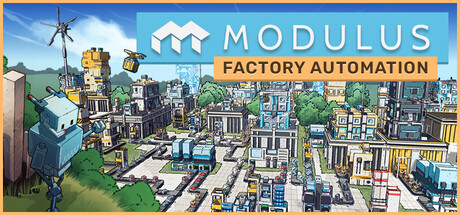
Modulus: Factory Automation
If Factorio's spaghetti belts give you anxiety but you still crave the dopamine of a perfectly timed production line, Modulus is the factory sim that finally lets you breathe.
GamerScout Verdict
Best for factory-sim fans who want puzzle-depth and creative ownership without the survival-mode stress of Factorio or Satisfactory.
Compare Prices(5 stores)
Every store in this table quotes us in euros, so the EUR figure is the price the seller actually set, not our arithmetic — which is why EUR is also the currency we rank in. We only list an offer here when the store gives us its price in euros, so nothing in this table is a number we invented.
Pick USD, PLN, GBP, CAD or AUD in the header and we convert from EUR at the European Central Bank reference rate — converted amounts are prefixed with ~. Your bank or the store may apply a different rate at checkout. We never hide offers based on where you are: everyone sees this whole table.
We may earn a commission when you buy games through links on this page — at no extra cost to you. It never affects our rankings or verdicts.
Price History
Screenshots & Media
About Modulus: Factory Automation
I've been watching this genre closely since Factorio turned spreadsheet-brain into a cultural phenomenon, so when a small Belgian studio ships a factory sim with 91% positive Steam reviews at launch, I pay attention. Modulus: Factory Automation comes from Happy Volcano, an 11-person team better known for the physics chaos of You Suck at Parking, and the pivot to precision automation is a genuine surprise. The core loop is familiar: mine Polyrock deposits (always four miners per node, that's not optional), smelt Base Cubes in Furnaces fed by conveyor belts, then shape those cubes into custom modules using Cutters, Assemblers, Stampers, and Painters. What makes this different from stacking pre-baked machinery is that every component your factory consumes is one you designed yourself, cut to a specific shape, coloured to a specific spec. The production line and the product are the same thing. The spatial constraint layer is where Modulus earns its identity. Factories are built across sky islands with fixed footprints, so belt routing is not an afterthought you can expand around later. You are solving a layout puzzle every time you scale up. Veteran automation players have compared it to a marriage of Zachtronics puzzle logic and traditional factory building, where throughput ratios and spatial limits have equal weight. The tech tree runs through three research tiers: Grey, Blue, and Yellow Datashards, with upgrades gating new mechanics rather than raw power spikes. Progression is smooth enough that new tools arrive before the current set feels exhausted, though some Steam reviewers flag a mid-game friction point around the Tier 2 droid phase where scaling feels mandatory before the systems reward it. That is a real pacing criticism worth noting, not a dealbreaker, but it does mean the mid-game can feel repetitive for players who expected the build-and-forget comfort of Satisfactory. The tutorial is unusually good for the genre. It introduces each operator class in sequence, from the Cutter through to the Assembler and Painter, with video-assisted walkthroughs in the early game that do not condescend. The stackable learning structure means new mechanics build directly on what you already have running, rather than dumping an entirely new system mid-factory. That design choice alone makes Modulus the most beginner-accessible automation title I can point newcomers toward without caveats. The absence of enemies, timers, and failure states removes every common point of new-player friction. The campaign mode gives clear objectives; Creative Mode hands you unlimited resources and expanded module sizes with no goals at all. Both are legitimate entry points depending on how you think. On the visual and audio side, the cel-shaded solarpunk art, green foliage contrasting white machinery, is genuinely pleasant to look at for long sessions. Sound design is deliberate, clicky feedback on assembly events and a calm atmospheric soundtrack that scales subtly with factory size. It is not a game that needs to be loud. One practical note for Linux players: click-and-drag had a documented issue under Proton at launch, though the team has been shipping patches at a reasonable pace since release, including a significant 1.0.4 update. Steam Workshop mod support is not present, which is a gap this genre usually fills with community quality-of-life tools, and that absence will matter to players who rely on mod ecosystems for long-term replayability. The bottom line is that Modulus sits in a precise band of the automation genre: more puzzle-focused and spatially constrained than Satisfactory, less punishing and complex than Factorio, closer in spirit to Shapez 2 but with a physical, three-dimensional construction layer that makes every output feel handmade. If the idea of debugging a belt throughput problem across a sky island with atmospheric music is a good Saturday to you, this is your game right now.

Strategy & simulation
Tags
System Requirements
Minimum
- OS
- Windows 10 - 64 bit
- Memory
- 16 GB RAM
- DirectX
- Version 11
- Storage
- 5 GB available space
- Graphics
- Nvidia GeForce GTX 1660 / AMD Radeon RX 590
- Processor
- Intel Core i5-11600K / AMD Ryzen 5 5500
Recommended
- OS
- Windows 10 - 64 bit
- Memory
- 16 GB RAM
- DirectX
- Version 11
- Storage
- 5 GB available space
- Graphics
- Geforce RTX 3060 / Radeon RX 6600 XT
- Processor
- Intel Core i5-12600K / AMD Ryzen 5 5600X
Keep exploring
Community Discussion
Be the first to comment on Modulus: Factory Automation.
Reviews & Ratings
No ratings available
Game Info
- Developer
- Happy Volcano
- Publisher
- Kwalee
- Release Date
- Apr 2, 2026