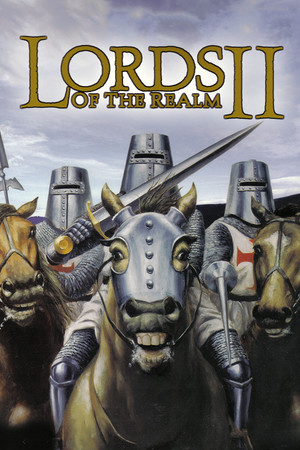
Lords of the Realm II
A 1996 feudal warlord sim that holds up better than most of its era: tight resource loops, real-time siege battles, and a Metacritic 77 that undersells how deeply it hooks strategy players.
GamerScout Verdict
Best for strategy fans who want a no-frills feudal sim with genuine economic depth and satisfying siege battles, if they can tolerate dated AI and minor compatibility legwork.
Compare Prices(0 stores)
Loading prices...
We may earn a commission when you buy games through links on this page — at no extra cost to you. It never affects our rankings or verdicts.
Price History
Screenshots & Media
About Lords of the Realm II
My first session with Lords of the Realm II ate an entire Saturday afternoon, and the reason is embarrassingly simple: the resource loop is just good. You start with a single county in 13th-century England, and before a single sword is swung you are already making tense decisions. How much grain goes to feeding peasants versus building stockpiles? Do you push more labor into iron mining to forge weapons faster, or do you keep the fields healthy enough to avoid a Malthusian population collapse? The game has no technology tree, no magic, no abstracted production queues hiding the math from you. It is a direct negotiation between food, people, happiness, and military readiness, and every slider adjustment has visible downstream consequences within a turn or two. The hybrid structure is what made this a landmark release and what still makes it interesting today. Kingdom management runs turn-based, with each turn representing a season, so you watch your landscape cycle through summer harvests and winter shortfalls. When armies collide, the game switches to a real-time battle engine where you command pikemen, archers, knights, crossbowmen, and mace-armed infantry individually or in formations. Siege scenarios add another layer: catapults, battering rams, and siege towers go up against castle walls and boiling oil pots, and the attacker-defender calculus shifts considerably based on how large a fortification your opponent has had time to build. Smaller stockade castles fall quickly; a fully upgraded royal castle with six oil pots and a large garrison is a genuinely different tactical problem. The game rewards players who think two or three seasons ahead rather than just massing the biggest army. For newcomers worried about the complexity: the interface is more approachable than you might expect from a mid-90s strategy title. Most actions run through slider bars and click-to-assign peasant groupings rather than dense menus. The game also lets you delegate battles to an auto-resolve calculator if you want to focus entirely on the economic and diplomatic side, though experienced players quickly learn that manual battles give a significant edge. The Steam community has produced thorough guides covering everything from optimal weapon-forging costs to the hidden auto-resolve formula used for castle sieges, which is exactly the kind of active player knowledge base that keeps older strategy games alive and approachable in 2024. The weaknesses are real and worth naming. The AI is the biggest one. Critics noted at launch that even the highest difficulty setting becomes predictable once you understand the economic fundamentals, and that diplomatic options are thin enough to be largely cosmetic. Enemy lords have distinct personalities and will hold grudges based on your alliance choices, which adds flavor, but their strategic behavior at the macro level is not going to surprise veterans. Windows 10 and 11 compatibility also requires some manual tinkering: community reports confirm launch issues on Windows 11 that need specific compatibility settings and sometimes additional fixes for the display. None of it is insurmountable, but plan for a fifteen-minute setup session before your first game. Multiplayer, technically available for up to five players over a network, is practically dead and requires third-party IPX tunneling software to attempt. Where Lords of the Realm II earns its place on a modern hard drive is in the purity of its decision-making. There is no bloat, no battle pass, no live-service noise. You grow crops, forge swords, conscript peasants, build castles, and fight for a throne. The feedback loop between economic decisions and military outcomes is clean enough that losses feel instructive rather than arbitrary. For the genre historian, this is a foundational piece of the grand strategy lineage. For the casual strategy fan who finds Crusader Kings III overwhelming, this is actually a reasonable entry point into feudal resource management at a fraction of the complexity.

Strategy & simulation
Tags
System Requirements
Minimum
- OS
- Windows Vista, Windows 7, Windows 8 or Windows 10
- Memory
- 512 MB RAM
- Storage
- 500 MB available space
- Graphics
- NNVidia/ATI 3D graphics card compatible with DirectX 7 with Hardware T&L support (compatible with DirectX 9 recommended)
- Processor
- 1.8 GHz Processor
Keep exploring
Community Discussion
Be the first to comment on Lords of the Realm II.
Reviews & Ratings
Game Info
- Developer
- Impressions Games
- Publisher
- Rebellion
- Release Date
- Dec 3, 2015