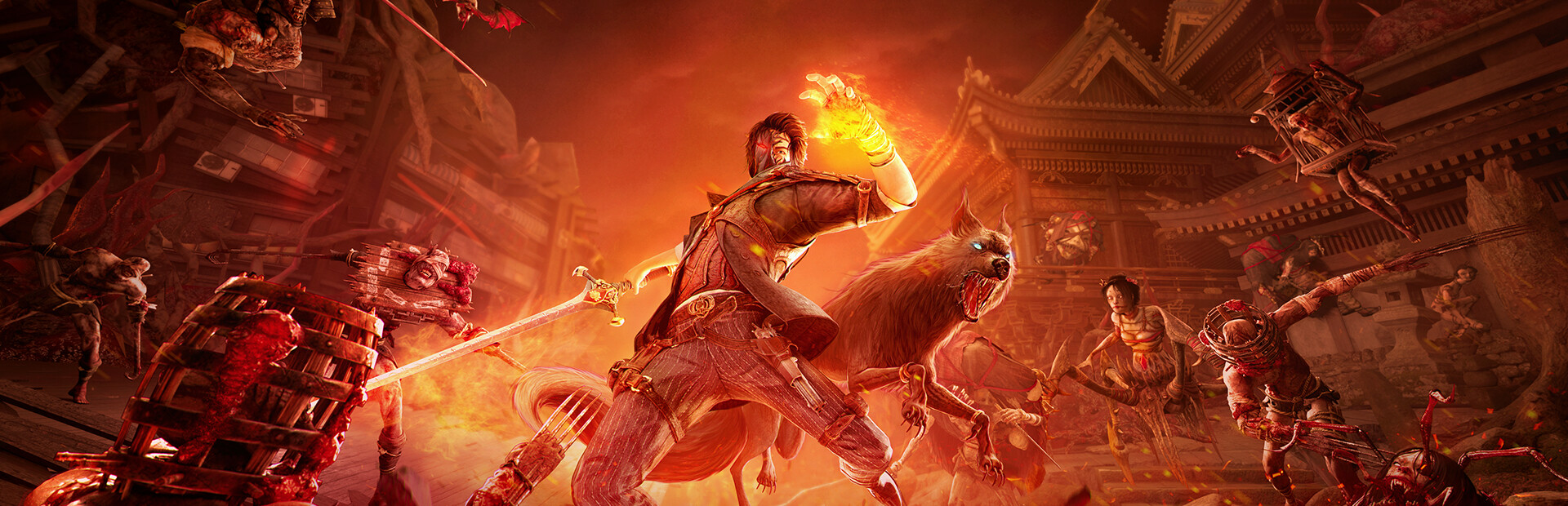

Hellsweeper VR
If your VR legs are solid and you can stomach a steep early learning curve, this first-person roguelike rewards creative combat more than almost anything else in the headset space right now.
GamerScout Verdict
Recommended for VR-seasoned players who want a combat sandbox with genuine build depth, not for headset newcomers.
Compare Prices(7 stores)
Every store in this table quotes us in euros, so the EUR figure is the price the seller actually set, not our arithmetic — which is why EUR is also the currency we rank in. We only list an offer here when the store gives us its price in euros, so nothing in this table is a number we invented.
Pick USD, PLN, GBP, CAD or AUD in the header and we convert from EUR at the European Central Bank reference rate — converted amounts are prefixed with ~. Your bank or the store may apply a different rate at checkout. We never hide offers based on where you are: everyone sees this whole table.
We may earn a commission when you buy games through links on this page — at no extra cost to you. It never affects our rankings or verdicts.
Price History
Screenshots & Media
About Hellsweeper VR
I came into Hellsweeper VR expecting another bog-standard wave-shooter dressed in hell-fire aesthetics, and the first twenty minutes genuinely surprised me. Mixed Realms, the studio behind Sairento VR, has built a roguelike action game around a movement system that most developers would never dare ship: wall-running, power sliding, backflips, somersaults, and bullet-time, all usable mid-combat, all contributing to a damage and buff calculation that rewards execution. That is not a gimmick layered on top of combat. The movement IS the combat system, and once you internalize that distinction, the loop clicks hard. The mechanical depth here leans more systems-oriented than most VR games will attempt. You carry melee weapons, a pistol, and a suite of elemental magic abilities, and the game actively encourages you to fuse them at runtime. Slam a fireball into your pistol barrel to get fire-boosted rounds. Conjure two fireballs and press them together to detonate a vortex that lifts and scorches surrounding enemies. Use telekinesis to float a dropped weapon and fire it from a distance. A Hellhound companion can be charged with your active element to amplify its attacks. Almost every combination you invent physically works, which is not something you can say about most VR titles. Runs are structured across three acts, each ending in a boss fight, and per-run buffs chosen at level transitions mean no two runs play identically. There are 18 maps, over ten enemy types with elemental variants, and a fortnightly Challenge Mode with leaderboards if the roguelike loop alone does not hold you long enough. The friction points are real and worth naming before you click anything. The upgrade and progression economy outside of runs drew criticism at launch for slow experience gain, with some reviewers noting the per-run XP felt disproportionately low relative to the grind required to unlock persistent upgrades. Controls, particularly the gesture-based skill assignments tied to trigger holds and wrist flicks, have a learning cliff that some players never clear, and the tutorial does not do much to ease that slope. Audio design is also a genuine weak spot, with the soundtrack feeling sparse in stretches where it should be driving tension. The PCVR version looks better than its Quest and PSVR 2 counterparts, which had documented resolution issues at launch, but even on PC the visuals do not push the hardware as hard as the movement system demands aesthetically. None of these are deal-breakers in isolation, but stacked together they explain why critical opinion split sharply between reviewers who got their VR legs and those who never did. Steam user sentiment settled around 85% positive across several hundred reviews, which is the honest signal to weight here. Who should actually consider this purchase? Anyone who already has meaningful VR hours logged, has played Sairento or something comparably intense, and specifically wants a run-based action game where build decisions compound across a full run. The three-player cross-platform co-op mode adds a social dimension that makes the early difficulty far more approachable: dying alongside teammates in a botched wall-run is a lot more palatable than solo runs where slow XP gain feels punishing. Newcomers to VR should treat the comfort options as mandatory scaffolding early on, not optional extras. Snap turn, teleport movement, and disabling the more acrobatic moves exist specifically for the stomach-adjustment period, but playing that way changes what the game is, so treat it as a stepping stone rather than a permanent setting. If you are coming from flat games looking for your first serious VR purchase, there are gentler entry points.

Strategy & simulation
Tags
System Requirements
Minimum
- OS
- Windows 7
- Memory
- 8 GB RAM
- DirectX
- Version 11
- Storage
- 12 GB available space
- Graphics
- NVIDIA GeForce GTX 1070
- Processor
- Intel i5-4590
- VR Support
- OpenXR. HP Reverb G2 required for Windows Mixed Reality
Recommended
- OS
- Windows 10
- Memory
- 16 GB RAM
- DirectX
- Version 11
- Storage
- 12 GB available space
- Graphics
- NVIDIA GeForce GTX 1080 or better
- Processor
- Intel i7-4770 or better
- VR Support
- OpenXR. HP Reverb G2 required for Windows Mixed Reality
Keep exploring
Community Discussion
Be the first to comment on Hellsweeper VR.
Reviews & Ratings
No ratings available
Game Info
- Developer
- Mixed Realms Pte Ltd
- Publisher
- Vertigo Games
- Release Date
- Sep 21, 2023