Four Last Things
Commit all seven deadly sins across a collaged Renaissance hellscape, guided by absurdist clergy logic and public-domain Bosch. One solo dev pulled this off, and the craft shows.
GamerScout Verdict
A tightly crafted ninety-minute absurdist puzzler that rewards art-history nerds and Python fans equally - short by design, not by accident.
Compare Prices(9 stores)
Every store in this table quotes us in euros, so the EUR figure is the price the seller actually set, not our arithmetic — which is why EUR is also the currency we rank in. We only list an offer here when the store gives us its price in euros, so nothing in this table is a number we invented.
Pick USD, PLN, GBP, CAD or AUD in the header and we convert from EUR at the European Central Bank reference rate — converted amounts are prefixed with ~. Your bank or the store may apply a different rate at checkout. We never hide offers based on where you are: everyone sees this whole table.
We may earn a commission when you buy games through links on this page — at no extra cost to you. It never affects our rankings or verdicts.
Price History
Screenshots & Media
About Four Last Things
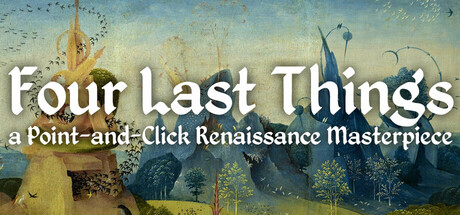
I picked this one up half-expecting a curiosity and finished it the same evening, genuinely charmed in a way I did not anticipate. Joe Richardson built the entire visual world by cutting, animating, and reassembling Old Master paintings - Hieronymus Bosch, Pieter Bruegel the Elder, Jan van Eyck among them - into a single coherent game world that somehow holds together despite being a collage of five centuries of European art. The result is less "art game" as a pretentious genre tag and more the sensation of watching a Flemish altarpiece develop a sense of humour. The premise runs on gleeful institutional absurdity. Your unnamed fool wants absolution, the bishops want jurisdiction, and the only loophole is to methodically commit all seven deadly sins within parish borders before confessing. So off you go with a checklist: pilfer from poets, lounge under a tree long enough to satisfy sloth, win a pie-eating contest for gluttony, and work your way down the list through a point-and-click structure that borrows the verb-coin interaction wheel and drag-and-drop inventory familiar from classic LucasArts adventures. The puzzles run on consistent internal logic rather than moon-logic leaps, and the game even includes an inventory-screen highlight function that marks interactable elements without spoiling solutions - a small accessibility grace note that the genre often ignores. One or two puzzles will still send you hunting for context clues in the dense painterly backgrounds, which can become a mild pixel hunt in darker scenes. That is a genuine gripe, not a mortal sin. The writing is what elevates the whole thing above a visual novelty. Richardson's script trades in sharp wit and dry self-awareness - the kind of humour that makes you smile in your head even if you don't audibly laugh. Character depth is thin by design; this is satire about religious bureaucracy and human foolishness, not a story about a person you will remember forever. The soundtrack, drawn entirely from public domain Renaissance recordings, fits the atmosphere with such precision that hearing a minstrel appear within a Bruegel scene, placed there as though performing live, feels like the game winking at you. Some players flag the music looping repetitively in puzzles that take a while to crack, and after a stuck ten minutes on a single scene the same few bars do wear thin. The lack of a manual save function, flagged by critics on release, is worth knowing before you sit down. The whole run lasts somewhere between ninety minutes and three hours depending on your puzzle tolerance, with no branching endings. Richardson made a deliberate call there, and critics noted it actually strengthens the satirical point - a story about the absurdity of moral bookkeeping does not particularly benefit from player agency over its conclusion. This is a game that knows exactly how long it wants to be, which I will always defend. It is also part of a larger trilogy now, the Immortal John Triptych, alongside The Procession to Calvary and Death of the Reprobate, so if the tone clicks with you there is more waiting. For anyone who finds the Terry Gilliam animation segments of Monty Python funnier than the sketches around them, or who has spent time genuinely looking at Northern Renaissance painting, this is the rare indie that was made specifically for you by someone who also spent that time.

Indie & narrative
Tags
System Requirements
Minimum
- OS
- Windows XP
- Memory
- 2 GB RAM
- DirectX
- Version 9.0c
- Storage
- 500 MB available space
- Graphics
- OpenGL 2.0 compatible with 512 MB RAM
- Processor
- 2 GHz - Dual Core
- Sound Card
- DirectX 9.0c Compatible Sound Card with Latest Drivers
Recommended
- OS
- Windows Vista/7/8/10
- Memory
- 4 GB RAM
- DirectX
- Version 9.0c
- Storage
- 500 MB available space
- Graphics
- OpenGL 2.0 compatible with 512 MB RAM
- Processor
- 2.6 GHz - Dual Core
- Sound Card
- DirectX 9.0c Compatible Sound Card with Latest Drivers
Keep exploring
Community Discussion
Be the first to comment on Four Last Things.
Reviews & Ratings
Game Info
- Developer
- Joe Richardson
- Publisher
- Akupara Games
- Release Date
- Feb 23, 2017