Firefighting Simulator: Ignite
Procedural fire physics, licensed Rosenbauer trucks, and four-player cross-platform co-op make this the most credible firefighting sim on PC right now. Solo players can manage, but this one was built for a crew.
GamerScout Verdict
Best for co-op sim fans who want genuine procedural firefighting; solo players should expect to pick up the AI's slack.
Compare Prices(10 stores)
Every store in this table quotes us in euros, so the EUR figure is the price the seller actually set, not our arithmetic — which is why EUR is also the currency we rank in. We only list an offer here when the store gives us its price in euros, so nothing in this table is a number we invented.
Pick USD, PLN, GBP, CAD or AUD in the header and we convert from EUR at the European Central Bank reference rate — converted amounts are prefixed with ~. Your bank or the store may apply a different rate at checkout. We never hide offers based on where you are: everyone sees this whole table.
We may earn a commission when you buy games through links on this page — at no extra cost to you. It never affects our rankings or verdicts.
Price History
Screenshots & Media
About Firefighting Simulator: Ignite
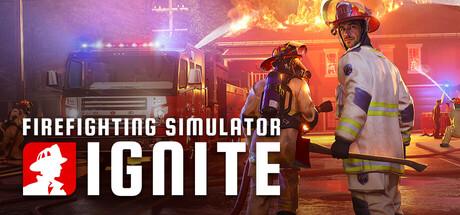
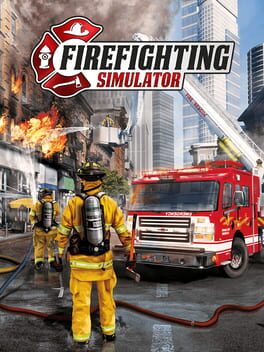
I went into Firefighting Simulator: Ignite the way I approach any sim from a pedigree studio: with a checklist. Does the tutorial respect newcomers without holding their hand forever? Are the systems deep enough to reward mastery? Does the AI hold up when you fly solo? Weltenbauer, the team behind Construction Simulator, checks most of those boxes and stumbles on at least one of them in ways that genuinely matter depending on how you plan to play. The core loop is mission-based, set in the fictional Midwestern city of Oakridge. You select a callout from the command room at fire HQ, drive a licensed Rosenbauer truck to the scene (or teleport if you want to skip the commute), and then work through a sequence of assess-ventilate-suppress-rescue before returning to base. Each mission type carries specific hazards: grease fires that explode if you spray water on them, electrical faults that require isolating the panel before any hose work, backdraft scenarios where opening the wrong door at the wrong angle turns a manageable blaze into a flashover. That last category is where the game earns its keep. Selecting the correct suppression agent, foam versus water versus CO2, is a genuine knowledge check, and the Unreal Engine 5 fire simulation backs it up visually with volumetric smoke, dynamic spread, and structural collapses that make ceilings cave in if you leave a room cooking too long. The equipment roster is impressive. Halligan bar, axe, thermal imaging camera, foam lines, STIHL-branded power tools for cutting through obstacles, and a radial command wheel for directing your NPC crew. That command wheel is both the game's most useful feature and its most frustrating one. In solo play, AI teammates handle the hose supply lines reliably at setup, but mid-mission their targeting logic falls apart. They will spray one spot while a victim needs a carry two meters away, or idle in smoke while you are waiting for ventilation. The community has documented this extensively. It does not ruin solo play, but it does mean you will personally carry more of the cognitive load than the game probably intends. At the training center you can run custom scenarios specifically to learn the maps and hazard positions before a real callout, and that investment pays off, particularly on higher difficulties where fire spread is faster and re-ignition is relentless. Multiplayer is where the design intent clicks. Cross-platform co-op for up to four players lets you split the roles properly: one firefighter on the supply line, one ventilating the structure, one on search and rescue. The integrated voice chat helps, and the drop-in / drop-out structure means an AI fills any gap left by a disconnected player. Early launch reviews flagged multiplayer stability problems, with guest-side crashes being a recurring complaint, so your mileage may vary depending on how well the post-launch patches have addressed connection reliability by the time you pick this up. The mod.io integration on PC is a genuine long-term asset: community missions are already appearing, and the Year 1 Season Pass roadmap promises additional vehicles and mission packs through 2026. Multiple difficulty settings span from a very forgiving easy mode, where fire spreads slowly and failure conditions are minimal, up to a hardcore simulation where limited resources and rapid spread demand real procedural thinking. Newcomers should absolutely start on easy, map out the hazard positions, then step up. This is one sim where the difficulty curve is well-structured. Performance is the asterisk. On PC, high-intensity scenes with large fires and volumetric smoke carry a real hardware cost, with texture pop-in and frame drops reported on mid-range systems. The animations have a stiffness that the Unreal Engine 5 hunch walk does not help, and rescued civilians react with approximately zero emotion, which breaks immersion after you have risked a simulated flashover to drag them out. These are not deal-breakers, but they are things to know going in.

Strategy & simulation
Tags
System Requirements
Minimum
- OS
- Windows 10
- Memory
- 8 GB RAM
- DirectX
- Version 12
- Storage
- 45 GB available space
- Graphics
- 8GB VRAM: NVIDIA -RTX 2060 Super / AMD - RX 5700-XT
- Processor
- AMD - Ryzen 5 3700 / Intel - Core i7 - 9700
Recommended
- OS
- Windows 10
- Memory
- 16 GB RAM
- DirectX
- Version 12
- Storage
- 45 GB available space
- Graphics
- RTX 3070 12GB (8GB) / RX 6800 8GB
- Processor
- AMD - Ryzen 7 5700X / Intel - Core i7 12700k
DLC & Add-ons for Firefighting Simulator: Ignite2
Expansions, DLC packs and add-on content for this game. Click any item to see store offers.
Keep exploring
Community Discussion
Be the first to comment on Firefighting Simulator: Ignite.
Reviews & Ratings
No ratings available
Game Info
- Developer
- weltenbauer. Software Entwicklung GmbH
- Publisher
- astragon Entertainment
- Release Date
- Sep 9, 2025