

Elven Legacy: Siege
If punishing hex-grid tactics and a brutally clever AI sound like your Friday night, Siege delivers nineteen missions of unrelenting pressure, but newcomers to the base game need not apply.
GamerScout Verdict
Worth it only if you finished Elven Legacy and want harder missions with a split-route campaign structure, otherwise skip to the base game first.
Compare Prices(7 stores)
Every store in this table quotes us in euros, so the EUR figure is the price the seller actually set, not our arithmetic — which is why EUR is also the currency we rank in. We only list an offer here when the store gives us its price in euros, so nothing in this table is a number we invented.
Pick USD, PLN, GBP, CAD or AUD in the header and we convert from EUR at the European Central Bank reference rate — converted amounts are prefixed with ~. Your bank or the store may apply a different rate at checkout. We never hide offers based on where you are: everyone sees this whole table.
We may earn a commission when you buy games through links on this page — at no extra cost to you. It never affects our rankings or verdicts.
Price History
Screenshots & Media
About Elven Legacy: Siege
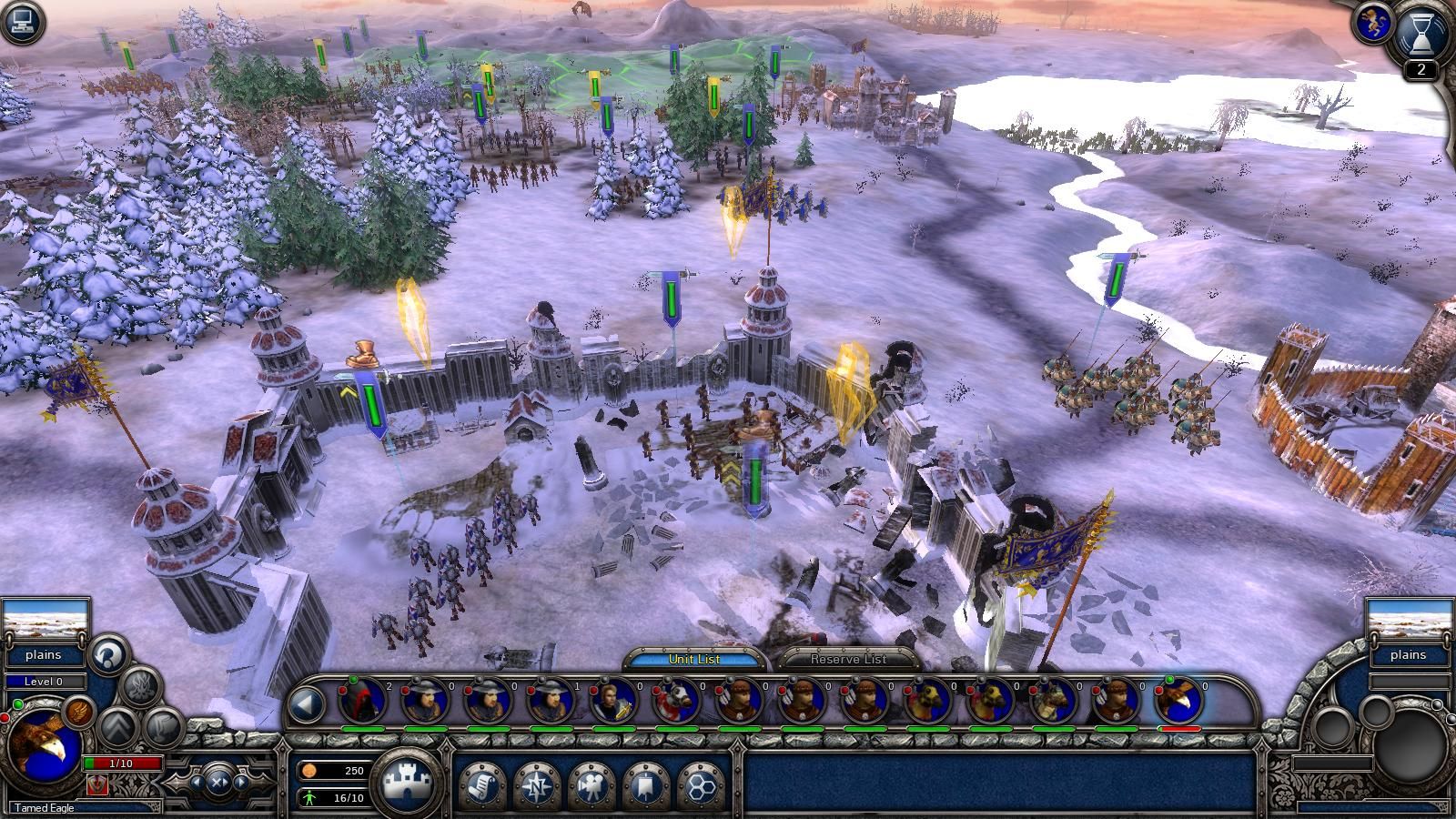
My spreadsheet instincts lit up the moment I saw that Siege splits its campaign across two parallel hero routes, each with separate armies, inventories, and mission choices. That structural decision alone makes it the most tactically interesting of the Elven Legacy expansions on paper, but the reality under the hood is considerably more complicated than a clean dual-campaign promise suggests. At its core this is the same hex-grid, turn-based system inherited from Fantasy Wars and carried forward through Elven Legacy and its first expansion, Ranger. Each unit gets one move and one action per turn: infantry close, archers pick angles, cavalry charges without orders if positioned badly, scout units retain partial movement after attacking, and mages throw spells that function more or less like field artillery. Eagles fly over friendly and enemy stacks as both air cover and tactical bombers. Units level up and unlock skills ranging from improved defense and armor to terrain-crossing passives and invisibility, and all of that hard-won experience evaporates permanently if the unit dies. Keep your heroes alive or fail the mission outright. That risk-reward loop around unit preservation is where the strategic meat actually lives. Where Siege distinguishes itself from Ranger is pure difficulty. Ranger softened the original game's edges somewhat; Siege cranks them back up, then adds an AI that actively uses expendable trash units to finish off your wounded stacks while stronger enemy forces hold objectives as layered strongpoints. The three new hero characters, Sir Karel, Inquisitor Morcius, and Captain Adrian, each command their own force, which on paper gives you two distinct tactical lenses on the same conflict. Mission outcomes carry forward to subsequent maps, so a sloppy silver victory can leave you resource-starved early in the next scenario. The campaign is reportedly stingy with gold and recruits in its opening missions before breathing room appears later. Completionists chasing gold-ranked clears on hard will be replaying individual maps repeatedly, and one bonus mission has a documented bug where casting the shadow spell causes the hero to die alongside the spell's expiry, which is unpatched and requires either a workaround or a console command to survive. That is not a minor footnote; it is the kind of thing that sours an otherwise solid run. The honest assessment is that Siege brings almost nothing mechanically new to the formula. No revised UI, no new unit classes that reframe tactics, no changes to the sound design or voice work (and the lack of voice narration, dropped from the original game, remains a genuine immersion gap). The nonlinear mission structure is the one genuine addition, and the AI quality is strong enough that even on easy the pressure rarely relents. For series veterans who have already absorbed the base game's rhythm, the dual-route campaign and the harder mission design offer real strategic replay value. For anyone hoping this expansion reinvents or meaningfully expands the system, it will read as a paid content drop that happens to be well-constructed rather than a design evolution. This is strictly a purchase for players who already own and enjoy Elven Legacy. The base game requires the Steam version to run, and no amount of tolerance for old-school difficulty will compensate for jumping in here without that foundation. If you cleared Ranger and want nineteen more missions with the AI playing noticeably harder, Siege earns its place. If you are still deciding whether the series is worth your time, start at the beginning and work forward.

Strategy & simulation
Tags
System Requirements
Minimum
- OS
- Windows XP
- Sound
- DirectX-compatible
- Video
- nVidia GF FX 5700 or ATI Radeon 9600 128 MB
- Memory
- 512 MB
- DirectX®
- DirectX 9.0c
- Processor
- 1.5 GHz Pentium IV; AMD 2000+ 1,5Ghz (Single Core)
- Hard Disk Space
- 3 GB of free space
Recommended
- OS
- Windows XP
- Sound
- DirectX-compatible
- Video
- nVidia GF 6800 or ATI Radeon R850XT с 256Мб
- Memory
- 1 GB
- DirectX®
- DirectX 9.0c
- Processor
- 2.4 GHz Pentium IV; AMD 3500+ 2.2Ghz (Single Core)
- Hard Disk Space
- 3 GB of free space
Keep exploring
Community Discussion
Be the first to comment on Elven Legacy: Siege.
Reviews & Ratings
No ratings available
Game Info
- Developer
- 1C:InoCo
- Publisher
- Fulqrum Publishing
- Release Date
- Nov 17, 2009
