Dungeon Defenders: Awakened
A loot-driven tower defense hybrid that plays it too safe solo but genuinely clicks when you bring three friends and crank the difficulty past Normal.
GamerScout Verdict
Worth it as a co-op session game with friends on Hard or higher; solo players should lower expectations significantly.
Compare Prices(6 stores)
Every store in this table quotes us in euros, so the EUR figure is the price the seller actually set, not our arithmetic — which is why EUR is also the currency we rank in. We only list an offer here when the store gives us its price in euros, so nothing in this table is a number we invented.
Pick USD, PLN, GBP, CAD or AUD in the header and we convert from EUR at the European Central Bank reference rate — converted amounts are prefixed with ~. Your bank or the store may apply a different rate at checkout. We never hide offers based on where you are: everyone sees this whole table.
We may earn a commission when you buy games through links on this page — at no extra cost to you. It never affects our rankings or verdicts.
Price History
Screenshots & Media
About Dungeon Defenders: Awakened
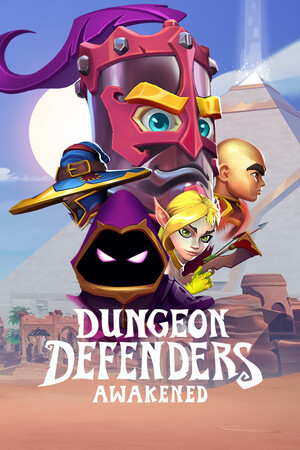
My first instinct with any hybrid strategy-action game is to stress-test the build phase, and Dungeon Defenders: Awakened handed me a clear verdict within a few sessions: the decision space is real, but the game actively hides it from newcomers by making low difficulties laughably easy. Start on Hard. Seriously. The default settings let you coast through wave after wave doing little more than collecting dropped currency between phases, which is the worst possible advertisement for what the mechanics can actually do. Push into the harder modes and the three-phase loop of warmup, build, and combat starts earning its keep: tower placement, aura stacking, and trap chaining across maps like Deeper Well and the Alchemical Labs demand genuine spatial thinking once enemy variety ramps up. The four base heroes, Squire, Huntress, Apprentice, and Monk, each bring a distinct toolkit that shapes how you draft a defense. The Squire leans on tanky blockades and melee towers; the Apprentice handles magic damage and area denial; the Huntress covers traps and ranged pressure; the Monk drops auras that buff nearby structures. Solo, you are locked to one hero per session unless you micromanage swaps at the tavern hub, which is a real constraint. In four-player co-op, each person specializing in one class is where the build variety opens up properly, with synergy between aura buffs and tower damage becoming a legitimate optimization puzzle at higher difficulties and in Survival mode's 25-wave gauntlet. Mix mode, which randomizes enemy compositions, is the chaos test that separates rehearsed strategies from adaptive ones. The loot system gives the progression loop a pull that keeps sessions from feeling inert. Gear drops constantly, stats matter across hero level, casting rate, and tower damage attributes, and the tavern serves as your between-run workshop for comparing and equipping pieces. Nightmare difficulty, unlocked after clearing the Insane campaign with a level 70-plus hero, is where the game finally applies real pressure and reportedly reaches a better balance between challenge and reward. The concern is the journey to get there: the early campaign is repetitive, the enemy pathing is fully visible in build mode which removes a lot of tension, and the story is so thin it functions purely as stage-select dressing. The player population on Steam has settled into a small but active niche, which creates a real co-op matchmaking friction for anyone without a pre-made group. The launch period was also marked by community backlash over a tower attack speed cap introduced to standardize the PC build with console ports, a compromise that frustrated veteran players who felt the PC version was being held back. Post-launch updates added content including the Nightmare difficulty tier and additional heroes, but the fundamental content volume still compares unfavorably to the original Dungeon Defenders at its post-DLC peak. Chromatic has the core loop right. The question is whether they committed enough support to build on it long-term. For a strategy player evaluating this right now: treat it as a co-op session game with a short-to-medium shelf life rather than a long-term live game. Round up three friends, play on Hard or higher from session one, and you will find a satisfying defense-builder with genuine class synergy. Go in solo expecting a rich single-player campaign and the shallow difficulty curve will wear you down fast.

Strategy & simulation
Tags
System Requirements
Minimum
- OS
- Windows 10 (64-bit Only)
- Memory
- 4 GB RAM
- DirectX
- Version 11
- Network
- Broadband Internet connection
- Storage
- 30 GB available space
- Graphics
- Nvidia GeForce GTX 750 or AMD Radeon HD 8760
- Processor
- Intel Core i3-3210 or AMD FX-4350
Recommended
- OS
- Windows 10 (64-bit Only)
- Memory
- 8 GB RAM
- DirectX
- Version 11
- Network
- Broadband Internet connection
- Storage
- 30 GB available space
- Graphics
- Nvidia GeForce GTX 1050 or AMD RX 470
- Processor
- Intel Core i7-4770K or AMD Ryzen 5 1500X
Keep exploring
Community Discussion
Be the first to comment on Dungeon Defenders: Awakened.
Reviews & Ratings
Game Info
- Developer
- Chromatic Games
- Publisher
- Chromatic Games
- Release Date
- May 28, 2020