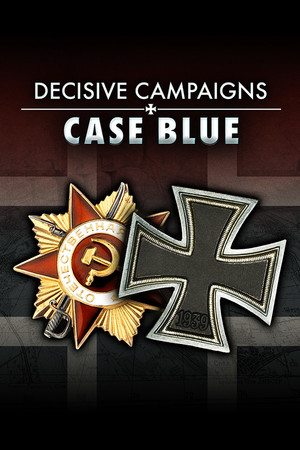
Decisive Campaigns: Case Blue
If you want Stalingrad without a 400-page Gary Grigsby manual, this is the operational wargame that actually respects your time while still punishing bad supply management.
GamerScout Verdict
Best for strategy players who want Eastern Front operational depth without a 500-page rulebook holding them hostage.
Compare Prices(6 stores)
Every store in this table quotes us in euros, so the EUR figure is the price the seller actually set, not our arithmetic — which is why EUR is also the currency we rank in. We only list an offer here when the store gives us its price in euros, so nothing in this table is a number we invented.
Pick USD, PLN, GBP, CAD or AUD in the header and we convert from EUR at the European Central Bank reference rate — converted amounts are prefixed with ~. Your bank or the store may apply a different rate at checkout. We never hide offers based on where you are: everyone sees this whole table.
We may earn a commission when you buy games through links on this page — at no extra cost to you. It never affects our rankings or verdicts.
Price History
Screenshots & Media
About Decisive Campaigns: Case Blue
I've spent enough hours with operational hex wargames to know that the Eastern Front usually demands a choice: accessibility or depth, pick one. Case Blue from VR Designs genuinely refuses that trade-off, and that alone makes it worth serious attention from anyone who has bounced off War in the East or found Panzer Corps too thin. The map covers 40-km hexes on a zoomable board-game-style canvas, with weekly turns and units organised as regiments, headquarters, and air groups. You play either Wehrmacht or Soviet commander, subordinate to a higher authority that issues objectives with tight deadlines, shaky rationale, and real consequences for failure, including removal from command. That pressure from above is not flavour text. It shapes every decision about where to concentrate your panzer spearheads and which corps officers you are willing to spend prestige points on. The core mechanic the game hangs everything on is the officer and action-card system. Each headquarters commander carries a hand of cards that can boost attached units' movement, combat, reconnaissance, morale, or supply. The number and effectiveness of those cards is a direct function of the officer's stats, things like audacity, charisma, and determination. Keeping your command chain clean, with capable officers assigned to the right echelons, matters as much as any individual hex-push. Mismanage it and the efficiency penalty bleeds into your combat rolls. The Soviet side handles this differently, with historically under-equipped commanders whose low organisational ratings impose a 25% efficiency drag on subordinate units, which is a nice way of modelling the Red Army's early-war coordination problems without separate rules for every unit type. Above the battlefield, Regime Cards let you petition Berlin or Moscow for reinforcements, but that costs prestige, and prestige is the currency you also need to hire and fire generals. Scenario variety is one of Case Blue's clearest selling points. Four campaign scenarios ship in the box: the full Case Blue offensive, a shorter version of the same, Operation Uranus (the Soviet encirclement that strangled the 6th Army at Stalingrad), and the 2nd Kharkov-Trappenjagd prologue that covers the disastrous Soviet spring offensive and the Crimean fighting. A linked four-scenario campaign following the 1st Panzer Army adds a consecutive narrative layer for players who want a through-line across the summer. Map sizes range from 22x22 hexes in the smaller scenarios to 160x125 for the full campaign, so the entry point is genuinely gradual. New players should note that the standalone scenarios like Voronezh are considered fairly demanding by the community. A better starting point is one of the short-form versions of the main operations, which strip away some of the later-game system complexity. Where the game shows its age is in the interface. Combat resolution screens are not immediately readable, and selecting individual units inside a hex can become a friction point during busy turns. The AI holds up well enough to provide a real opponent, and the PBEM++ system for asynchronous multiplayer keeps a small but persistent community active years after release. A scenario editor ships in the box and a community modding project has extended the content considerably, with scenarios ranging from Eastern Front side actions to entirely different theatres. For a niche wargame, that long tail of community content is significant. For someone coming from Panzer Corps or similar titles and wanting to understand how command friction, supply lines, and officer quality actually change outcomes, Case Blue is a measured, well-paced introduction that does not bury you in logistics spreadsheets. For the existing grognard, the prestige-and-card system adds a political texture to operations that most hex-and-counter games leave completely abstract. The age shows in some UI roughness, but the design thinking underneath it has held up well.

Strategy & simulation
Tags
System Requirements
Minimum
- OS
- Windows Vista, 7, 8, 10
- Memory
- 2 GB RAM
- DirectX
- Version 9.0c
- Network
- Broadband Internet connection
- Storage
- 500 MB available space
- Graphics
- 8MB video memory
- Processor
- 1.5 GHZ
- Sound Card
- DirectX Compatible 9 Sound Card
Keep exploring
Community Discussion
Be the first to comment on Decisive Campaigns: Case Blue.
Reviews & Ratings
No ratings available
Game Info
- Developer
- VR Designs
- Publisher
- Matrix Games
- Release Date
- May 7, 2015