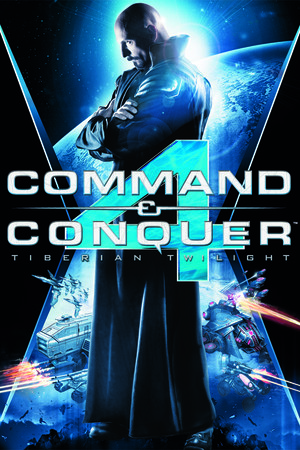
Command & Conquer™ 4 Tiberian Twilight
C&C veterans will recognize the unit names. Almost nothing else will feel familiar. This is the series finale that traded Tiberium harvesters and base construction for a mobile-crawler real-time tactics game nobody asked for.
GamerScout Verdict
Skip unless you need closure on Kane's story and can accept a tactics spin-off that barely resembles the RTS series it closes.
Compare Prices(2 stores)
Every store in this table quotes us in euros, so the EUR figure is the price the seller actually set, not our arithmetic — which is why EUR is also the currency we rank in. We only list an offer here when the store gives us its price in euros, so nothing in this table is a number we invented.
Pick USD, PLN, GBP, CAD or AUD in the header and we convert from EUR at the European Central Bank reference rate — converted amounts are prefixed with ~. Your bank or the store may apply a different rate at checkout. We never hide offers based on where you are: everyone sees this whole table.
We may earn a commission when you buy games through links on this page — at no extra cost to you. It never affects our rankings or verdicts.
Price History
Screenshots & Media
About Command & Conquer™ 4 Tiberian Twilight
I have a spreadsheet tracking every major RTS design pivot of the 2000s, and Tiberian Twilight occupies a uniquely grim cell: a flagship franchise conclusion that abandoned its own genre mid-run. The core loop is gone. No Tiberium harvesting, no base construction, no tech tree to race up. Instead you pick one of three Crawler classes at mission start, Offense, Defense, or Support, and that mobile base rolls around the map spawning units within a command-point cap until you hold enough capture nodes to win. It is a real-time tactics game wearing a C&C costume, and the fit is awful. The Crawler class system is the one place where a credible design idea hides. Choosing an Offense Crawler loads you up on tanks and assault units; Defense gets turrets, the only static structures in the game; Support unlocks area repairs and air strikes that become genuinely useful in the co-op campaign. On paper, coordinating all three across a five-versus-five online match has some tactical texture. In practice, the class choice becomes situational almost immediately rather than strategically interesting, and the persistent progression system compounds the problem badly. A large portion of the unit roster is locked behind experience gates, meaning newer players face opponents who have already ground out access to the top tier. That is a critical balance flaw in a game whose entire tension depends on small-squad decision-making. The always-online DRM is the other disaster. You must be connected to EA's servers to play, including the single-player campaign and offline skirmishes. Drop your connection mid-match and the game boots you, taking your earned progress with it. There is also no LAN mode. In 2010 that was widely condemned; today, with server futures uncertain on aging EA titles, it is a practical risk for anyone buying in. The single-player campaigns for GDI and Nod are short and structurally thin: you guide a small control group from objective to objective, mission after mission, with the enemy AI Crawlers simply repositioning whenever you push them rather than holding a line. The campaign's live-action cutscenes attempt a darker, more serious tone than classic C&C cheese, but they mostly land flat, which is a shame given how much of the franchise's charm lived in those deliberately campy sequences. Multiplayer is the one mode that earns mixed-to-decent marks from critics rather than outright condemnation. The five-versus-five capture-point format moves fast, unit spam beats slow-play, and the rock-paper-scissors of armor types (Light, Medium, Heavy, Reinforced, each countered by a specific weapon class such as Gun, Cannon, Laser, or Rocket) keeps positioning relevant. If you approach it as a lean, arcade-pace tactics game and strip away any expectation of depth, there are thirty or forty hours of serviceable fun in online play before the shallowness fully surfaces. That is genuinely not nothing. The problem is that this game carries the weight of a thirty-year franchise on its back, shipped as a definitive farewell to Kane and the Tiberium universe, and the story delivers nothing close to that closure. For strategy enthusiasts who want a clean purchase recommendation: this is a hard sell. The design jettisons everything that made the series worth studying, the always-online requirement is a live risk on aging infrastructure, and the unit-unlock gating punishes anyone who comes in cold. If you are a C&C historian who wants the Kane storyline finished and can tolerate the multiplayer-tactics framing for what it is, and not what the box implies, there is a narrow path to mild enjoyment here. Everyone else should revisit Tiberium Wars instead.

Strategy & simulation
Tags
System Requirements
Minimum
- OS
- Windows XP SP3, Windows Vista SP1, or Windows 7
- Sound
- DirectX 9.0c compatible sound card
- Memory
- 1 GB (1.5 GB Vista and Windows 7)
- Graphics
- 256 MB (SM 3.0) - Nvidia GeForce 6800 or better, ATI Radeon X1600 or better
- DirectX®
- DirectX 9.0c
- Processor
- Intel Core 2 or better, AMD 64 X2 or better
- Hard Drive
- At least 10 GB of free space
Recommended
- Memory
- 2GB
- Graphics
- 256 MB (SM 3.0) - Nvidia GeForce 8800 or better, ATI X1900 or better
- Processor
- Intel Core 2 Duo 2.6 GHz; AMD Athlon 64 X2 Dual-Core 5600+
Keep exploring
Community Discussion
Be the first to comment on Command & Conquer™ 4 Tiberian Twilight.
Reviews & Ratings
Game Info
- Developer
- EA Los Angeles
- Publisher
- Electronic Arts
- Release Date
- Mar 16, 2010